
IHSG Plunges Over 2%, Returns to 7,100 Level
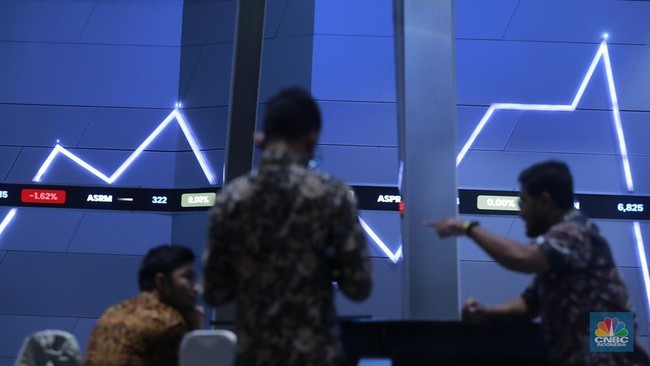
Jakarta, CNBC Indonesia - The Composite Stock Price Index (IHSG) tumbled more than 2% during trading today, Friday (24/4/2026). As of 10:58 WIB, the index fell 187 points or 2.54% to 7,191.44.
Seventy-nine stocks rose, 637 fell, and 98 remained unchanged. The value of morning transactions reached Rp 11.19 trillion, involving 24.90 billion shares in 1.45 million transactions. Market capitalisation also plunged to Rp 12,880 trillion.
All trading sectors recorded weakness, with the deepest corrections seen in the infrastructure, consumer, property, and energy sectors.
Major blue-chip issuers with large capitalisations collectively weighed down the IHSG’s performance today. The main laggards included BBCA, BBRI, AMMN, DSSA, and TLKM.
Trading in the final week is expected to face continued pressure following heightened geopolitical tensions in the Middle East. The surge in oil prices and the US dollar index is also anticipated to burden the IHSG and the rupiah.
Brent crude oil prices soared again, closing up more than 3% at US$105.07 per barrel, the highest since 7 April 2026. Meanwhile, the US dollar index jumped to 98.77, the highest since 9 April 2026.
Meanwhile, Asia-Pacific stock markets opened mixed as investors remained cautious despite the extension of the Israel-Lebanon ceasefire for three weeks, underscoring lingering geopolitical uncertainty.
Israel and Lebanon agreed to extend their ceasefire for three weeks following a meeting at the White House with senior US officials, President Donald Trump said on Thursday.
“The meeting went very well!” Trump said in a Truth Social post announcing the temporary ceasefire extension.
The temporary ceasefire, originally scheduled to end after 10 days, will now provide additional time for diplomatic efforts, with Washington also pledging to work with Lebanon to strengthen its defences against Hezbollah.
US oil futures rose around 1.23% to about $97.03 per barrel.
Japan’s Nikkei 225 index rose 0.71%, while the Topix gained 0.30%, after core inflation in Japan increased for the first time in five months, rising to 1.8% in March, with the Iran war sparking energy concerns.
Government data showed the inflation figure - excluding fresh food prices - matched the 1.8% forecast by economists surveyed by Reuters and was higher than the 1.6% seen in February.
South Korea’s Kospi index fell 0.23%, while the Kosdaq index for small-cap stocks traded flat.
Hong Kong’s Hang Seng index futures were at 25,802, lower than the previous close of 25,915.2. In Australia, the S&P/ASX 200 declined 0.29%.
Overnight in the US, stocks fell on Thursday, led by declines in software stocks and higher oil prices, as investor uncertainty about the direction of the Iran war weighed on markets.
The S&P 500 traded down 0.41% to close at 7,108.40, after previously hitting a new intraday record high. The tech-heavy Nasdaq Composite fell 0.89% to 24,438.50. This index also set a new all-time high during the trading session. The Dow Jones Industrial Average lost 179.71 points, or 0.36%, to 49,310.32.