
IHSG Plummets 5.2%, Analyst Responses
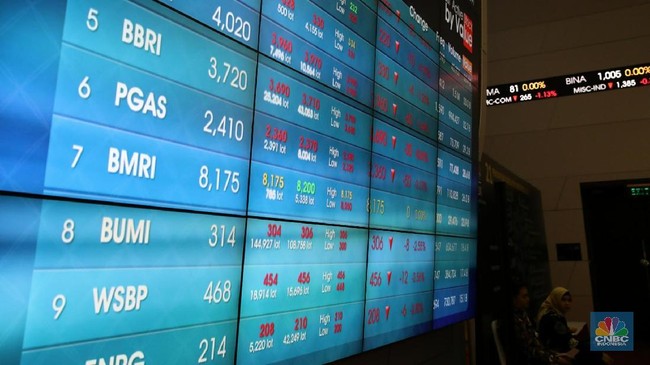
Jakarta — Indonesia’s Composite Stock Index (IHSG) collapsed sharply at the beginning of the week, touching a low of minus 5.2% to reach 7,156 points. A total of 449 shares fell, 57 rose, and 158 remained unchanged, with transaction value reaching Rp1.5 trillion.
Nafan Aji Gusta, Senior Technical Analyst at Mirae Asset Securities, said IHSG movements remained influenced by negative sentiment from the conflict between the United States and Iran, which prompted global investors to reduce risk appetite and shift towards safe-haven assets.
“Technically, IHSG is in a bearish consolidation phase following the formation of a downward bar pattern. On the other hand, the Stochastics K_D indicator shows negative signals, whilst volume has decreased; however, the RSI is already oversold,” he said on Monday, 9 March 2026.
Additionally, Fitch Ratings’ downgrade of Indonesia’s credit outlook from “stable” to “negative” has raised investor concerns about the government’s fiscal policy direction and macroeconomic stability.
He noted that investors can focus on stocks with solid fundamentals and cheap valuations.
A similar view was expressed by Maximilianus Nicodemus, Associate Director at Pilarmas Investindo Securities, who stated that Fitch Ratings’ revision of Indonesia’s debt rating outlook from stable to negative, whilst maintaining the rating at BBB (investment grade), has also drawn investor attention.
“This outlook change reflects heightened risks to fiscal prospects and future economic policy direction, particularly amid uncertainty over policy direction and potential widening of the budget deficit,” he explained.
Fitch highlighted the need for greater financing to support various government priority programmes, including the Free Nutritious Meals initiative, which could increase pressure on the fiscal position if not balanced by increased state revenues.
Additionally, the rating agency also noted the government debt ratio, which remains manageable but has the potential to rise, as well as the burden of interest payments, which is relatively high compared to other countries with equivalent ratings.
“We assess that if fiscal discipline weakens or the debt ratio increases faster than expected, the risk of a rating downgrade can emerge. Fitch’s step aligns with Moody’s’ earlier decision to also downgrade Indonesia’s outlook to negative, thus adding to global investor scrutiny of Indonesia’s fiscal policy credibility going forward,” he said.
Over the past week, the IHSG has plummeted nearly 8% in just one week, recording the worst decline exceeding the MSCI crash of late January. There are three factors driving the Indonesian share market’s collapse.
In recent times, the IHSG has been influenced not only by domestic factors but also by external pressures and changes in global investors’ perceptions of Indonesia as an investment destination.
Escalating geopolitical tensions, particularly in the Middle East region, have prompted global investors to adopt a more defensive stance. In such conditions of uncertainty, financial markets typically experience a shift in sentiment towards risk-off, a tendency for investors to reduce exposure to assets considered riskier.
Developing countries, including Indonesia, are often among the most affected because foreign capital inflows that previously entered can quickly reverse direction.
This situation triggers a phenomenon often referred to as geopolitical contagion, whereby the impact of conflict or tension in one region spreads to global financial markets. International investors tend to move their funds to instruments considered safer, such as developed country government bonds or US dollar-based assets.
As a result, emerging markets’ stock markets face pressure from capital outflows. For Indonesia, this condition can trigger volatility in the share market whilst constraining potential gains in the IHSG in the short to medium term.
Second, growing concerns over Indonesia’s position within global share indices. Investor attention is also focused on the possibility of Indonesia’s classification change within global indices compiled by Morgan Stanley Capital Index (MSCI).
Currently, Indonesia’s weighting in the MSCI Emerging Markets Index continues to experience a downward trend and has approached the 1% range. This decline in weighting reflects the increasingly smaller share of Indonesia’s stock market in global portfolios following the index.
A risk being discussed among market participants is the potential for Indonesia to experience a downgrade in status from emerging market to frontier market category.
Although this scenario may not necessarily occur in the near term, discussion of such a possibility alone is sufficient to influence investor sentiment. Many global investment funds, particularly passive funds and ETFs, automatically adjust their portfolios based on MSCI index composition.
If a country experiences a classification change, the capital flows following that index will also change accordingly. In an extreme scenario, this status change could trigger a significant outflow of foreign capital from the domestic stock market.
Third, heightened attention to sovereign credit risk. Beyond external pressures and market classification issues, investors are also monitoring developments from the macroeconomic fundamentals side, particularly regarding the perception of risk to government debt.
Several international rating agencies such as Fitch Ratings, Moody’s Investors Service, and S&P Global Ratings have issued cautionary signals through outlook changes towards Indonesia becoming more negative.
These outlook changes do not automatically mean that a credit rating downgrade will occur in the near term. However, such signals indicate that rating agencies are beginning to see risks that warrant attention, particularly concerning fiscal conditions, government debt dynamics, and potential pressures on the deficit.