
IHSG Plummets 2.86%, Commodity Stocks Tumble!
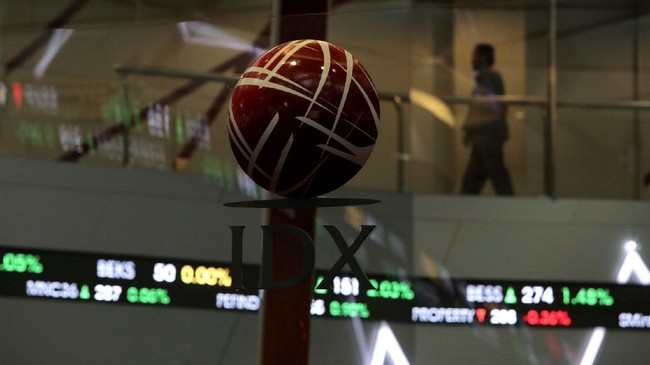
Jakarta, CNBC Indonesia — The Composite Stock Price Index (IHSG) closed this week’s trading session below the 7,000 level.
The IHSG closed down 204.92 points or -2.86% at 6,969.40 on Friday (8/5/2026). A total of 607 stocks declined, 138 rose, and 214 were unchanged.
Trading value was notably high at Rp 36.06 trillion, involving 54.38 billion shares in 2.8 million transactions. Market capitalisation also fell to Rp 12,406 trillion.
According to Refinitiv, nearly all sectors were in the red, with utilities, basic materials, and energy experiencing the deepest declines at -9.34%, -6.76%, and -5.27% respectively.
Commodity stocks, from coal to nickel, suddenly dropped significantly in the second trading session. Merdeka Copper Gold (MDKA), Timah (TINS), Vale Indonesia (INCO), and Merdeka Gold Resources (EMAS) fell by more than 10%.
However, the two main drags on the IHSG today were Barito Renewables Energy (BREN) and Dian Swastatika Sentosa (DSSA), contributing -20.29 points and -20.28 points respectively.
The correction in commodity stocks, particularly nickel, comes alongside the government’s plan to implement a new tax on the coal and nickel sectors over the ‘windfall’ profits of the industry. This tax is often referred to as a windfall profit tax.
The imposition of the windfall tax on the mining and nickel processing sector will be accompanied by the introduction of export duties. At present, the policy is still being discussed with the Ministry of Energy and Mineral Resources (ESDM).
Finance Minister Purbaya Yudhi Sadewa stated that the export duties plus windfall profit tax for nickel commodities are aimed at compensating for the energy subsidies that the government has rolled out amid high volatility in global crude oil prices, due to the conflict in the Middle East.
Separately, the Ministry of National Development Planning (PPN)/Bappenas has set a series of tax policies to apply in 2027, to pursue a state revenue ratio of 11.82%-12.40% of GDP.
The state revenue ratio for 2027 consists of a tax revenue target of 10.02%-10.50% of GDP and non-tax state revenue (PNBP) of 1.80%-1.89% of GDP.
In the 2026 Government Work Plan (RKP) document, it is revealed that efforts to achieve that ratio target will be pursued through the modernisation of tax and PNBP administration, integration of data bases supported by digitalisation to prevent leaks and capture all economic activities (including the informal sector).
This includes the implementation of windfall tax policies. “Strengthening supervision, simplification of regulations to reduce informality, measured and targeted implementation of windfall tax, and strengthening synergy between central and regional governments,” quoted from the 2027 RKP document, Friday (8/5/2026).
In addition, the government is examining the implementation of a profit-sharing system like that in the oil and gas sector for the mineral and coal mining (minerba) industry. This is done so that the management of natural resources can be considered to provide greater benefits for the state and public welfare.
Energy and Mineral Resources Minister Bahlil Lahadalia explained that the government wants to ensure that both old and new mines can contribute maximally to state revenue. One approach being considered is adopting a cooperation pattern similar to that in the oil and gas sector.
In the oil and gas sector, there are at least schemes such as cost recovery and gross split used in cooperation contracts between the government and private parties. This model is considered a reference for implementation in the minerba sector.
From abroad, tensions have resurfaced in the Middle East between the United States (US) and Iran on Thursday-Friday (8/5/2026). In the latest update, both countries exchanged fire in the Strait of Hormuz.
Attacks were also reported in the skies over Tehran. On the other hand, the United Arab Emirates (UAE) also reported drone and missile attacks. An announcement of a meeting between US President Donald Trump and President Xi Jinping was also announced.
In line with this, stock exchanges in the region also entered the red zone. The ASX200 fell the most at -1.51%, followed by HSI -0.87%, Taiwan -0.79%, and Nikkei -0.19%.