
IHSG Opens Weaker at 7,449 Level, Global Pressures Loom Over the Market
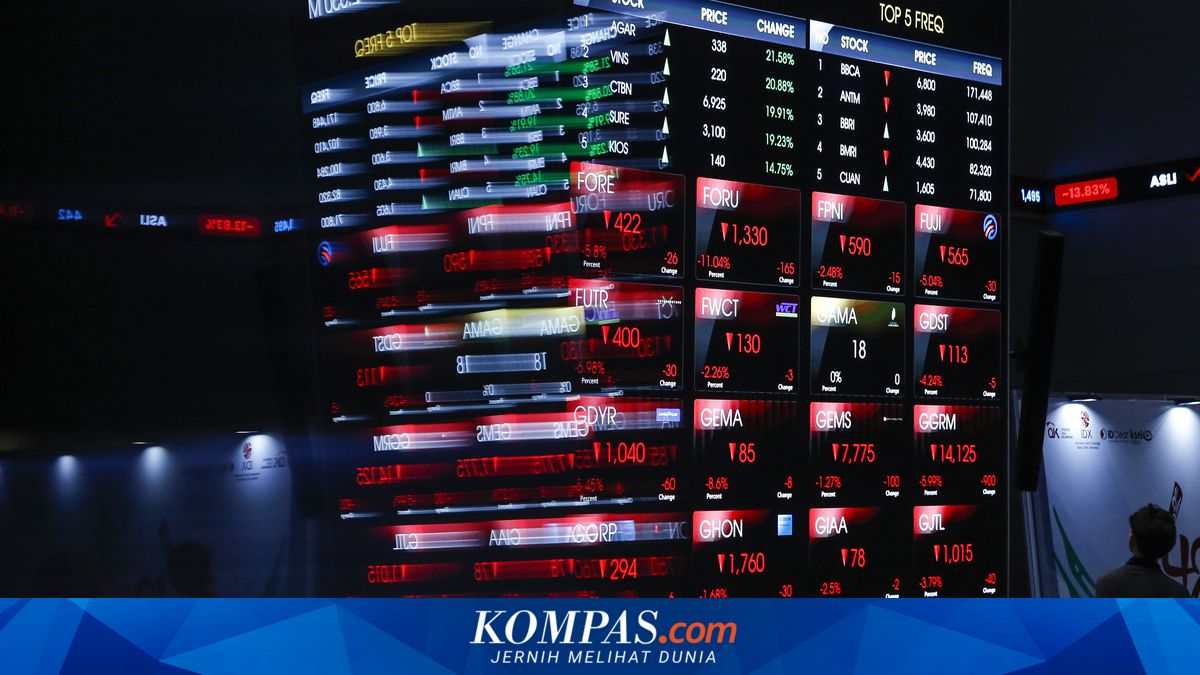
JAKARTA – The Composite Stock Price Index (IHSG) opened weaker during trading on Monday (13/4/2026). According to data from the Indonesia Stock Exchange (BEI) around 09:23 WIB, the IHSG fell 9.32 points or 0.12% to the level of 7,449.18.
The IHSG opened at the level of 7,410.09 and moved within the range of 7,351.36 to 7,457.57 throughout the trading session.
Market activity was observed to be moderate. Trading volume reached 7.05 billion shares with a transaction value of Rp 3.12 trillion and a frequency of 477.9 thousand times. A total of 238 stocks strengthened, 352 stocks weakened, and 369 stocks were stagnant.
Meanwhile, Sharia-based indices tended to strengthen slightly. The Jakarta Islamic Index (JII) rose 0.13 points or 0.03% to the level of 516.79. The Indonesia Sharia Stock Index (ISSI) strengthened 0.03 points or 0.01% to the level of 268.70.
On the other hand, the IDX30 fell 2.10 points or 0.52% to the level of 398.19. Meanwhile, the JII70 recorded a gain of 0.33 points or 0.17% to the level of 195.38.
As a note, the IHSG today is expected to move volatily with a tendency to weaken. Negative sentiment comes from the failure of negotiations between the United States (US) and Iran.
Meanwhile, the support area is in the range of 7,308 to 7,346. In a negative scenario, the IHSG has the potential to fall deeper if geopolitical tensions increase. The levels of 7,300 to 7,200 become areas that could potentially be tested, in line with selling pressure and potential capital outflow.
Conversely, the IHSG has the opportunity to strengthen if positive sentiment emerges from global negotiation developments. However, the strengthening is expected to be limited in the range of 7,550 to 7,600 and not strong enough to form a long-term upward trend.
“Thus, the current IHSG movement more reflects a trading range phase rather than a solid directional trend,” said Hendra to Kompas.com on Sunday (12/4/2026) night.
Amid high volatility, sector diversification becomes important. The energy and commodities sectors are considered relatively more resilient in conditions of global uncertainty.