
IHSG Opens Sharply Lower at 8,116, Pressured by Geopolitical Sentiment
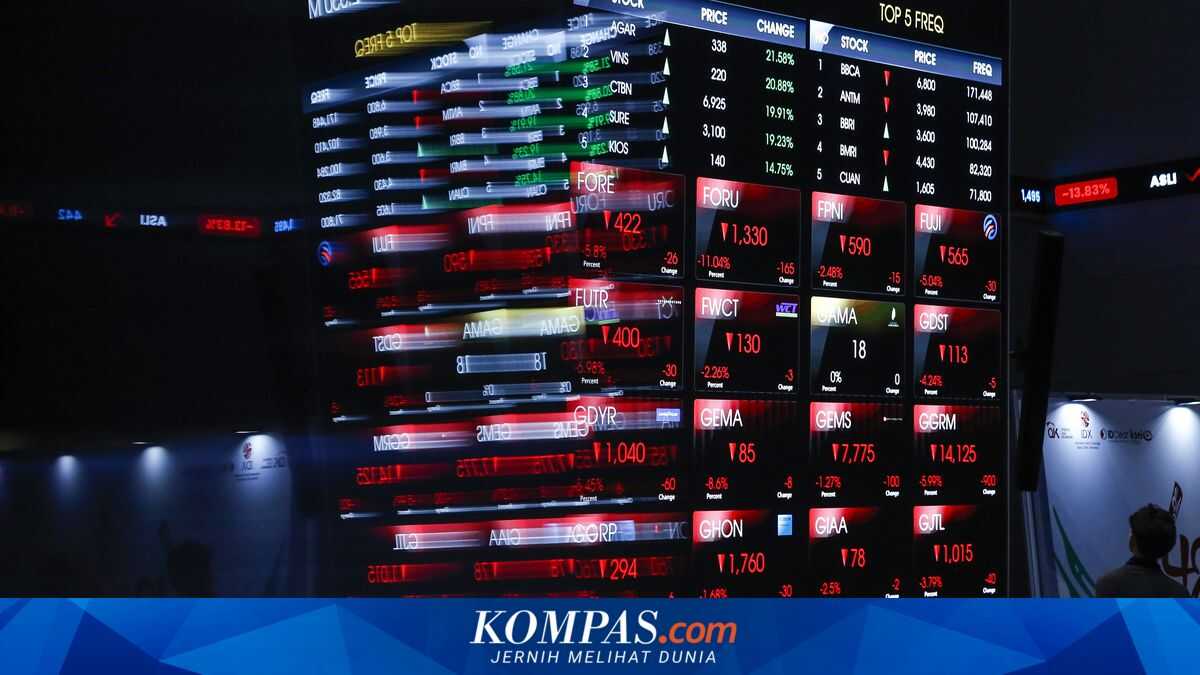
JAKARTA – Indonesia’s Composite Stock Price Index (IHSG) opened weaker during Monday trading (2 March 2026). Based on data from the Indonesia Stock Exchange (BEI) until approximately 09:35 Western Indonesian Time, the IHSG stood at 8,116.66 or down 118.83 points (-1.44 per cent).
The IHSG opened at 8,092.90, level with the previous closing position. Throughout the initial session, the index moved within a range of 8,039.51 to 8,132.09, reflecting considerable selling pressure since the start of trading.
Transaction activity was brisk, with trading volume reaching 14.55 billion shares valued at approximately Rp 8.361 trillion. Trading frequency was recorded at 1,039,000 transactions. Market capitalisation stood at approximately Rp 14.532 trillion.
The IHSG’s weakness aligned with the majority of major indices. The LQ45 Index fell 1.30 per cent to 823.54. The Jakarta Islamic Index (JII) weakened 0.69 per cent to 550.97.
The KOMPAS100 corrected 1.27 per cent to 1,141.66. The Indonesian Sharia Stock Index (ISSI) fell 1.33 per cent to 288.99. The IDX30 weakened 1.18 per cent to 434.62, whilst the JII70 fell 0.53 per cent to 207.66.
On technical grounds, the IHSG is estimated to potentially move weaker with elevated volatility during today’s trading, with support and resistance in the 8,150-8,330 area.
Attacks by the United States and Israel against Iran are expected to continue despite having killed Iran’s Supreme Leader, Ali Khamenei.
Beyond military escalation, markets are also concerned about global energy distribution stability, particularly at the Strait of Hormuz. The Asia region purchases over 80 per cent of crude oil produced in the Middle East, with approximately 90 per cent of the volume passing through this route.
Brent crude oil prices rose to $72.87 per barrel, whilst WTI crude strengthened to $67.02 per barrel.
“Thus far, the increases remain relatively controlled, but this will not be favourable for the long term. Several projections suggest crude oil prices could potentially return to $100 per barrel, which could certainly trigger inflation subsequently,” according to daily analysis.