
IHSG Opens Down 2% at 6,900-Level
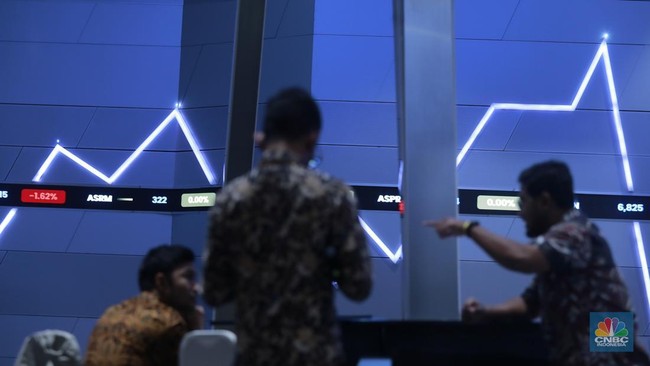
Jakarta — Indonesia’s Composite Stock Price Index (IHSG) opened down 0.3% or -21.76 points to 7,115.45 in the first trading session on Monday 16 March 2026. A total of 154 shares rose, 177 fell, and 316 remained unchanged. Trading in the first session was thin, with a transaction value of Rp 220.08 billion involving 449.49 million shares across 36,592 transactions. Market capitalisation declined to Rp 12.614 trillion.
Within minutes of market opening, the IHSG fell sharply and corrected more than 2% to 6,967. Since the morning, the IHSG has consistently remained in negative territory, experiencing considerable volatility.
This week’s trading market will be exceptionally brief, operating only two days on Monday and Tuesday, before the extended Lebaran Idul Fitri holiday begins Wednesday 18 March through the following Tuesday.
Before the extended break, investors face numerous concerns regarding both domestic and global economic conditions. Global financial markets will encounter significant sentiment shifts and important economic data releases this week. The conflict in the Middle East and its impact on energy supplies will remain a principal driver of global markets, and this issue will prove critical in a series of interest rate decisions from major central banks worldwide.
The primary focus this week is on central bank decisions. At least eleven central banks will hold rate-setting meetings this week, including the US Federal Reserve and Indonesia’s Bank Indonesia.
Since the Indonesian market will be closed during significant global data releases, investors must carefully assess what steps to take during these two trading days.
Bank Indonesia will hold a Board of Governors Meeting on Monday and Tuesday this week (16-17 March 2026) and will hold a press conference on Tuesday. Bank Indonesia is expected to hold its benchmark rate at 4.75% this month to protect the rupiah’s exchange rate amid escalating Middle East tensions and surging oil prices. Bank Indonesia has maintained its benchmark rate since September 2025.
From the United States, investors await the release of February Producer Price Index data on Wednesday this week (19 March 2026). Previously in January 2026, US producer prices rose 0.5% month-on-month, exceeding market expectations of 0.3%. The increase was primarily driven by the services sector, whilst goods prices actually fell due to declining petrol prices.
The primary focus this week centres on the Federal Reserve’s interest rate decision, scheduled for Tuesday-Wednesday US time and to be announced early Thursday morning Indonesian time (19 March 2026). The Fed’s current rate stands at 3.5%-3.75% following three cuts last year. Markets now await signals regarding the next policy direction, particularly amidst inflation uncertainty and global economic conditions.
Most analysts expect the Federal Reserve to maintain its rate at 3.50%-3.75% at the March FOMC meeting. Projections on FedWatch even show 99.2% probability of a rate hold.
Investors must also monitor Middle East conflict developments. Israeli military spokesman Effie Defrin stated that Israeli forces still have “thousands” of targets to strike in Iran, hours after attacks expanded to include western and central regions of Iran.
Iranian Foreign Minister Abbas Araghchi stated that Tehran has not asked the United States for a ceasefire. In an interview with CBS News, the BBC’s US media partner, Araghchi also said Iran sees no reason to speak with the United States.
During the weekend, US President Donald Trump threatened additional strikes against Kharg Island, Iran’s principal oil export hub. He also stated he is not yet ready to reach a deal ending the conflict that has closed the Strait of Hormuz, a vital global energy trade route, and roiled global energy markets.
The Trump administration plans to announce as early as this week that several countries have agreed to form a coalition to escort ships through the Strait of Hormuz. However, they are still discussing whether the operation will commence before or after the conflict ends, according to a Wall Street Journal report citing unnamed US officials. The White House has not provided official comment.
Trump, who stated on Friday that the US Navy would soon begin escorting oil tankers, claimed that Iran wanted to negotiate. However, this claim was disputed by Iranian Foreign Minister Abbas Araghchi on Sunday.