
IHSG Falls More Than 2.5% as Conglomerate Stocks Plummet
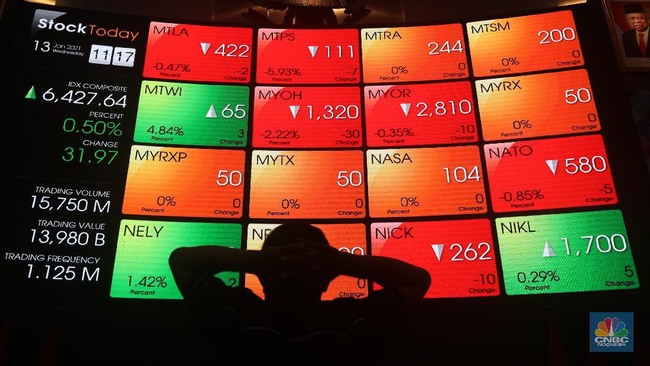
Jakarta, CNBC Indonesia - The Jakarta Composite Index (IHSG) opened weaker in the morning session today, Wednesday (4/3/2026). The morning weakness extended the significant correction from yesterday’s trade, when IHSG fell 0.96% and two days earlier collapsed 2.65%.
Within less than 30 minutes after the market opened IHSG shed 202 points, or 2.55%, to a level of 7,736.92.
A total of 561 stocks fell, 105 rose, and 168 were unchanged. This picture shows persistent selling pressure among shares listed on the Indonesia Stock Exchange. The morning’s turnover reached Rp 5.97 trillion, involving 11.07 billion shares across 693,762 trades.
ENRG, BUMI and MEDC were the most actively traded stocks this morning.
Gold mining stocks posted broad weakness and weighed on IHSG’s performance this morning. Likewise, conglomerate-owned shares declined in unison, dragging the index down.
All sectors traded in the red, with the deepest declines in the infrastructure and raw materials sectors. The health and energy sectors, meanwhile, were the most resilient with the smallest declines.
Specifically, blue-chip stocks and conglomerate-owned issuers were the main drags on IHSG’s performance today. All shares owned by Prajogo Pangestu weakened, as did shares of other conglomerates such as Hapsoro, Aguan, Bakrie, Hary Tanoe and Garibaldi ‘Boy’ Thohir.
Here are the 10 stocks that weighed on IHSG today:
Barito Renewables Energy (BREN) -15.73 points
Amman Mineral International (AMMN) -10.62 points
Telkom Indonesia (TLKM) -10.52 points
Bank Mandiri (BMRI) -10.09 points
Bumi Resources Minerals (BRMS) -9.70 points
Chandra Asri Pacific (TPIA) -8.29 points
Bank Central Asia (BBCA) -7.10 points
Bank Rakyat Indonesia (BBRI) -6.29 points
Merdeka Gold Resources (MDKA) -5.96 points
VKTR Teknologi Mobilitas (VKTR) -5.61 points
The Indonesian financial market is expected to continue facing pressure, from both domestic and international sources. Domestically, the Financial Services Authority (OJK) disclosed important recent developments in meeting demands from the global index provider MSCI.
OJK said regulators and Self-Regulatory Organisations (SROs) have updated disclosures of shareholding data with more than 1% ownership that must be deposited as public information. For the first time KSEI disclosed investor shareholdings above 1% as of 27 February 2026, reported on Tuesday (3/3/2026).
Next, OJK said that the reclassification of shareholders from 9 investor types to 27 investor types is being pursued by KSEI and Bursa Members, and progress has reached 94%.
Furthermore, regarding the increase of the minimum free float from 7.5% to 15%, OJK said the process is still being implemented internally at BEI and will subsequently be approved by OJK so it can be implemented soon.
Finally, OJK also said it will introduce a shareholder concentration list, which will help investors consider concentration risk and the difficulty of acquiring the mentioned stocks in the market.
Meanwhile, South Korea’s Kospi fell 7.24% on Wednesday (4/3/2026), continuing the latest broad sell-off after the index posted its worst drop in 19 months amid increasing Middle East tensions.
Investors in Asia-Pacific will also watch China’s annual policy meetings, which begin on that day.
The meetings, called the “Two Sessions”, consist of the CPPCC (the Chinese People’s Consultative Conference) which starts today, and the National People’s Congress opening on Thursday. Chinese Premier Li Qiang will unveil a series of economic targets at the National People’s Congress, most of which were decided at the December meeting.
The S&P/ASX 200 in Australia started the day down 1.81%. The Nikkei 225 in Japan fell 1.59%, while the Topix declined 1.61%.
Hang Seng index futures in Hong Kong were at 25,448, below the last close of the underlying index at 25,768.08.
Oil prices continued their rise with US crude futures up 0.87% to $75.21 per barrel, while Brent rose 5.43% to $81.96 per barrel amid expanding conflict, with Iran seeking to close the Strait of Hormuz.
A senior commander of the Islamic Revolutionary Guard Corps said on Monday that the vital route has been closed and warned that any vessel attempting to navigate the waterway would be targeted, according to Iranian media.
US President Donald Trump said on Tuesday evening that the US Navy would escort tanker vessels through the Strait of Hormuz if necessary.
“Whatever happens, the United States will ensure the free flow of energy to the world,” he said in a Truth Social post. “The economic and military might of the United States is the greatest on Earth - further actions will follow.”
Last night in the US, stock markets again experienced a volatile session amid concerns over the prolonged US-Iran conflict rocking markets.
The Dow Jones Industrial Average fell 403.51 points, or 0.83%, to 48,501.27. The S&P 500 declined 0.94% to 6,816.63, and the Nasdaq Composite dropped 1.02% to 22,516.69. At the day’s low, the S&P 500 lost 2.5%, and the Nasdaq about 2.7%. The Dow Jones dropped more than 1,200 points, or around 2.6%, at its low.