
IHSG Expected to Remain Volatile; Shares to Monitor
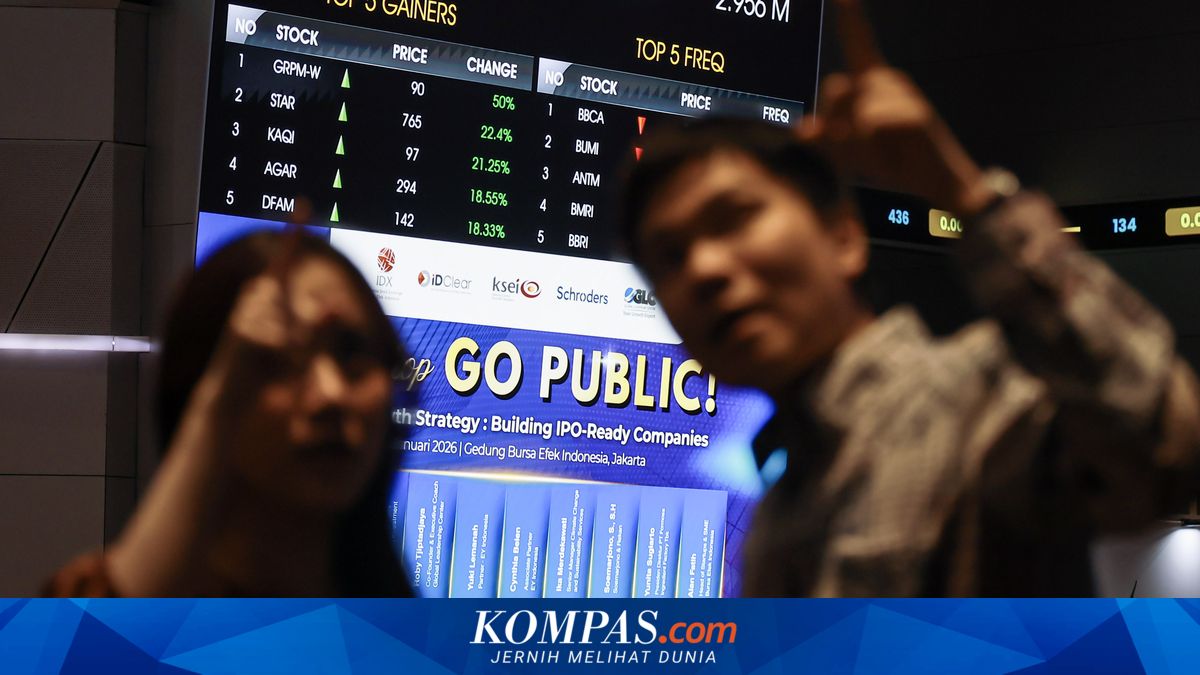
JAKARTA — The Indonesian Stock Exchange Composite Index (IHSG) is forecast to continue moving volatilely with consolidation tendencies during Thursday (12 March 2026) trading. The index weakened by 0.69 per cent to 7,389.40 at the close of Wednesday’s session.
Rising geopolitical tensions in the Middle East are considered the primary factor triggering volatility in financial markets and making investors more cautious.
Capital market analyst and founder of Republik Investor, Hendra Wardana, believes the stock market is currently facing external sentiment pressures, particularly geopolitical tensions in the Middle East that are triggering volatility in global financial markets.
This situation is prompting global investors to reduce exposure to risky assets such as stocks and shift towards instruments considered safer.
“This situation makes the movement of the Indonesian Stock Exchange Composite Index more sensitive to external developments in the short term,” said Hendra when contacted by Kompas.com on Wednesday evening (11 March 2026).
In current market conditions, market participants tend to wait for clarity on the direction of global sentiment before increasing exposure to risky assets again.
For Thursday’s trading, IHSG movement is forecast to remain volatile with consolidation tendencies.
Technically, the nearest support area for the IHSG is in the range of 7,320–7,350, whilst short-term resistance is in the area of 7,450–7,500.
If global sentiment pressure continues, the IHSG could potentially retest the psychological level around 7,300.
However, if geopolitical tensions begin to ease and foreign capital flows stabilise, the opportunity for a technical rebound towards the 7,450 range remains open.
Hendra added that in a market situation full of uncertainty, investors tend to become more selective in choosing share issuers.
Shares with strong fundamentals and high liquidity are typically more sought after because they are considered more able to withstand external shocks.
In this context, major banking stocks, the telecommunications sector, and several technology-based issuers have the potential to support index movement because of their relatively defensive characteristics.
On the other hand, commodity-based shares and raw materials industries tend to be more volatile because of their sensitivity to energy price movements and global economic dynamics.