
IHSG declines on the combination of geopolitical tensions and revised credit outlook
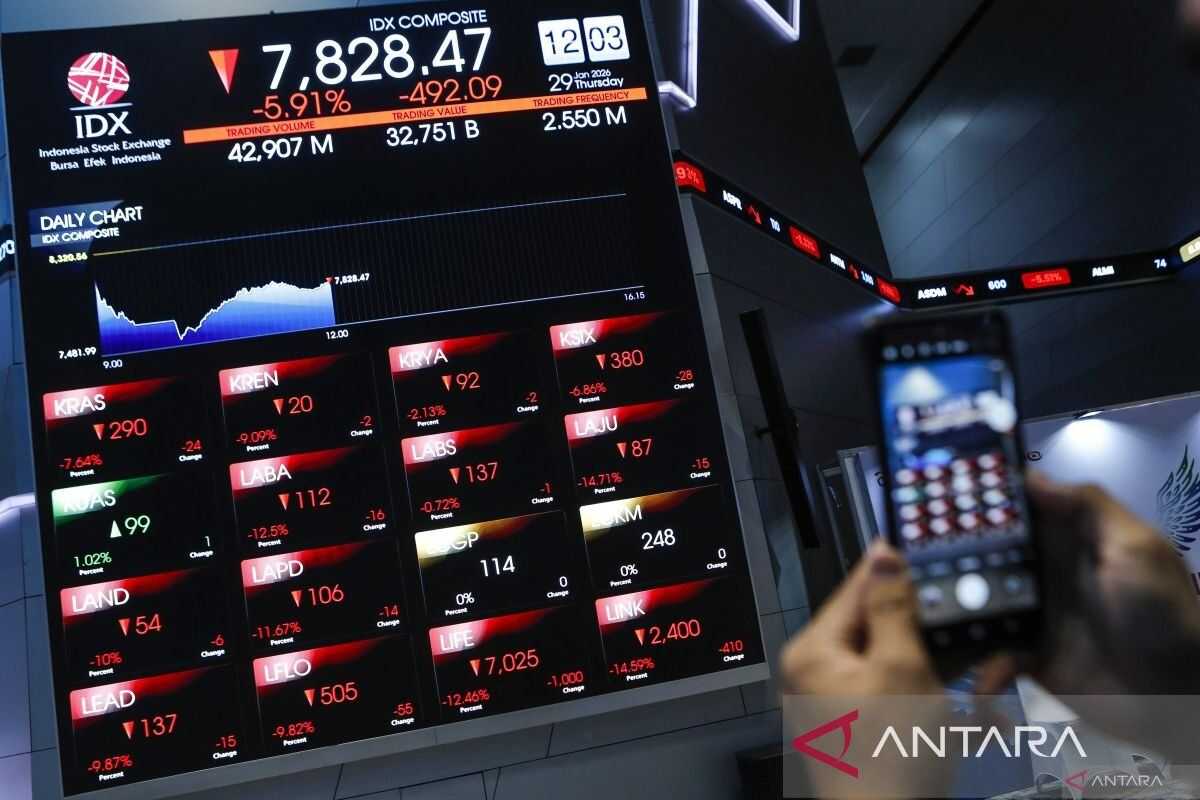
Geopolitical tensions in the Middle East and Fitch Ratings’ decision to cut Indonesia’s credit outlook to negative combined to weigh on the markets.
The Jakarta Composite Index (JCI) closed down 362.70 points or 4.57% at 7,577.06. Meanwhile the LQ45 index of the 45 top shares fell 33.14 points or 4.11% to 772.44.
‘The combination of Middle East geopolitical tensions and Fitch Ratings’ downgrade of Indonesia’s credit outlook is negative,’ said Muhammad Wafi, Head of Research at PT Korea Investment And Sekuritas Indonesia (KISI), to ANTARA in Jakarta on Wednesday.
Global rating agency Fitch Ratings revised the outlook for Indonesia’s debt from stable to negative, while preserving the country’s sovereign rating at BBB, which is still considered investment grade.
Fitch judged that increasing policy centralisation could affect medium-term fiscal prospects, investor sentiment, and Indonesia’s external resilience.
‘Foreign capital outflows. The main driver is global risk-off sentiment and loss of confidence in domestic fiscal stability,’ Wafi said.
In response to Fitch’s credit outlook revision, Wafi said the downgrade worsens the negative sentiment following S&P Global Ratings’ warning to Indonesia.
‘The impact would be a surge in the cost of sovereign funding, a weaker rupiah, and aggressive selling by foreign investors in the big-cap banking sector,’ Wafi added.
Separately, stock markets across Asia fell broadly amid concerns about disruptions to global supply chains, notably oil, linked to Iran’s closure of the Strait of Hormuz.
A surge in oil prices could push global inflation higher, ultimately forcing central banks to maintain tight monetary policy for longer.
Given the current environment, investors are shifting funds into safe-haven assets, such as gold and the US dollar, leaving emerging market equities.
The market opened in negative territory and stayed there through the morning session. In the second session, the index stayed in the red until the close.
According to the IDX-IC Sectoral Index, all eleven sectors were down, with the raw materials sector recording the steepest fall of 7.39%, followed by the Transport & Logistics sector and the non-primary consumer goods sector, which fell 7.08% and 6.35% respectively.
Top performers included IFSH, SOTS, ITMA, GRPM and INPS. The biggest losers were ICON, MPOW, BUVA, MDIA, and LEAD.
The trading frequency stood at 3,302,236 transactions with 53.61 billion shares traded valued at Rp29.72 trillion. Of the stocks, 54 rose, 734 fell, and 33 were unchanged.
Across Asia-Pacific, Nikkei declined by 2,033.60 points or 3.61% to 58,057.19; Shanghai fell by 40.21 points or 0.98% to 4,082.46; Hang Seng declined by 518.59 points or 2.01% to 25,249.48; Kuala Lumpur fell by 13.73 points or 0.80% to 1,698.22; and the Straits Times dropped by 103.89 points or 2.11% to 4,812.75.