
IHSG Continues Declining Due to Energy Crisis and Global Oil Prices
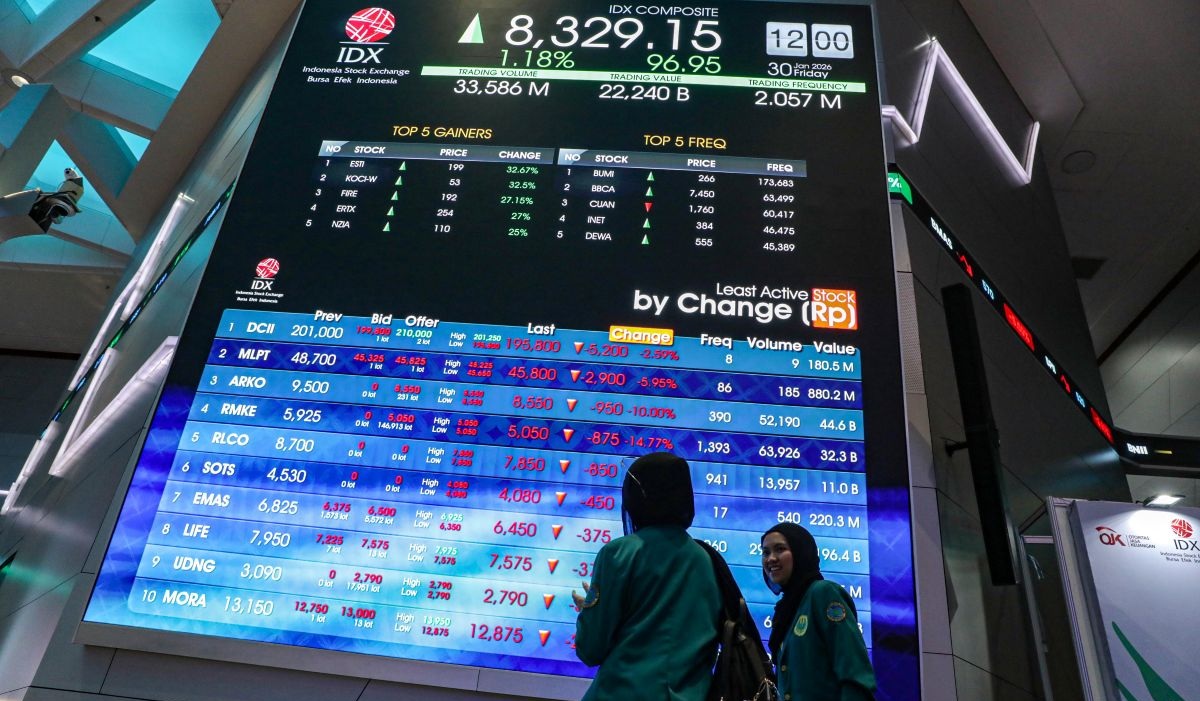
Indonesia’s Composite Stock Index (IHSG) at the Indonesia Stock Exchange (BEI) closed significantly weaker during Monday afternoon (9 March 2026) trading. The index’s collapse was driven by market participants’ concerns over the threat of global energy inflation as crude oil prices worldwide soared.
The IHSG ended down 248.32 points, or 3.27 per cent, to 7,337.37. Meanwhile, the 45-share blue-chip index, the LQ45, also corrected 25.47 points, or 3.28 per cent, to 750.57.
Rarna Lim, Head of Research at Phintraco Securities, explained that the IHSG’s weakness occurred amid escalating geopolitical tensions and the potential for global inflation. The closure of the Strait of Hormuz in the Middle East has had a significant impact on global energy supply chains.
By 17:12 WIB, WTI crude oil prices had surged 11.86 per cent to US$101.68 per barrel. Meanwhile, Brent crude jumped 12.77 per cent to US$104.53 per barrel. This situation triggered concerns about a potential massive global economic slowdown.
From the Asian region, China’s inflation in February 2026 rose 1.3 per cent year-on-year, exceeding market expectations of 0.8 per cent. This increase was the highest since January 2023, largely driven by surging consumption during the Lunar New Year holiday period.
On the domestic front, Indonesia’s Consumer Confidence Index (IKK) in February 2026 fell to 125.2 from 127 in January. This decline reflects weakening public expectations regarding income prospects and job availability over the next six months.
Based on the IDX-IC Sectoral Index, all eleven stock sectors weakened simultaneously. The non-staple consumer goods sector recorded the steepest decline of 5.00 per cent, followed by the transportation and logistics sector at 4.93 per cent and the raw materials sector at 4.42 per cent.
Trading frequency was recorded at 2,474,203 transactions with share volume reaching 46.80 billion shares worth Rp23.88 trillion. A total of 708 shares weakened, 68 shares strengthened, and 41 shares remained unchanged.
A similar condition occurred across Asian exchanges. The Nikkei index declined significantly by 5.20 per cent, Shanghai fell 0.67 per cent, Hang Seng corrected 1.35 per cent, and Strait Times weakened 1.89 per cent.
The risk-off stance of investors was driven by escalating conflict in the Middle East region, as well as elevated US Treasury yields resulting from expectations of sustained high Federal Reserve interest rates.