
IHSG Collapses 4.7%, Series of Blue-Chip Stocks Become Cheap: Time to Buy?
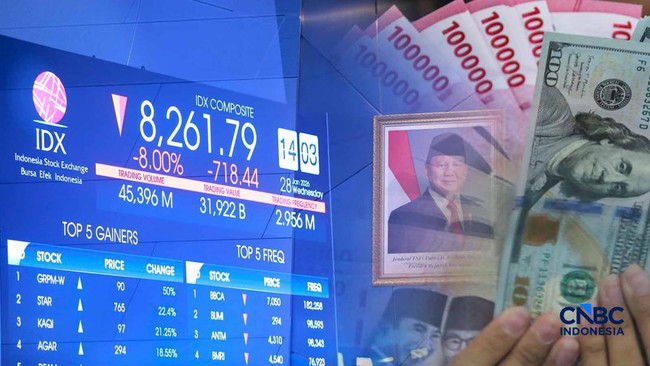
Jakarta, CNBC Indonesia - The Composite Stock Price Index (IHSG) experienced significant selling pressure at the close of trading on Friday, 6 March 2026. The index fell 1.62 per cent to touch the level of 7,585.69.
On Monday, 9 March 2026, the IHSG collapsed 4.7 per cent to 7,214.7.
This weakness represents an accumulation of market participants’ panic in response to a series of negative sentiments on both global and domestic scales. Geopolitical tensions in the Middle East reached a critical point following military actions by Israel and the United States against Iran.
This escalation peaked with the blockade of the Strait of Hormuz, triggering concerns over disruption to global energy supply chains and pushing oil prices past US$100 per barrel today.
Amidst the heating military tensions, domestic market sentiment was further weighted down by the actions of international rating agency Fitch Ratings. On Wednesday, 4 March 2026, Fitch revised Indonesia’s investment outlook to negative.
The combination of global security uncertainty and a revision of macroeconomic outlook prompted both individual and institutional investors to temporarily withdraw their liquidity, triggering significant risk-off activity whilst awaiting further decisions regarding MSCI announcements regarding stock exchange performance in supporting data transparency.
Rotation of Foreign Capital Flows and Market Reform Catalysts
Current selling pressure essentially opens an investment narrative with potential benefits for the domestic market when viewed through the lens of global capital flows, commonly known as foreign flows.
The global investment landscape is currently in a transitional phase. The United States stock market is deemed to have reached overvaluation levels, prompting global investment managers to begin rationalising their portfolios.
On the other hand, the Middle East and several points in Asia are now becoming destinations for global liquidity collection due to being considered still in more discounted conditions. This situation is triggering a shift in the direction of foreign capital flows towards more stable developing nations.
Indonesia has significant potential to become the primary destination for this rotation of fresh capital. The appeal of the domestic market is supported by consistent steps by authorities implementing capital market reforms.
Increased emitter transparency, improved governance, and strengthening of exchange infrastructure provide a solid foundation of trust for foreign investors seeking fair valuations with positive growth prospects.
Attractive Valuations of LQ45 Stocks Amidst Pressure
Market panic due to external crises often depresses share prices without regard to the fundamental rationality of companies. This decline creates momentum for investors holding cash to execute pure fundamental play strategies.
A number of large-cap stocks in the LQ45 index are now being dragged into discounted territory with cheap valuations, even though these companies have not experienced weakening core operational performance.
Market data shows there are six LQ45 stocks being traded with Trailing Twelve Months (TTM) Price to Earnings Ratio (PER) consistently below 10 times.
Furthermore, the metric of standard deviation of average Price to Book Value (PBV) over the past year on these six issuers confirms that their stock prices are currently in historically undervalued territory.
Based on this data, banking issuers (BBRI, BMRI, BBNI) offer PER ratios in the range of 7.8x to 9.8x. These three state-owned banks continue to record very high Net Profit Margins (NPM) TTM, exceeding their five-year historical averages.
This figure represents operational efficiency and asset quality resilience amidst economic turbulence from both international and domestic sides that are increasingly uncertain.
EMTK recorded the lowest PER valuation at 6.05x combined with the highest profitability rate (NPM TTM 43.20 per cent), indicating a very significant price discount.
In the commodities and infrastructure sectors, ADRO and TOWR demonstrate essential fundamental resilience, traded at PER levels around 8 times with solid profit margins above 26 per cent.
ADRO will benefit from rising coal prices due to global supply shocks and rising aluminium prices. TOWR, meanwhile, focuses on technology development spanning various regions across Indonesia.
For fundamental investors, this correction momentum provides a very optimal margin of safety. When market rationality returns and foreign rotation begins to materialise, these fundamental stocks with discounted valuations are projected to lead the subsequent recovery rally.
Disclaimer: This article is a journalistic product comprising CNBC Indonesia Research’s perspective. This analysis does not aim to encourage readers to buy, hold, or sell related investment products or sectors. The decision lies entirely with the reader, and we therefore take no responsibility for any losses or gains arising from those decisions.