
IHSG closes down 4.57%, back to the 7,500 level
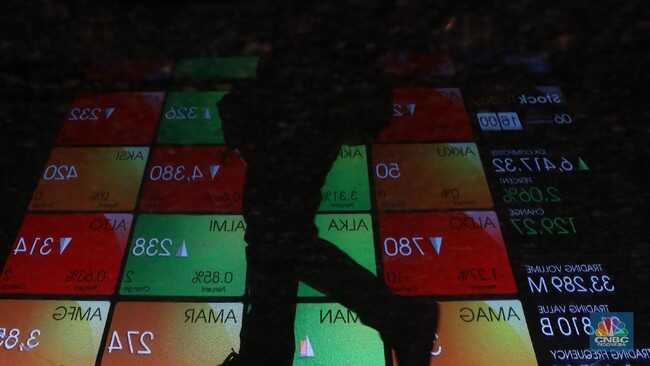
Jakarta, CNBC Indonesia — The Jakarta Composite Index (IHSG) slumped to the 7,500 level in trading today, Wednesday (4 March 2026). The IHSG declined 362.71 points or 4.57% to 7,557.06. A total of 767 stocks rose, 61 fell, and 130 were unchanged. Turnover was fairly brisk at Rp 29.59 trillion, involving 50.02 billion shares in 3.24 million trades. Market capitalisation fell to Rp 13,522 trillion.
Two Bakrie Group issuers, Energi Mega Persada (ENRG) and Bumi Resources (BUMI), were the most actively traded. ENRG closed up 0.47%, while BUMI dropped 7.14%.
Citing Refinitiv, all sectors ended in the red, with Basic Materials down the most at 7.88%. This was followed by the consumer non-durables sector down 6.43% and Technology down 5.29%.
Saham yang menjadi pemberat utama adalah Telkom (TLKM), contributing -26.3 index points. This was followed by Amman Mineral (AMMN) with -22 points and Bumi Resources Minerals (BRMS) with -19.42 points.
A number of banking stocks also weighed on the IHSG: Bank Central Asia (BBCA) -18.95 points, Bank Rakyat Indonesia (BBRI) -12.58 points, and Bank Mandiri (BMRI) -9.32 points.
The IHSG correction today came as a draft announcement circulated among global rating agency Fitch Ratings, revising Indonesia’s credit outlook to negative from its previous stable, while keeping the sovereign debt rating at BBB, still within the investment-grade category.
Fitch said the change in outlook reflects increased policy uncertainty and concerns about the consistency and credibility of the government’s policy mix going forward.
In other developments, global oil prices rose again on Wednesday morning (4 March 2026) as tensions between the United States and Israel with Iran began to disrupt energy production and distribution in the Middle East.
As of 10.00 WIB, Brent Crude traded at US$82.03 per barrel, while West Texas Intermediate (WTI) stood at US$74.95 per barrel, according to Refinitiv.
On the day, Brent edged higher from Tuesday’s US$81.40 close. Looking back over the past week, the rally has been pronounced; on 24 February 2026, Brent was around US$70.77 per barrel.
Oil has heated up as Israel, in the early hours of Wednesday, announced a broad wave of strikes against Iran targeting missile launch sites, air defence systems and additional Iranian infrastructure.
Diplomatically, Trump widened tensions with Western allies. He threatened to cut all trade ties with Spain after Madrid refused to allow the US military to use its bases for missions related to attacks on Iran. He also vented his disdain for UK Prime Minister Keir Starmer, who did not participate in the strike against Iran but did allow the use of British bases by US troops. “This is not Winston Churchill we are dealing with,” Trump said.
Meanwhile, the conflict’s impact continued to spread in the region. Lebanon’s Health Ministry said Israeli strikes on two southern Beirut cities killed six people and wounded eight more. Aramoun and Saadiyat lie outside Hizbollah’s traditional base. The United Nations reported at least 30,000 people had fled Lebanon due to intensified Israeli airstrikes.
On the other hand, the US Department of Defence identified four of six American soldiers killed on Sunday in a drone attack on a US base in Kuwait. President Donald Trump said more US personnel could die before this war ends. The President also claimed Iran actually planned to strike first before Washington acted, revising earlier comments by Foreign Minister Marco Rubio that Israel had triggered the war.
“I think they would strike first, and I don’t want that to happen. So, if there is any escalation, I may have forced Israel to act,” Trump said.
Casualties continue to mount on both sides. The Iranian Red Crescent Society said at least 787 people have died since the conflict began. The worst mass casualty incident to date was an attack on a girls’ elementary school in Minab on Saturday, which killed up to 168 people.
Iran itself has continued firing dozens of ballistic missiles at Israel, though most have been intercepted by air defence systems. To date, 11 people in Israel have been reported killed since the outbreak of the conflict.
The crisis has also spurred military movements across Europe. French President Emmanuel Macron ordered the nuclear-powered aircraft carrier Charles de Gaulle to move from the Baltic Sea to the Mediterranean to help safeguard allied assets. The carrier will be escorted by a frigate and its air wing.
(mkh/mkh) Add as a preferred source on Google [Gambas:Video CNBC]