
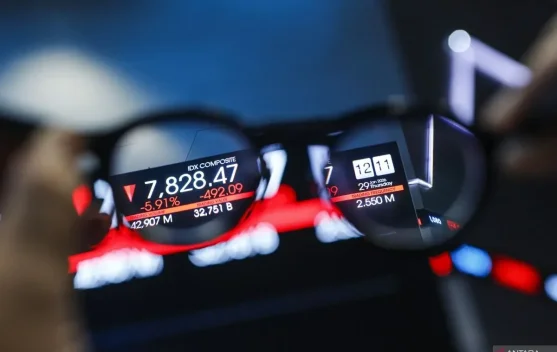
IDX Urges Investors to Stay Calm Amid Middle East Tensions
IDX Urges Investors to Stay Calm Amid Middle East Tensions
Oleh - Gusti Panji Alif Pratama
Editor - Lasti Martina
2 Mar 2026
Voice of Indonesia
RRI.CO.ID, Jakarta - Geopolitical tensions in the Middle East triggered turmoil in Asian stock markets, including Indonesia, at the beginning of this week.
The Jakarta Composite Index (JCI) opened down 23.95 points or 0.29 percent to 8,211.31 in trading on Monday, March 2, 2026.
Acting President Director of the Indonesia Stock Exchange (IDX), Jeffrey Hendrik, asked market players to remain calm and stick to fundamental analysis. “We urge investors to remain rational and always pay attention to fundamentals,” Jeffrey said in Jakarta on Monday, March 2, 2026, as quoted by Antara.
He also called on investors to adjust their investment strategies. “Adjust your investment strategy to each investor’s risk tolerance,” Jeffrey said.
The pressure was not only felt in Indonesia, as several Asian stock exchanges also weakened. The Kuwait Stock Exchange even halted trading, while the United Arab Emirates (UAE) closed its stock market on Monday, March 2, and Tuesday, March 3.
The decline occurred after the conflict between Iran, Israel, and the United States (US) escalated sharply. Large-scale airstrikes launched by Washington and Tel Aviv on various strategic targets in Iran, as part of Operation Epic Fury, triggered a further military response from Tehran.
Iran then launched ballistic missiles at several countries that have US military bases and allies in the Gulf region, including Bahrain, Qatar, Kuwait, Saudi Arabia, Jordan, and the UAE. This escalation has heightened global concerns about regional stability and global energy supplies.
Investors’ attention is also focused on the Strait of Hormuz, a vital route for around 20-25 percent of global crude oil and liquefied natural gas (LNG) supplies. Potential disruptions to this route risk shaking up energy prices, supply chains, and global shipping insurance costs. ***