
IDEAS forecasts 2026 Qurban economic value decline as public shifts to cheaper animals
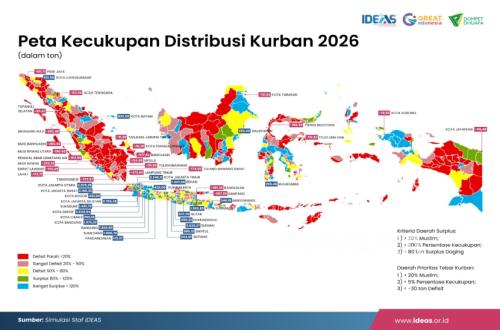
Research institute Institute for Demographic and Affluence Studies (IDEAS) forecasts the national Qurban economic potential to reach Rp26.89 trillion in 2026. This figure comes from approximately 1.9 million households participating in Qurban, with an estimated total of 1.59 million sacrificial animals. According to IDEAS’ projections, this includes 493,180 cattle and 1.09 million goats and sheep. The potential distribution of Qurban meat is estimated at 99,290 tonnes. IDEAS researcher Tira Mutiara explained the estimate was calculated using the Muslim population with expenditure above five times the district/city poverty line as a proxy for economically capable households. ‘The simulation also considered preferences for animal types and weights, from whole cattle to shared 1/7 cattle schemes, along with goats and sheep in various weight categories,’ Tira stated on Monday (25 May 2026). Despite the substantial figure, the 2026 Qurban economic forecast shows a decline from Rp27.10 trillion in 2025. The decrease is attributed to fewer participating households and a shift away from larger animals. IDEAS noted a projected drop of around 10,170 cattle and 3,430 goats and sheep compared to the previous year, leading to a reduction in meat distribution potential by approximately 1,850 tonnes. Tira said the shift reflects consumer behaviour adjustments amid domestic economic pressures. ‘The public is still striving to maintain the Qurban ritual but is increasingly opting for more affordable animals. This is evident in rising demand for 40kg and 20kg goats and sheep,’ she said. She noted the shift signals early signs of declining purchasing power due to rising food prices, living costs, and livestock prices in recent years. On the other hand, IDEAS highlighted the ritual’s important social function in expanding access to animal protein for poor and vulnerable communities. However, meat distribution remains uneven. Of Indonesia’s 514 districts and cities, 163 are classified as severely deficient with distribution coverage below 20%, while 107 are highly deficient and 73 fall into the deficient category with coverage between 50-80%. Conversely, the largest surpluses are concentrated in Java’s urban areas. North Jakarta recorded a surplus of approximately 3,879.25 tonnes, followed by Depok City at 3,644.94 tonnes and Sleman Regency at 3,639.37 tonnes. Meanwhile, East Lampung is among the regions with the highest deficit at 473.60 tonnes, with distribution coverage of just 3.5%. IDEAS said future national Qurban strategies must not only focus on increasing animal numbers but also strengthen distribution management for more equitable allocation. ‘There needs to be mapping of surplus and deficit areas, establishment of standardised slaughter hubs, and enhanced inter-agency coordination to ensure more effective and targeted meat distribution,’ Tira said. She added that improved distribution management could turn the Qurban economic potential into a tool for equitable protein distribution and strengthening national social solidarity.