
ICW on Religious Affairs Minister Nasaruddin Umar's Private Jet: Potential Gratification
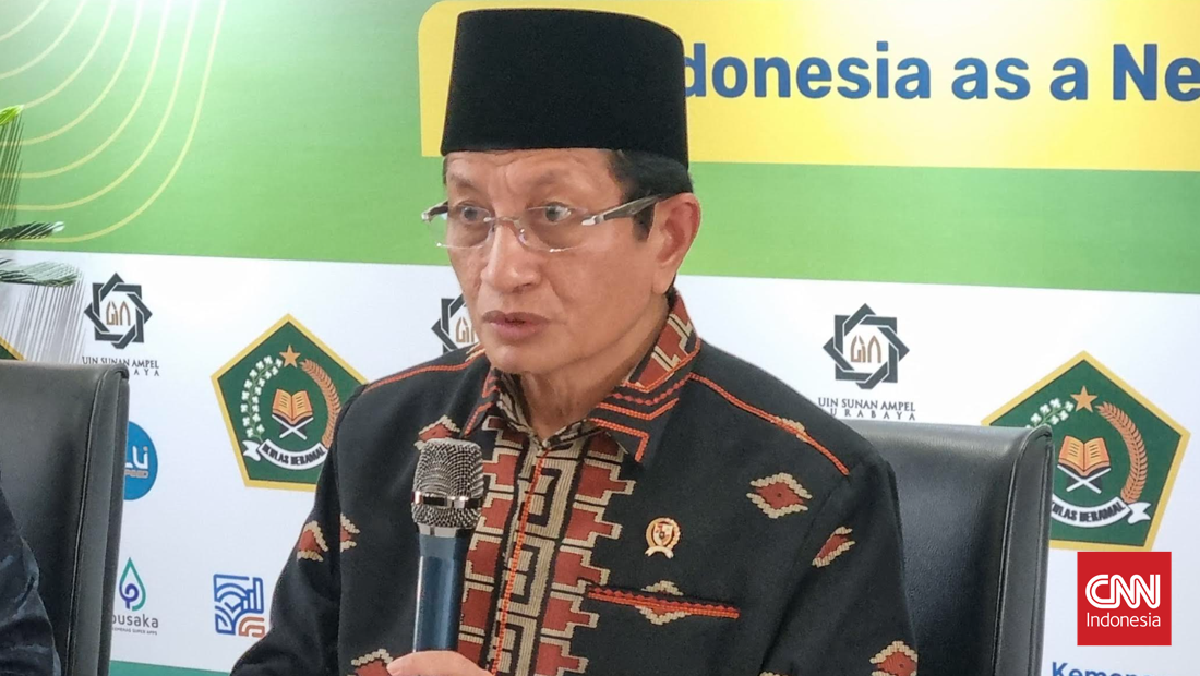
Indonesia Corruption Watch (ICW) has assessed that the private jet facility received by Religious Affairs Minister Nasaruddin Umar from businessman and politician Oesman Sapta Odang (OSO) potentially falls within the category of gratification.
“The receipt of a private jet facility by the Religious Affairs Minister also potentially fulfils the elements of a corruption offence as stipulated in Law Number 20 of 2001 on the Eradication of Corruption regarding gratification provisions,” said ICW Investigation Staff member Zararah Azhim Syah in a written statement on Thursday (19 February).
Azhim explained that Article 12 paragraph B subsections (1) and (2) of the Corruption Law stipulate that any state official who receives gratification valued at Rp10 million or more, and cannot prove that such gratification does not constitute a bribe, may be sentenced to a minimum of four years and a maximum of life imprisonment.
As a state official, he said, Nasaruddin should have refused any form of gift that clearly contravenes the law, particularly if the gift originates from a political figure who could potentially give rise to a conflict of interest in the future.
Although there are exceptions that exempt state officials from the obligation to report the receipt of gratification for certain goods or services, the regulations still set firm limits on the types of goods and services that may be accepted.
Azhim noted that Article 2 subsection (3) paragraph j of Corruption Eradication Commission (KPK) Regulation Number 1 of 2026 does allow state officials to receive transport and accommodation facilities. However, this provision is not absolute and is constrained by a number of cumulative requirements.
First, the value of the facility received must not exceed the unit cost standards applicable at the recipient’s institution. Second, there must be no double financing — a situation where an official has already received official travel funding from the state budget yet still accepts similar facilities from another party.
Third, the receipt must not give rise to a conflict of interest or violate prevailing laws and regulations.
On the matter of compliance with cost standards, Azhim said, Finance Minister Regulation (PMK) Number 32 of 2025 on Standard Input Costs for Fiscal Year 2026 sets the maximum cost for domestic business-class return airfares for official travel at Rp22.1 million.
The value of Nasaruddin’s private jet facility reached approximately Rp566 million, clearly exceeding the Standard Input Cost provisions and contravening KPK Regulation Number 1 of 2026.
“If the Religious Affairs Minister did not refuse the facility and did not report it to the KPK for verification that the gratification in question does not constitute a bribe, then the elements of gratification are potentially fulfilled,” said Azhim.
“The receipt value exceeding Rp10 million, combined with the potential conflict of interest and violation of cost standards, strengthens the argument that such conduct may be classified as a suspected corruption offence,” he added.
OSO’s Private Jet
The visit to Bone, South Sulawesi, on 15 February was not Nasaruddin’s first trip there. On 1 October 2025, Nasaruddin made a homecoming visit to Bone using a commercial aircraft.
However, on his most recent visit he used a private jet — as confirmed by information published by the Ministry of Religious Affairs on its official website. The registration number of the private jet used was PK-RSS.
Trend Asia researcher Zakki Amali said that according to Ministry of Transport data, PK-RSS is owned by Natural Synergy Corporation, an entity registered in the British Virgin Islands, a British territory known as a tax haven.
OSO has been a shareholder in the company since 2008. According to the International Consortium of Investigative Journalists database, the company remains active to this day.
Based on calculations, the flight was valued at least Rp566 million for the return journey totalling approximately five hours.
This figure is based on the jet’s journey carrying Nasaruddin on 14–15 February 2026 along the route Jakarta–Makassar–Bone–Makassar–Jakarta.
Meanwhile, Zakki said the carbon dioxide emissions produced amounted to 14 tonnes of CO2, making private jets the most polluting form of transport.
He argued that officials should not use luxury facilities in carrying out their duties, especially when there are many alternative modes of transport.
“Expensive, luxurious, and high-emission air travel should be avoidable. Moreover, the Religious Affairs Minister has previously taken a commercial flight to Bone. This means there are alternatives, and the journey can also be made by land,” said Zakki.
“As a public official, he should set an example in reducing the climate crisis by avoiding private jets as the world’s most polluting mode of transport,” he added.
Ministry of Religious Affairs Responds
Religious Affairs Minister Nasaruddin Umar received the private jet facility from OSO when inaugurating the Sarkiah Hall in Takalar Regency on Sunday, 15 February 2026. Nasaruddin’s attendance was at OSO’s direct invitation.
“Mr OSO specifically invited him and hoped that the Sarkiah Hall would be inaugurated by the Religious Affairs Minister. Mr OSO took the initiative to arrange a private jet for the Minister so that he could attend amidst his packed schedule,” said Head of the Public Relations and Communications Bureau of the Ministry of Religious Affairs, Thobib Al Asyhar, in Jakarta on Monday (16 February), as reported on the Ministry’s official website.
“All modes of transport for the journey were arranged by the organiser,” he added.
Meanwhile, the KPK has expressed hope that Nasaruddin will come to the Deputy for Prevention and Monitoring to explain the receipt of the facility.
“There [at the Deputy for Prevention and Monitoring] is the Directorate of Gratification and Public Services, which can address and explain the issues currently developing,” said KPK Chairman Setyo Budiyanto at his office in Jakarta on Wednesday (18 February).
Following that, Setyo explained, the KPK can follow up with an analysis or review.
“We can then analyse it and review it,” he added.