
Ibas Emphasises Irrigation Continuity as Key to National Food Sovereignty
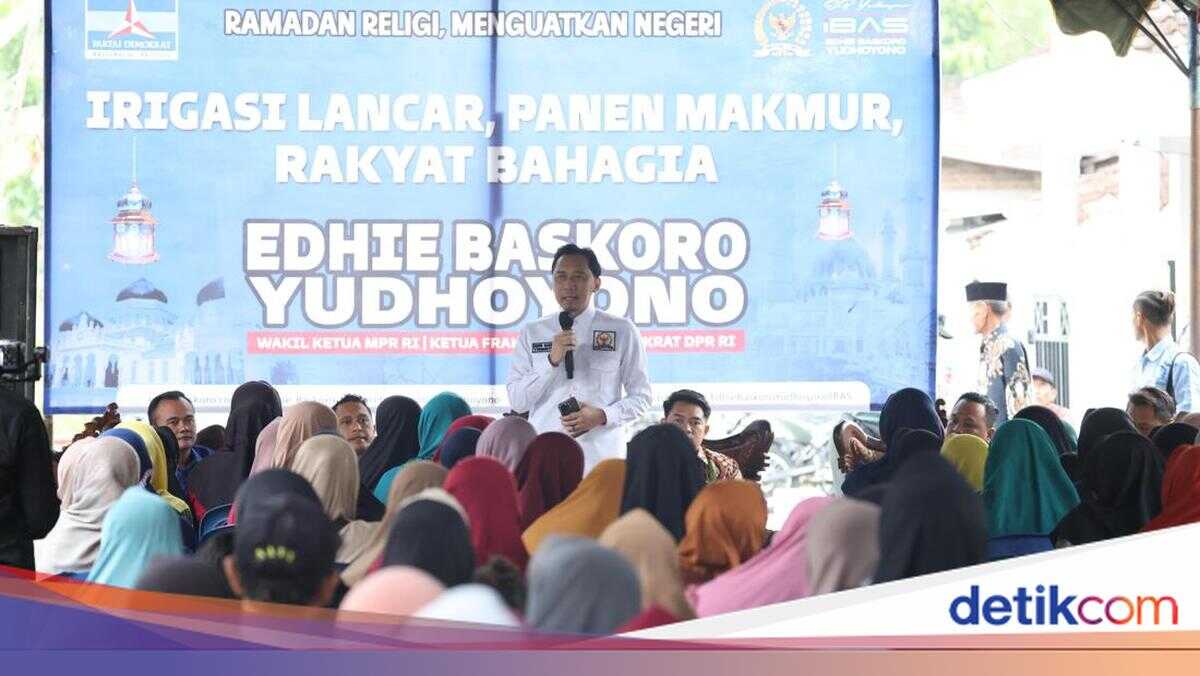
Deputy Chairman of Indonesia’s People’s Consultative Assembly Edhie Baskoro Yudhoyono (Ibas/EBY) conducted a direct inspection of an irrigation programme in Kedunggalar, Ngawi Regency, as part of his 2026 recess activities. Ibas emphasised that irrigation is the lifeblood of national agriculture.
“I am here this afternoon with a simple message: water is life. Irrigation is the lifeblood of agriculture,” Ibas stated in his remarks on Friday, 27 February 2026.
Ibas disclosed that over 70 per cent of national rice production depends on irrigation systems. Nationally, Indonesia possesses more than 7 million hectares of irrigated land, though some still requires rehabilitation and modernisation.
“Every 10 per cent improvement in irrigation efficiency can increase rice productivity by 5–8 per cent. This means irrigation is not merely a technical project, but a strategy for food sovereignty,” he asserted.
A Constitutional Mandate
The Chairman of the Democratic Party Faction in the House of Representatives emphasised that water management is a constitutional obligation. He cited Article 33, paragraph (3) of the 1945 Constitution, which states that the earth and water are controlled by the state and utilised for the greatest welfare of the people.
“The meaning is clear. The state is obliged to protect water for farmers. There is no harvest without irrigation. There is no prosperity without water,” he explained.
As one of East Java’s food granaries, Ngawi is considered to have a strategic role in maintaining national food stability. However, Ibas acknowledged that there remain challenges in the field, such as channel sedimentation, embankment breaches, water gate damage, and uneven distribution.
On this occasion, Ibas also called upon the community to preserve the environment surrounding irrigation and agricultural areas. Water source sustainability depends heavily on collective environmental stewardship.
“We must protect the environment together. The water flowing to the rice fields originates from a healthy natural environment. If the environment is damaged, agriculture will also be affected,” he said.
Ibas also highlighted the existence of the Trinil Museum in Ngawi, which possesses high historical and scientific value and is not found elsewhere in Indonesia.
“Ngawi possesses a great legacy such as the Trinil Museum, which is a source of pride for us all. Therefore, the preservation of the surrounding environment must be maintained together so that its benefits can be felt by the current and future generations,” he added.
Tangible Economic Impact
Ibas explained that smooth irrigation enables farmers to plant two to three times annually. He affirmed that an increase in cropping intensity will have a direct impact on farmers’ income.
“If productivity increases by just one tonne per hectare across hundreds of hectares, the added value can reach billions of rupiah. This is not a small figure. This is people’s income,” he said.
He also stated that increases in agricultural production must continue to be promoted to support the national food security programme launched by President Prabowo.
“We must ensure that agricultural production continues to increase so as to support the national food security programme. Good irrigation becomes the primary foundation for realising this,” he asserted.
Ibas encouraged strengthening the role of P3A (farmer irrigation water management groups) as the frontline force in managing irrigation based on mutual cooperation. This aligns with Article 33, paragraph (1) of the 1945 Constitution regarding the principle of kinship in the economy.
“Mutual cooperation is the strongest social technology possessed by the Indonesian nation,” he said.
Going forward, Ibas promoted modernising the irrigation system through digital monitoring, automatic water gates, and data-based discharge mapping. He also invited the younger generation to become involved in managing agriculture and water resources using a technological approach.
“Whoever controls water controls the future. Today’s agriculture must be precise, data-based, and involve young people,” he said.
Ramadan and Water Reflection
In the spirit of Ramadan, Ibas invited the community to make the fasting period an opportunity to reflect on the importance of water for life.
“Ramadan teaches us to endure thirst. Farmers experience the importance of water every day. Therefore, water management must be fair and pro-people,” he said.
In closing his remarks, Ibas affirmed the need to oversee irrigation network rehabilitation, strengthen well-targeted budgeting, and foster collaboration between central and local governments.
“If irrigation flows smoothly, farmers are at ease. If farmers are at ease, harvests flourish. If harvests flourish, people are happy. Ramadan strengthens religion and nation,” he concluded.