
IAPI is Preparing to Build a Sustainability Assurance Ecosystem
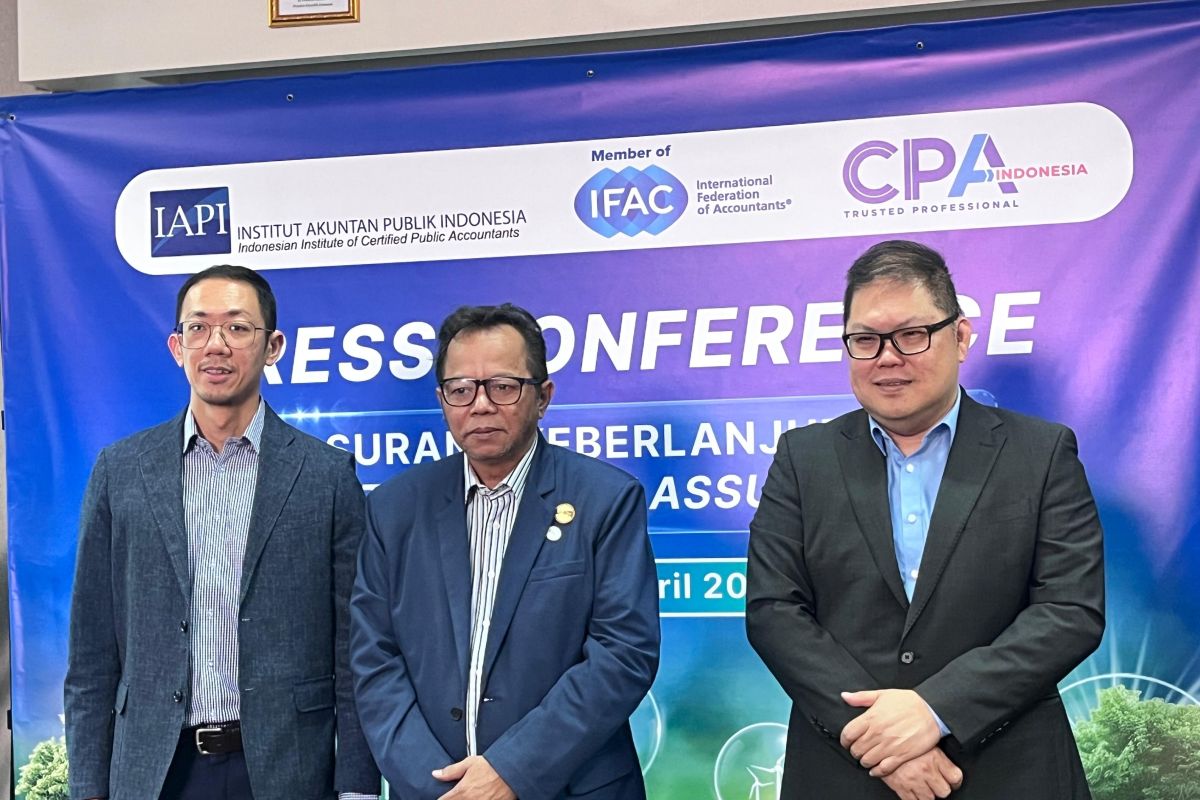
Jakarta (ANTARA) - The Indonesian Institute of Public Accountants (IAPI) is preparing to build a sustainability assurance ecosystem in Indonesia to improve the quality and credibility of sustainability reports.
IAPI National Board Member Sempurna Bahri stated that global accounting developments are currently shifting towards the creation of sustainability reports linked to Environmental, Social, and Governance (ESG) aspects for companies, while still including financial reports.
“So, readers of financial reports will check whether there are any violations committed by the company related to laws. These laws could cover labour, environmental or waste regulations, and so on. It’s not just about financial performance; this aims to build the trust of stakeholders—users of financial reports—in managing risks and complying with regulations,” he said during a press conference on Sustainability Assurance in Jakarta on Tuesday.
On that occasion, IAPI appreciated the Financial Services Authority’s (OJK) steps to strengthen the Sustainable Finance regulatory framework in Indonesia through the Draft Financial Services Authority Regulation (RPOJK) on the Implementation of Sustainable Finance for Financial Sector Business Actors (PUSK), Issuers, and Public Companies.
This RPOJK requires PUSK to prepare sustainability reports based on Sustainability Reporting Standards Statement (PSPK) 1, “General Requirements for Disclosure of Sustainability-Related Financial Information”, and PSPK 2, “Climate-Related Disclosures”.
In this context, IAPI emphasises that sustainability reports and financial reports are closely interconnected and must be synchronised with one another. The information presented in sustainability reports must be consistent and aligned with that reflected in financial reports, thereby forming a unified and integrated corporate reporting framework.
In its review of the RPOJK, IAPI paid special attention to the use of the term “verification” in the RPOJK as a means of providing assurance over sustainability reports.
It considers that the terms verification and assurance have fundamental differences: verification focuses more on technical checks of data, whereas assurance involves a more comprehensive independent evaluation, encompassing aspects of systems, processes, materiality principles, and the consistency of presented information.
“So, when investors or market participants want to make investment decisions, what they are looking for now is not just financial reports or financial information, but also how the company manages its operations in line with established concepts, making sustainability reports an important element in the capital markets and financial sector,” said IAPI National Board Member Susanto.
Furthermore, it explained that assurance practices cannot be separated from the international standards ecosystem, particularly assurance over sustainability information, which must refer to several international-level standards.
The second standard is the International Ethics Standards for Sustainability Assurance (IESSA) as an ethical guideline for conducting sustainability assurance, which is currently in the adoption phase by IAPI’s Professional Ethics Board.
The third is International Education Standards (IES) 2–4, which integrate competencies related to sustainability assurance as mandatory competencies for public accountants.
Finally, there is the Quality Management Standard (SMM) adopted from the International Standards on Quality Management to strengthen quality management at the Public Accounting Firm (KAP) level. This is done to ensure that KAPs and their personnel meet their responsibilities in accordance with professional standards and applicable laws and regulations, and to carry out engagements in accordance with those standards and provisions.
“IAPI feels the need to introduce this ecosystem to improve the quality and credibility of sustainability reports, which are increasingly needed by the business world and capital markets,” Susanto revealed.