
HSBC Group CEO: Banking Between Trade and AI (2/2)
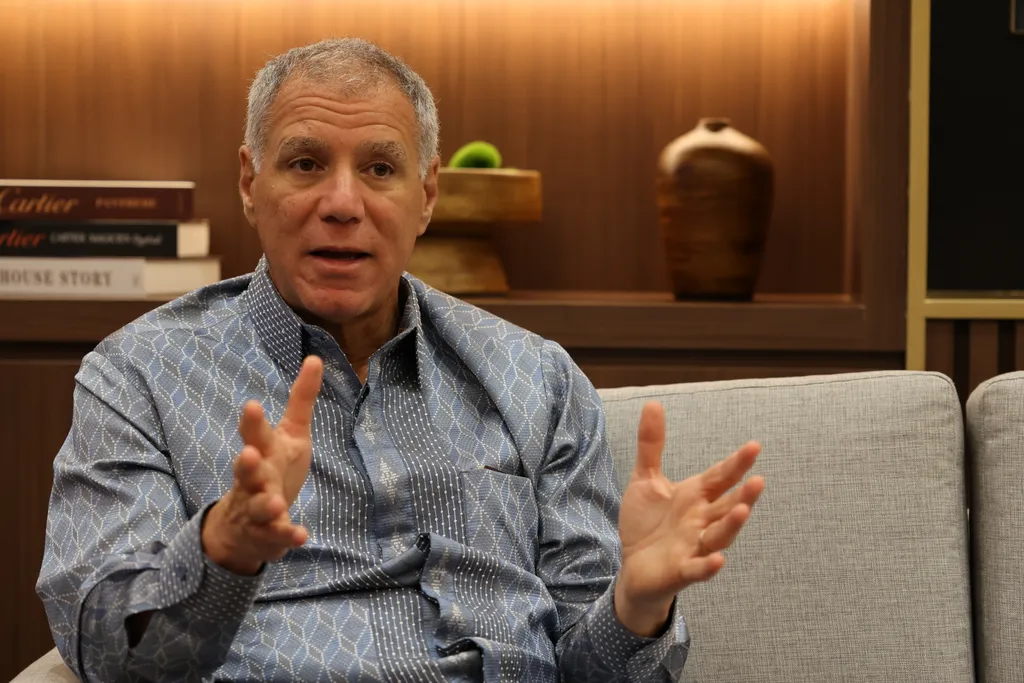
In this second part, HSBC Group CEO Georges Elhedery provides insights into Indonesia’s trade sector development, banking trends, and the role of artificial intelligence as a driver of change. He also discusses Indonesia’s potential in the global electric vehicle supply chain.
How strategically important is Indonesia’s position as a regional trade and investment hub going forward?
Most global direct investment is aimed at building local market capacity and supporting Indonesia’s export capabilities. Therefore, the trade sector will become very important, starting with the growth of manufacturing exports.
Secondly, if the Indonesian economy grows at, say, 5-6 per cent over the next five years, consumer purchasing power will grow rapidly. Moreover, Indonesia is the fourth most populous country in the world. If this growth drives increased purchasing power among Indonesians, import demand will also rise.
Thus, Indonesia’s trade sector can become a business driven by both exports and imports. For us, this is critical. I mean, we are the largest, and we have now become the number one trade finance bank in Indonesia for three years. We will certainly be at the forefront in supporting our clients to capture this major opportunity.
How will HSBC facilitate these opportunities given external challenges, such as the imposition of Trump tariffs?
Tariff policies are not new in trade. We have always learned to operate in a world with various forms of tariffs. There are several things to note. First, Asian exports reached record levels in 2025, despite US tariff policies. So all Asian countries continue to benefit from increased shipments. That is one positive thing.
Second, Asia buys from Asia. Trade growth within Asia, such as between Indonesia and ASEAN, ASEAN and China, Indonesia and Asia, has overall grown in double digits. Our estimates suggest growth in the range of 20-30 per cent. Trade between ASEAN and China has grown above 30 per cent. This demonstrates considerable resilience in trade.
Trade between Indonesia and the US may decline, but Indonesia’s trade share with the US is only 5 per cent of total Indonesian trade. Even if it decreases, there are so many other sectors growing that we see as opportunities. And I am confident that overall this will remain a growth opportunity in the trade field.
Indonesia is now a key player in the global nickel and electric vehicle battery supply chain. How do you view the financing potential of this sector, and how big are the opportunities and challenges for Indonesia to become an important player in the global EV industry?
Indonesia has been a major exporter, primarily in extraction and mining, agriculture, or oil and gas. However, Indonesia is developing as an exporter of more complex or advanced manufactured goods. Growth is still relatively small.
This represents a major investment opportunity for Indonesia because much of the raw material is available here. Similarly, with production capabilities, such as for electric vehicles, batteries, and other electrical goods, including electronics.
We are an industry with strict regulations. With the emergence of generative AI, we will still rely on humans, because we need security and safety. In this regard, humans are responsible for making assessments and decisions.
The capability is already in place. However, it now requires greater scale. This scale will be achieved through greater investment and job creation. I am confident this transition is still ongoing, and we believe this is one of the biggest growth opportunities.
For both our multinational companies and the Indonesian economy, such investment will be very helpful. This will certainly create more jobs and increase higher skills and capabilities because we are talking about more advanced goods. So this will be very beneficial and have high added value for Indonesia.
As an international bank, how does HSBC view the future direction of banking?
I think the biggest shift in banking will be driven by technology, particularly with the emergence of generative AI. We are an industry with strict regulations. With the emergence of generative AI, we will still rely on humans, because we need security and safety. In this regard, humans are responsible for making assessments and decisions.
On the other hand, generative AI can also enable us in the banking sector to deliver major breakthroughs in providing banking services in a personalised manner, at scale, and in real-time. Imagine every customer can complete the onboarding process in real-time.
Additionally, customers can also receive investment advice tailored to their risk appetite, aspirations, and specific needs. However, all these processes remain aligned with the bank’s perspective, because we provide our research to generative AI.
In my view, banking services can become very seamless. So this is truly personalisation at scale and in real-time.