
How Israel Remains Wealthy and Its Economy Thrives Despite Ongoing War
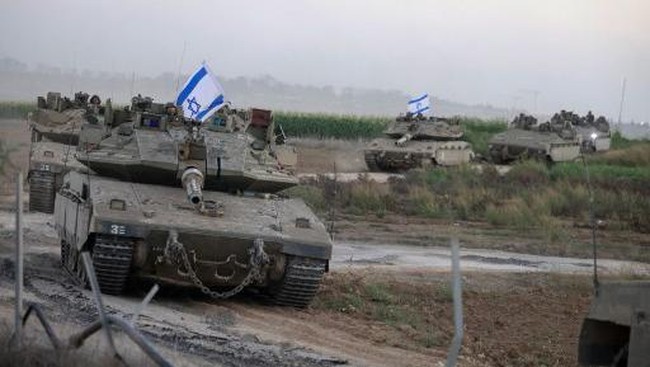
Israel’s economy is still growing rapidly despite being hit by prolonged war. Israel’s stock market has even surged amid escalating conflict.
Israel has been involved in ongoing conflicts since the militant group Hamas’s attack on 7 October 2023, which triggered Israel’s offensive in Gaza.
Israel also attacked Iran alongside the US on 28 February and is fighting against Iran’s proxy group, Hezbollah, in Lebanon. Additionally, Israel has been targeted by attacks from the Houthi group in Yemen.
Despite being engaged in war, the Zionist state’s economy remains surprisingly robust.
Earlier this month, Israel’s central bank cut its economic growth projection for this year due to the Middle East conflict.
However, it was quite surprising that the central bank still forecasts Israel’s economy to grow by 3.8% in 2026, even after a 1.4 percentage point reduction.
The bank’s governor, Amir Yaron, stated that if the regional conflict eases, Israel’s economy could recover to 5.5% next year.
The International Monetary Fund (IMF) also projects Israel’s economy to grow by 3.5% this year. This growth is higher than that of the United States (2.3%) and the European Union (1.3%).
Despite spending heavily on war, Israel has a debt-to-GDP ratio much lower than many other advanced countries, at around 69.8% this year. Although slightly up from 2025, this figure is still far below the G7 average of 123.7%.
Israel’s unemployment rate has also risen only slightly to 3.2% in March 2026. This is still lower than the US (4.3%) and the Eurozone (6.2%).
Other macroeconomic indicators, such as inflation, remain positive. Inflation has been relatively stable for two months since the Iran war began, even dipping slightly to 1.9% in March 2026, amid a surge in oil prices.
Keren Uziyel, a senior analyst at the Economist Intelligence Unit, said that although Israel’s economy is growing below its potential due to the war, several factors keep it resilient.
The senior Economist Intelligence Unit analyst, Keren Uziyel, pointed to a combination of a strong private sector, low inflation, skilled workforce, and consistent growth as key to recovery from crises.
According to her, technology exports have been the main engine of Israel’s growth over the past two decades. However, expansion has also occurred in other sectors such as natural gas and the defence industry.
Not only that, Israel has also recorded a surge in major investments. In 2025, there were two of the largest foreign transactions in history in the cybersecurity sector, namely Google’s acquisition of Wiz for US$32 billion and Palo Alto Networks’ acquisition of CyberArk for US$25 billion, completed in March 2026.
From a demographic perspective, Israel is also advantaged. Population growth is approaching 2% per year with a relatively young population structure, and per capita economic performance has remained solid over the past 20 years.
If a ceasefire holds, Israel’s economy is expected to recover strongly and grow around 3% in 2026.
“High-tech goods and services exports have been the main factor behind two decades of strong growth and wealth creation, but the economy has also grown rapidly in other sectors, including natural gas resource development and defence exports,” Uziyel told CNBC International.
She added that Israel’s demographic factors are also favourable for an advanced economy, with average population growth approaching 2% per year for most of the past two decades.
“By the standards of advanced countries, Israel’s population is relatively young. Even on a per capita basis, its economic performance has remained strong over the past 20 years,” she said.
The energy sector will also see significant investments in 2026-2027, both in developing domestic renewable energy capacity and in supporting increased production and export capacity in the natural gas sector.
However, Joao Gomes, a finance professor at the Wharton School, University of Pennsylvania, told CNBC that Israel’s economy is beginning to feel the impact of the Iran war.
One of them is a shortage of working-age labour mobilised for conflict and weakening consumer spending due to security concerns. He added that the tourism sector has also been severely affected, further pressuring growth and government revenue.
Gomes said that the long-term economic impact will greatly depend on the form of the peace agreement in the Middle East and perceptions of Israel’s security level.
Israel’s government debt is said to have surged significantly and will require fiscal adjustments.
However, the situation is still considered manageable as long as Israel can achieve a peace framework that allows for sustainable reductions in defence spending, while maintaining foreign investor confidence and workforce quality.
“The impact of the war on Israel’s international reputation and its attractiveness to global tourists may not be too crucial, but it remains relevant,” Joao Gomes told CNBC.
Gomes warned that without a clear peace agreement, Israel’s economic prospects will be far more challenging. Looming risks include capital outflows, currency weakening, and inflation surges.
Stock Market Soars
Amid geopolitical pressures, Israel’s financial markets are showing strong performance. According to Karen Schwok, CEO of Lucid Investments, capital flows are continuing to enter the domestic market.
Since the beginning of the year, the Tel Aviv 35 index has surged around 20%, after rising 51.6% in 2025. During the Iran war, the index still recorded a gain of around 1%.
Meanwhile, the Israeli shekel has strengthened nearly 7% against the US dollar this year, even rising around 4% during the war period.
The Tel Aviv 35 index’s performance this year has even outperformed many advanced country markets, including the three major Wall Street indices.