
How Indonesia’s Mount Dukono tragedy mobilised a village - and left it scarred
How Indonesia’s Mount Dukono tragedy mobilised a village - and left it scarred
With deep knowledge of the active volcano, villagers living in the shadows of Dukono were instrumental in the search and recovery of three people killed on its slope, say authorities.
MAMUYA, North Maluku: Just a few days ago, Mamuya - a small village in Indonesia’s North Maluku - pulsed with the activity of 150 military and civilian rescuers.
For three days they shuttled between a command centre along Mamuya’s main road and a base camp at the foot of Mount Dukono, some 10km away, where three hikers including two Singaporeans had died following the volcano’s eruption.
But after the bodies of the three were evacuated from the slopes, the operation wound down and the makeshift command post has since returned to its original function as a Dukono volcanology observation office.
The senior officials who once frequented the site - issuing orders and holding press briefings - have returned to their offices hundreds of kilometres away in the cities of Ternate and Ambon.
What remains for the locals who volunteered in the rescue effort are the memories of a weekend when this remote village stood at the centre of a crisis unfolding beneath one of Indonesia’s most restless volcanoes.
“I have never seen bodies like that,” 42-year-old Mamuya resident Jabir Abdul told CNA of seeing the remains of two of the victims. “I still get chills just talking about them. It was terrifying.”
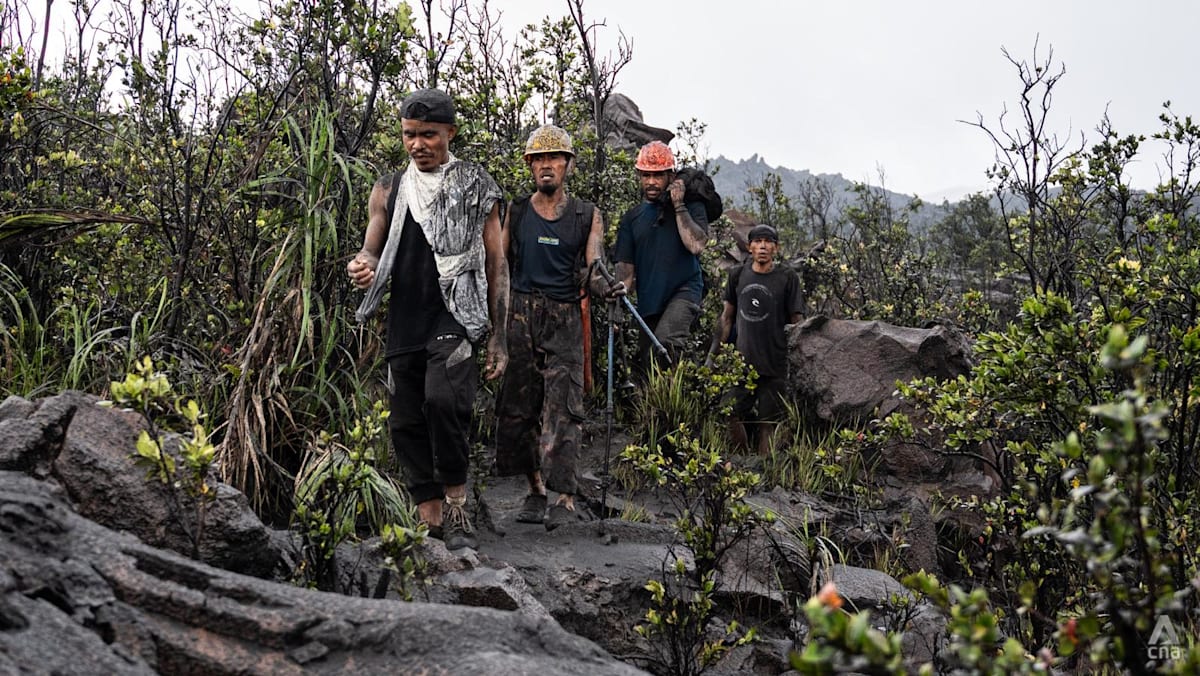
Jabir is one of around 30 locals who joined the rescue operation.
Every morning, they were among the first to hike the mountain and some of the few people brave enough to get near the still fuming crater where the bodies of Indonesian Angel Krishela Pradita, 28 and two Singaporeans: Timothy Heng Wen Qiang, 30, and Shahin Muhrez Abdul Hamid, 27 were buried beneath layers of fiery volcanic ash.
The three were among 20 hikers who were on the slopes of Dukono when a massive eruption occurred on Friday morning.
While the other 17 made it out back to base camp, Angel’s lifeless body was discovered on Saturday afternoon, while Heng and Shahid’s were located on Sunday morning.
Various rescue units, including the National Search and Rescue Agency (Basarnas), described the locals as instrumental.
Because the locals regularly work as manual labour in plantations and construction sites, their stamina, strength and familiarity with the surroundings were key contributions to the rescue efforts, said authorities.
“They are very important because they are familiar with the environment. They have local knowledge that enables them to understand the situation, condition and especially the characteristics of Mount Dukono,” Iwan Ramdani, chief of the local office of Basarnas, who was leading the operation, told CNA.
“They are very enthusiastic about helping our operations. Even people who don’t participate directly in finding the victims, help out with logistics, transportation and so on.”
A SHOCK TO THE COMMUNITY
On May 8, Dukono erupted violently, sending a thick plume of ash 10,000m into the atmosphere, making it one of the volcano’s biggest eruptions in recorded history.
According to data from the Indonesian Volcanology and Geological Disaster Mitigation Centre (PVMBG) past eruptions have rarely expelled ash of more than 1,000m in height since 1933 when such measurement began.
“Even we locals who are used to seeing Dukono erupting were taken aback by the (May 8) eruption,” said Jabir.
When 17 people emerged from Dukono’s slopes to report that three of their friends were missing, locals had a hunch that this would not be a normal search and rescue mission but one of recovery.
“This is the first time someone died on the slopes of Dukono. This time we had three dying in one single eruption. This comes as a huge shock for us locals,” Mamuya native Sababil Pasaraja, 29, who also took part in the rescue effort, told CNA.
Scouring the slopes for missing climbers is familiar territory for him and fellow residents.
Every time a hiker went missing on Mount Dukono in the past, Basarnas would ask locals to participate in search and rescue efforts. Almost all of the locals treated Dukono as their backyard, with intimate knowledge of every ridge, forest path and obstacle.
The last time locals assisted in a search and rescue operation was in 2017, when a then-17-year-old boy was separated from his peers and got lost. He was found more than 24 hours later.
Locals were also asked to comb the slopes of Dukono after major eruptions in case there were hikers stranded or in need of rescue like what they did in August of 2024 and March 2026.
“Whenever Basarnas needs us, the villagers are very eager to help. Sometimes they can’t arrive quickly, so they ask us to head up first,” Sababil told CNA.
The volcano is extremely active and has had “elevated or abnormal activity” since 2008, forcing authorities to impose a 2km radius ban on all activities on the slopes of Mount Dukono from that year. But the ban did not stop hikers and thrill seekers from climbing the volcano and getting close to its crater.
“Dukono has two official entrances, one in Mamuya and the other in (neighbouring village) Ruko. But there are countless ways hikers can use to get to the mountain,” said Sababil.
Because of increased volcanic activity, Dukono’s alert status was upgraded to the second highest of four levels on Apr 17 and the ban radius was raised to 4km, effectively barring everyone from entering the mountain entirely.
UNFORGIVING CONDITION
Despite knowing the volcano like the back of their hands, rescuers like Jabir and Sababil still had to navigate through rough and unforgiving terrain, with stretches of slippery foot paths made worse by rain and volcanic debris.
The good news was rescuers knew where to look because one of the missing climbers had activated a personal locator beacon which sent out distress signals. But the bad news was the signal was coming from less than 50m from the edge of the still volatil