
How Indonesian Biscuit Exporters Are Surviving Amid Rising Raw Material Prices
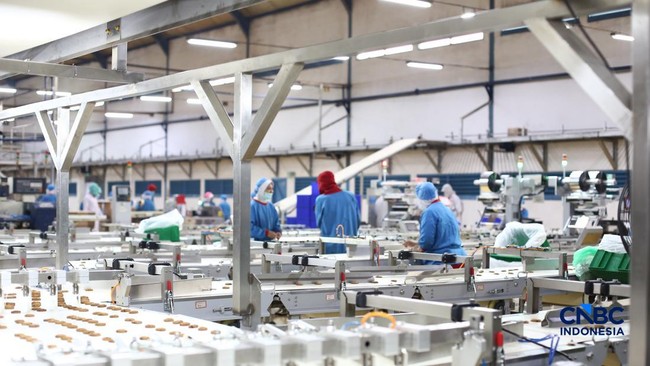
Surabaya, CNBC Indonesia - One of Indonesia’s producers and exporters of biscuits and wafers, PT Mega Global Food Industry (Kokola Group), is beginning to feel business pressures from the rising costs of production raw materials.
The industry, based in Gresik, East Java, is now bearing packaging costs that have increased by around 40-45% due to higher prices and disrupted global plastic supplies.
“All packaging materials have risen by an average of 40-45%. And the supply chain security is very limited. From the end of the plastic packaging material supply, everything is in demand because of the uncertainty,” said Director of Mega Global Food Industry, Richard Cahyadi, in Gresik, East Java, on Friday (17/4/2026).
To anticipate this issue, the company, he said, also has to prepare substantial financing for purchases, as securing raw material stocks now requires cash payments upfront.
“So we pay in advance, we pay cash. We need strong financial funding strength for that packaging,” he explained.
In addition, he acknowledged that the company also needs to adjust product selling prices since 15 April 2026 by around 5-10%, considering the competitiveness of products in export destination countries.
“It has been in effect since the 15th. Just recently. So the increase is from 5% to 10%. We can’t adjust above that. B2B prices and it will be reflected in retail,” he stated.
Regarding employees, Richard assured that there will be no impact and the company will continue to maintain its 350 workers. Instead, Richard is implementing efficiencies on the production side, such as using alternative packaging with a new model.
“What was previously one piece packed directly into one package is now two pieces into one package. We will look for alternatives like that,” he said.
On the other hand, there is still support from the Indonesia Export Financing Agency (LPEI) or Indonesia Eximbank in supporting the company’s business activities, particularly in the export sector. The company currently exports its products to more than 55 countries, with main market reaches including Australia, Japan, South Korea, and the Philippines, and collaborates with more than 100 supermarket partners around the world.
LPEI provides financial assistance in the Special Export Assignment (PKE) programme in the form of financing, both at the beginning and end of the export process, including guarantee facilities. Details of the programme include strengthening financial structure, improving cost competitiveness (cost leadership), supply chain stability, and accelerating export growth.
Business Executive Director II of LPEI, Sulaeman, explained that PKE is a Government programme mandated to LPEI with the aim of encouraging national strategic industries and competitive SMEs in the global market as well as creating development impacts.
Up to last year, exporters like Kokola Group have utilised PKE Trade Finance facilities with a total limit of Rp3.35 trillion. The realisation of disbursements throughout 2025 was recorded at Rp7.68 trillion.
The processed food sector became the largest portfolio in PKE Trade Finance, with a portion of 39% or 31 debtors. In addition to providing financial support for business actors, PKE Trade Finance also plays a role in encouraging the creation of development impacts.
Throughout 2025, PKE Trade Finance disbursements have contributed to the creation and/or saving of foreign exchange amounting to Rp21.12 trillion. PKE Trade Finance can currently be channelled to 18 industrial sectors and commodities, including rubber products, coffee, furniture, footwear, processed food, textiles and textile products, jewellery and gems, tea and spices, wood products, crafts, electronic products, chemical products, automotive components, leather products, machines and electrical equipment, iron and steel, agricultural products, and paper products.
“This synergy combines Kokola’s internal strengths—including strong manufacturing foundations, operational discipline, and export experience—with financing and export facilitation support from LPEI to drive more aggressive and sustainable expansion,” said Sulaeman.
Throughout last year, Kokola Group or Mega Global Food Industry was still able to show significant export performance growth. The value of its product exports was recorded at US$19.96 million, up around 45% from the 2024 figure of US$13.71 million.