
How Do Elephants Pass Survival Knowledge on to Their Young?
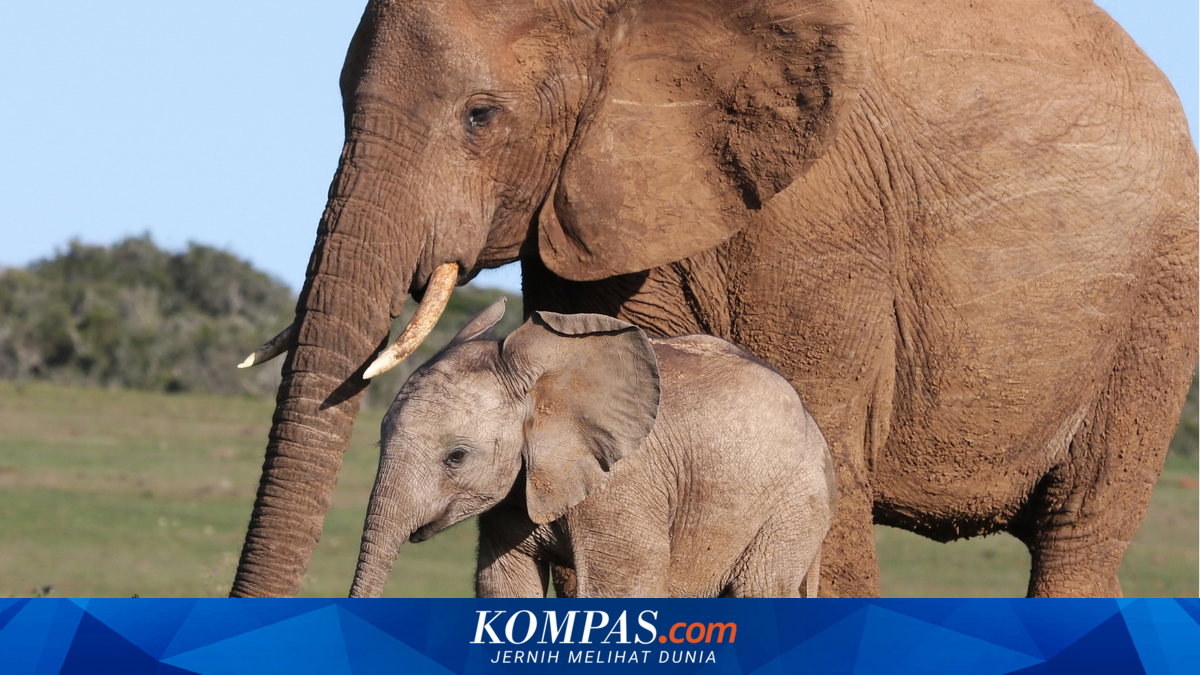
Writer KOMPAS.com - Young elephants have a lot to learn in order to survive in the wild. They must know which foods are safe to eat, what to avoid, and how to behave toward other members of their group as well as threats in their surroundings.
While growing up with their mothers and older female relatives, the learning process usually unfolds naturally. However, recent research indicates that when elephant populations lose older individuals—for example due to poaching or mismanagement of populations—the young elephants will face significant difficulties in developing and surviving.
Behavioural ecologist Lucy Bates from the University of Portsmouth in the United Kingdom led an analysis of 95 studies on elephant populations in Africa and Asia. The results show that elephant populations that lose older individuals tend to have lower survival rates, less social interaction, and less appropriate responses to threats.
According to Bates, when older elephants disappear from a group, it is not just the individuals that are lost, but also the collective knowledge passed down across generations.
“Usually they can still survive when elders are gone. But many more subtle aspects of behaviour can disappear as well,” said Bates.
The loss of this knowledge is not only dangerous for the elephants themselves, but it can also affect their relationships with other animals and humans living in and around their habitats.
Their mature relatives were previously shot in Kruger National Park—not by poachers, but by park managers who judged that the elephant numbers had become too high. The managers at the time assumed that the young elephants could survive merely by relying on instinct.
Yet the reality was far more complex.
Behavioural ecologist Graeme Shannon from the Norwegian Institute for Nature Research, who studied the group, found that these young elephants were likely to experience trauma and a lack of essential knowledge usually learned from older elephants.
To investigate further, Shannon and his team replayed elephant vocalisations from various groups through loudspeakers mounted on cars.
The results differed markedly between the two populations:
In Amboseli, Kenya, the elephant groups led by an older matriarch could recognise the sounds they heard. If the sound came from a group they knew, they remained relaxed. But if the sound came from an unfamiliar elephant group, they immediately gathered to protect the youngsters.
In Pilanesberg, groups without a matriarch responded to all sounds in the same way—always defensive. They also could not distinguish between the calls of young and old elephants, or even the number of roaring lions.
In Amboseli, the young elephants learned when to be cautious by observing the reactions of the adult elephants.
“Behaviour that is too anxious in orphaned elephants is clearly exhausting for them,” Shannon said.
Young elephants in Pilanesberg were observed to frequently attack park staff, visitors, and even researchers. Some young, unmanageable bulls even killed dozens of white rhinos in the park.
That behaviour only subsided after the park managers brought in six older, more dominant bulls. Their presence provided social models for the young elephants.
Although often considered solitary, bulls actually seek interaction with other bulls after leaving the matriarchal group where they were raised. Because they tend to live more solitary lives as adults, the process of learning from older elephants becomes very important.
Also read: Elephants Living Near Humans Tend to Be More Brave and Curious