
How Chinese Propaganda Frames the Iran War?
Last week, an AI-generated video produced by Chinese state media went viral. The video depicts the US-Israel war against Iran through the figures of a Persian cat and a bald eagle. It garnered nearly one million likes in just a few hours and was flooded with comments.
The video provides insight into how Beijing interprets the Iran war to shape domestic public opinion. The main message conveyed to Chinese society aligns with the frequently used narrative that the United States (US) is an aggressive hegemonic power that is weakening. Meanwhile, China remains a rising great power that is peaceful and stable.
The viral CCTV production features a wounded “Persian cat” seeking revenge against the arrogant “white eagle,” ruler of a desert region called the “golden flow valley.” The eagle forces the area to trade rare resources exclusively using “white eagle golden tickets.” Those rare resources are referred to as “black iron essence.”
After the eagle kills the Persian cat’s leader, a major unbalanced war erupts. The eagle expends expensive “anti-air golden needles” to shoot down cheap “wooden birds.”
This not-so-subtle symbolic message is rooted in Beijing’s political messaging since the war began. The narrative is reinforced across the Chinese media network.
“From the start, Chinese officials have clearly portrayed this war as an illegal act and a threat to global stability,” said W.A. Figueroa, assistant professor of history and international relations at the University of Groningen in the Netherlands.
“The image presented is of a stable, actively engaged, and diplomatic China, in stark contrast to an aggressive and unpredictable United States,” he added.
What is China’s media strategy?
In sharp-toned commentaries, the official Xinhua news agency argues that the US’s true goal is “a sovereign-less Iran” and describes the war as “not just for ‘security,’ but for hegemony.”
On domestic social media, these geopolitical themes are broken down into short, easily digestible, nationalistic content.
“Jing Si You Wo,” a popular influencer on China’s short-video app Douyin, reaches millions of viewers. His latest videos enthusiastically claim that the US has “backed down” in the face of Iran’s resolve, and Iran’s greatest weapon is the determination for “mutual destruction.”
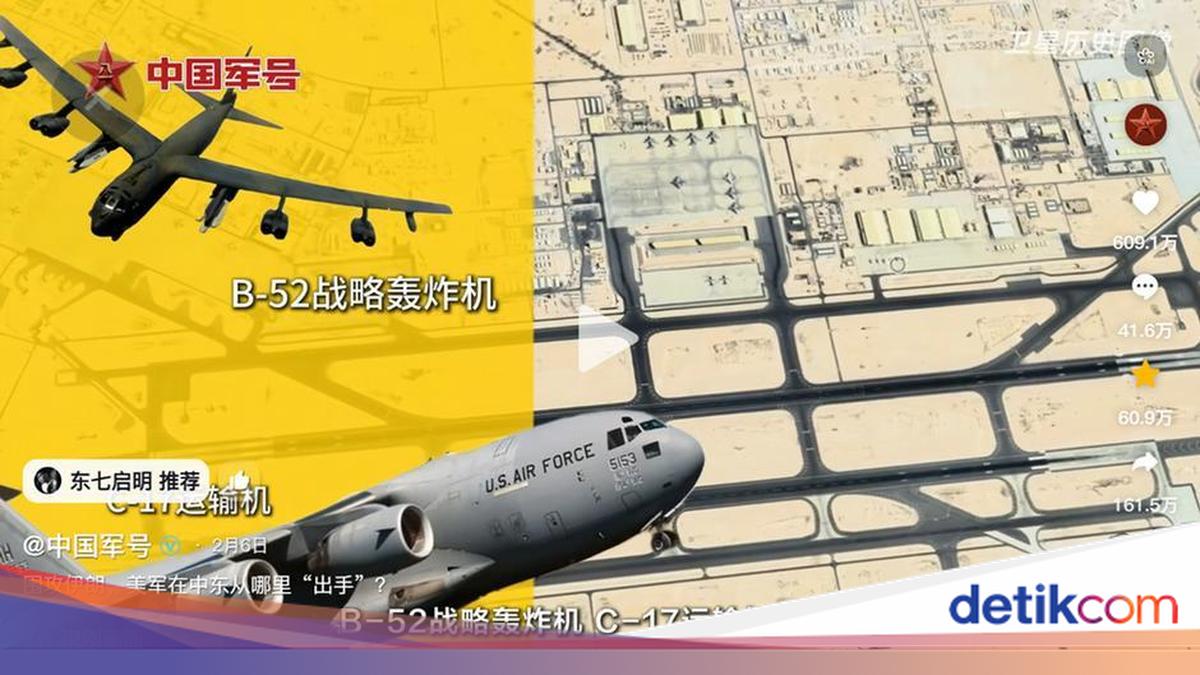
The official Douyin account of the Chinese military also published a video using high-resolution satellite imagery to analyse in detail the US troop deployments in the Gulf. The post received over 6 million likes, indicating strong enthusiasm among Chinese society to learn about US military tactics and strategies.
Alicja Bachulska, a China analyst at the European Council on Foreign Relations, told DW that the CCTV AI video marks an evolution in Chinese propaganda by filtering it through the popular wuxia fiction genre.
Bachulska observed that the use of artificial intelligence makes government narratives feel “much more acceptable” and “entertaining” for local audiences compared to dry television coverage. By cleverly leveraging nostalgia for 1980s Hong Kong kung fu films, state media seamlessly inserts geopolitical messages into popular culture.
How China builds its narrative against the US
Furthermore, Figueroa, whose research covers contemporary China-Middle East relations, said that the political calculations behind China’s narrative on the Middle East conflict are part of a broader long-term strategy.
According to him, the Chinese government must continually counter Washington’s accusations that China is a destabilising force.
“This allows them to demonstrate, not only to the world but also to their own people, that China is truly doing well, progressing steadily, and is a force for stability,” he said.
Bachulska added that Chinese political elites view the world through the lens of existential competition.
“All global developments… are filtered through the prism of how China can leverage them to strengthen the narrative that the US is a neo-imperial power and an actor that has lost credibility,” she said.
Ultimately, Beijing proudly offers its own geopolitical solutions to the global chaos it highlights with enthusiasm.
The short animated film of the “cat and eagle” concludes with a Chinese martial arts proverb: “The highest essence of martial arts does not lie in the use of weapons, but in efforts to stop violence.”
When shrewd merchants successfully bypass the white eagle’s trade blockade, the video subtly promotes China’s Belt and Road Initiative (BRI) as the main path to escape US economic hegemony.