
Houthis Officially Aid Iran: Will the Hormuz Blockade Extend to Bab al-Mandeb?
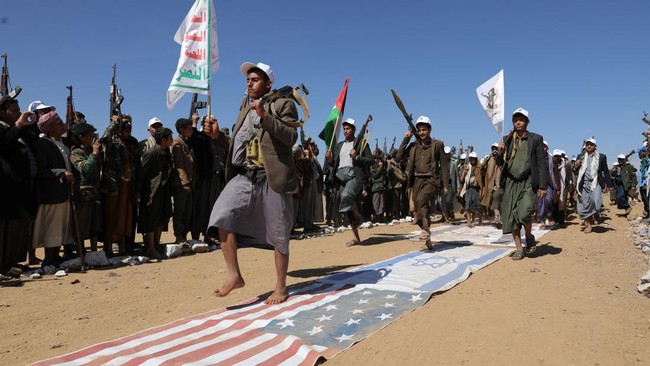
Jakarta, CNBC Indonesia - The official involvement of Yemen’s Houthi group in the Iran conflict has triggered alarm bells for global maritime trade. The world’s attention is now focused on the Bab al-Mandeb Strait, where this pro-Tehran group threatens to completely close access to the Red Sea, following Iran’s move to paralyse the Strait of Hormuz.
If both of these vital routes are paralysed simultaneously, the impact on international logistics flows would be utterly devastating. This situation proves Napoleon Bonaparte’s adage that a country’s policy is greatly determined by its geography, given Yemen’s strategic position capable of severing the world’s economic lifeline.
The Houthis are a Shia group that has controlled much of Yemen, including the capital, since 2014 and is known for its complex military resilience despite frequent counterattacks. In August 2025, Israel succeeded in killing the Houthi prime minister, chief of staff, and several cabinet ministers in a single intelligence strike, but to date, Israel has never managed to locate the movement’s supreme leader, Abdul Malik Al-Houthi.
Although UN reports indicate that much of their weaponry is supplied from Tehran, the Houthis had previously never fought directly on behalf of Iran. Since Monday (30/03/2026), the situation has intensified after the ceasefire with the United States (US), mediated by Oman since May 2025, began to be threatened amid rising tensions in the region.
That ceasefire had previously emerged due to significant damage suffered by the Houthis from repeated US and UK strikes on their missile launchers. Nevertheless, the Houthi side has always emphasised that the agreement does not apply to Israel, so some attacks have continued thereafter.
The push for the ceasefire in early 2025 was actually part of Iran’s desire to build political momentum ahead of nuclear talks with the US. Even the Houthis temporarily extended the ceasefire to Israel in October 2025 when Israel agreed to a ceasefire with Hamas in Gaza, but that calm is now on the brink.
Due to this uncertainty, major shipping companies like Maersk are only slowly resuming passage through the Red Sea. Many of them still opt for the alternative route around the Cape of Good Hope, which is much longer and far more expensive than passing through the highly vulnerable Bab al-Mandeb Strait to drone, missile, and small boat attacks by the Houthis.
Middle East specialist from the London-based think tank Chatham House, Farea Al-Muslimi, has issued a stark warning regarding the potential economic paralysis from this conflict.
“Any sustained disruption will raise shipping costs, increase oil prices, and add further pressure to an already fragile global economy due to the situation in the Strait of Hormuz,” said Al-Muslimi, quoted by The Guardian on Monday (30/3/2026).
Al-Muslimi also predicts that Iran’s broader strategy to activate allied groups across the region is beginning to unfold. Over time, domestic perceptions in Yemen that the Houthis are too subservient to Iran’s interests are expected to grow and strengthen.
On the other hand, the Houthis are likely still acting cautiously as they await financial rewards from Saudi Arabia. Currently, Saudi Arabia holds sole control over Yemen’s future after the United Arab Emirates withdrew from the area, a heavy burden that requires Riyadh to reach agreements with various factions, including the Houthis, to minimise threats in the Red Sea.
Saudi Arabia continues to pour massive funds into the new government in the southern region, while the Houthis in the north likely want a share of that funding flow in exchange for not continuing the fighting or disrupting shipping. However, the Houthis’ true strength lies in their ability to intercept commercial vessels rather than merely firing missiles at Israel.
This tension also threatens Yemen’s peace efforts, which have been embroiled in civil war for over a decade. This escalation is feared to drag the country into a broader regional conflict and worsen civilian suffering.
The UN Special Envoy for Yemen, Hans Grundberg, expressed deep concern over the current developments.
“This escalation threatens to drag Yemen into a regional war, which would make resolving the conflict in Yemen more difficult, deepen its economic impacts, and prolong civilian suffering,” Grundberg concluded.