
Hopes Are High for Next Phase of Bali Uluwatu Sea Wall Project to Start by Tourist High Season
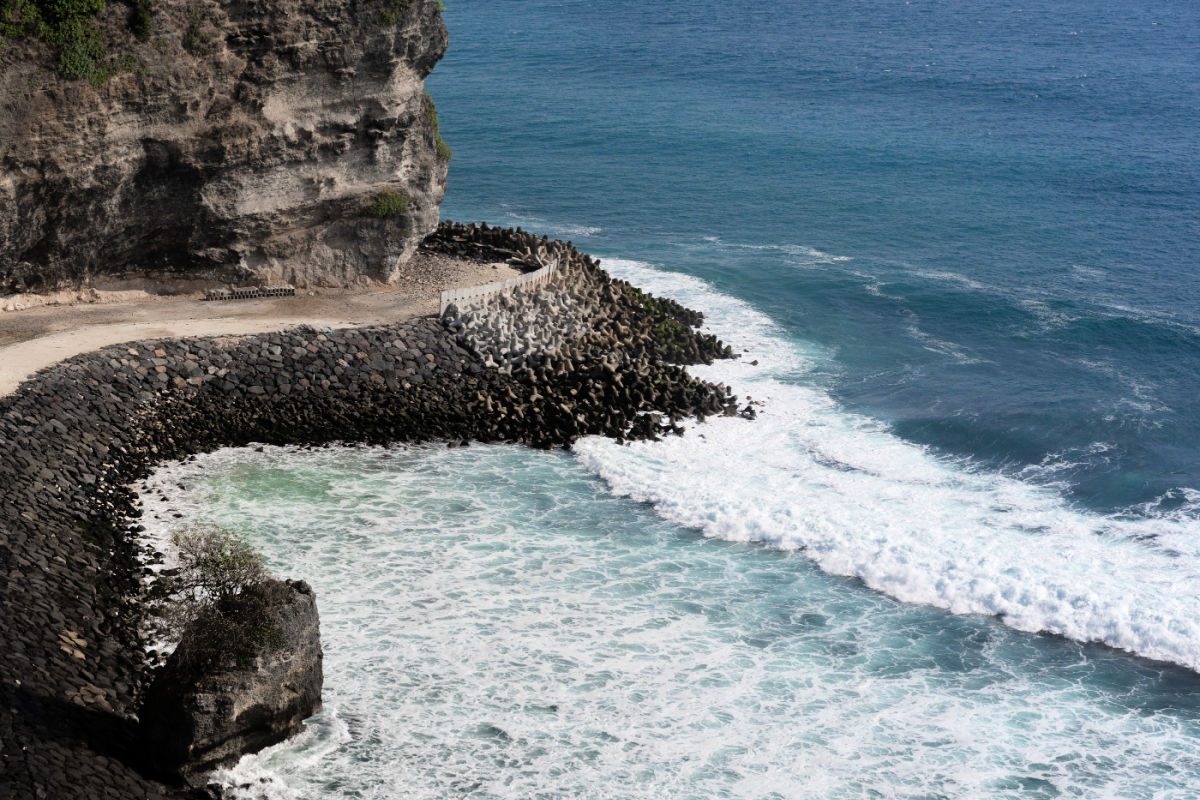
The Uluwatu Sea Wall project has been one of the most contentious infrastructure projects in Bali in recent years.
The project was initially presented to the public as an initiative to stabilise the limestone cliff against cracking and erosion, though there has been speculation that the access road created for the crack-stabilisation work will later be used for tourism development projects.
The Uluwatu Sea Wall project has caught the attention of local residents and us here at The Bali Sun once again this week, as concerns have been raised over erosion and damage to the newly built sea wall structures, as well as substantial new cracks in the limestone cliff.
The site in question sits just metres from the iconic Pura Luhur Uluwatu, also known simply as Uluwatu Temple. The site is of high spiritual significance to Balinese Hindus as one of the island’s few ocean temples, and welcomes millions of visitors every year.
The development team reported that the first phase of the project was completed last year, though not without controversy. Local residents raised legal complaints that the project had been permitted to start without a formal AMDAL, or environmental impact assessment, being completed.
The conclusion to the case was that the government was allowed to start work on the access road to the sea wall development site without completing an AMDAL on the grounds that the work was an emergency situation. However, many local residents argued that the cracks in the cliff had first been recorded more than 20 years ago and had not worsened since.
In response to the speculated damage to the sea wall project, Pecatu Traditional Village Head, I Made Sumerta, told reporters, “Yes, it was hit by a storm. Some parts collapsed. The boundary wall also collapsed first due to the extreme weather. It probably collapsed a few months ago due to the large waves there. It collapsed after the Mulang Pakelem ceremony there.”
He shared his hopes that in the long run, the project will secure the cliffside and, in turn, the temple above. He explained, “Given these conditions, we can evaluate and improve them to make them taller and more solid. Because this is a real-life lesson, we’re asking for improvements and evaluations, especially the lower part of the temple.”
Sumerta concluded, “I hope this is completed. If it’s stopped now, it will give the impression of inadequate planning. This is to protect the cliffs, so hopefully, it will be refined, or something like that, and we need to review the existing situation on the ground.”
Speaking to reporters this week in the wake of a wave of dialogue on social media regarding the sea wall. The Acting Head of the Badung Regency Public Works and Public Housing Agency, Anak Agung Rama Putra, explained that the photos circulating online are not of concern since the apparent damage is not affecting the seawall, as it was left at the end of the previous phase of the project.
According to Putra, the structure appears to be disintegrating because the limestone fill has not been coated with protective materials and is, as such, being hit by the tides. He confirmed that his team is monitoring the area through CCTV cameras around the project site.
Putra told reporters that the project is far from being abandoned and that there is work happening behind the scenes. He explained, “That’s not the final structure, and we haven’t finished it yet. So it looks like it’s decomposing. It’s still just limestone fill.”
He confirmed that the next and final stages of construction will begin in 2026, with the installation of armor stone and limestone layers to strengthen the coastal protection structure. He noted, “The finishing layer will be implemented in 2026 using armour stone and limestone. There’s no damage to the previously finished sections.”
He confirmed the stages of the project have been and will be carried out strategically. First, the protective stone will be coated with limestone to reinforce the structure. He added that the stone structure already installed has also helped reduce the force of the waves.
Putra explained that without the coastal protection structure, the cliffs of Uluwatu Temple would have to withstand the direct impact of large waves from the open sea over time. “Without the revetment structure, the cliffs of Uluwatu Temple would have to withstand the direct impact of the open sea waves.”
Though he asked the public to be patient while awaiting the process, which will continue this year. “The 2026 work on the Pura Luhur Uluwatu coastal protection structure has entered the tender process.” There are hopes that this will result in the next phase of the project starting by the high season, though the tender process is frequently a time-consuming one that has halted many other major projects across Bali over the years.
Remove All Ads & Unlock All Articles… Sign up for The Bali Sun Premium
Plan Your Bali Holiday:
Book The Best English Speaking Drivers For Airport Transfers & Tours
Choose From Thousands of Bali Hotels, Resorts, and Hostels with Free Cancellation On Most Properties
Book Cheap Flights To Bali
Don’t Forget Travel Insurance That Covers Medical Expenses In Bali
For the latest Bali News & Debate Join our Facebook Community
SUBSCRIBE TO NEW POSTS
Enter your email address to subscribe to The Bali Sun’s latest breaking news, straight to your inbox.
Discover more from The Bali Sun
Subscribe to get the latest posts sent to your email.