
HNW: Muhammadiyah Presents Various Positive Ijtihad for the Nation
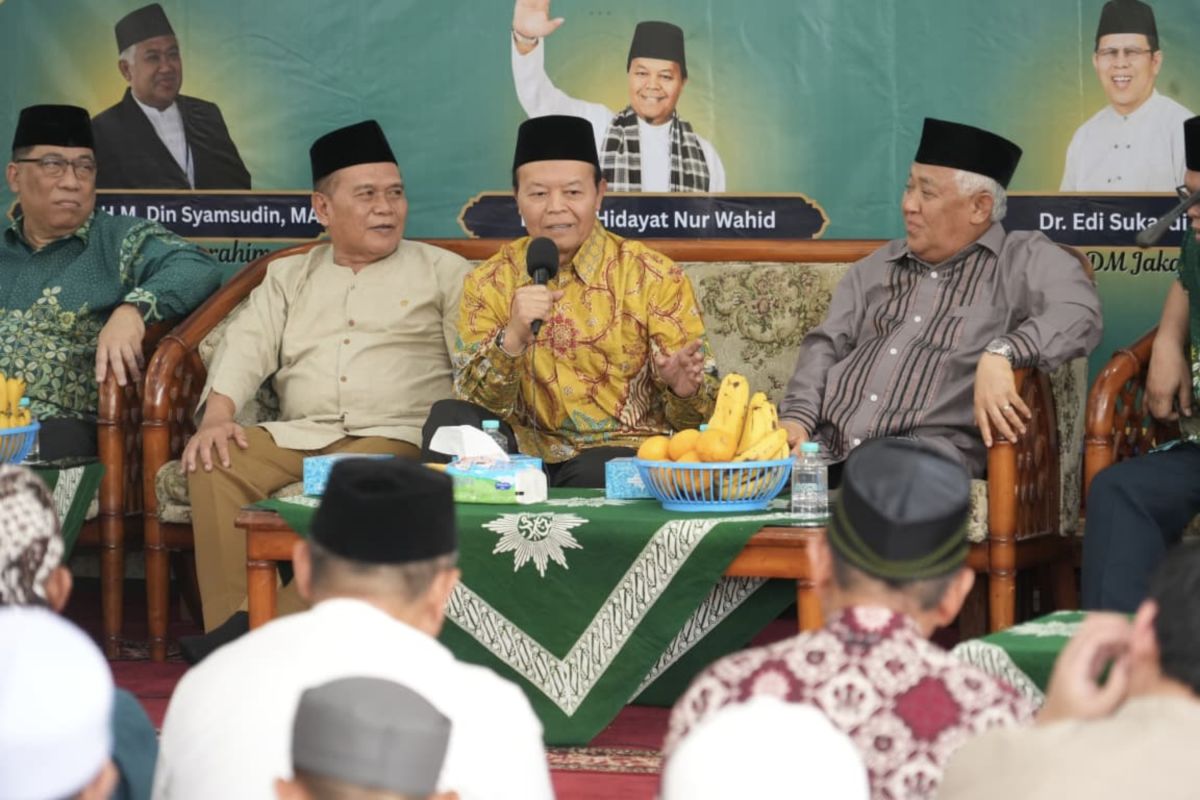
Jakarta (ANTARA) - Deputy Speaker of the People’s Consultative Assembly (MPR) RI and Member of Commission VIII of the House of Representatives (DPR) RI, Hidayat Nur Wahid, revealed that the Halal bi Halal tradition, now an accepted and inseparable part of Indonesian society, has historical roots stemming from the legacy of ijtihad within Muhammadiyah circles.
HNW, the familiar name for Hidayat Nur Wahid, mentioned that the term Halal bi Halal was initially popularised by Rahmad, a Muhammadiyah member from Gombong, Central Java, who wrote about it in the Soeara Moehammadijah magazine, issue 5 of 1924, in a special column facilitating readers to express apologies and build silaturahmi through the mass media, using the term “Alal Bihalal”.
Then, in Eid al-Fitr of 1926, the Soeara Moehammadijah magazine featured advertisements related to the now-popular term Halal bil Halal.
“Thus, the tradition known as ‘Halal bi Halal’ today is inseparable from the role of Muhammadiyah members in popularising the term in the life of the ummah, as part of efforts to present an enlightening Islam and strengthen brotherhood,” said Hidayat in his statement in Jakarta on Sunday.
He conveyed this during the Eid al-Fitr 1447H Silaturahim event with the Muhammadiyah Regional Board (PD) of South Jakarta.
Hidayat, who is also an advisor to the PD Muhammadiyah of South Jakarta, added that in its historical journey, specifically in 1948, the term Halal bi Halal was then adopted in a national context.
KH Wahab Hasbullah in 1948 responded to President Soekarno’s request to hold an event that would attract the presence of national figures beyond the term Silaturahim.
Wahab proposed to President Soekarno to use the term Halal bi Halal to bring together and reconcile national figures who were then experiencing political tensions. President Soekarno accepted it, and thus was born a tradition that applies in the state palace in particular and in Indonesia.
“The Halal bi Halal momentum in the early days of independence became a strategic means to strengthen unity against the colonial Dutch divide et impera politics. This shows that Islamic traditions can be accepted, continued, and make a significant contribution to maintaining national integrity and strengthening the bonds of brotherhood among national leaders and fellow citizens,” he said.
According to Hidayat, this year’s Halal bi Halal momentum has a broader meaning, not only as a socio-religious tradition, but also as a means to strengthen collective commitment in facing global problems, including the major annual agenda of the Muslim ummah post-Ramadan, namely the Hajj pilgrimage.
HNW revealed that the commitment to improving Hajj management was also initiated by Muhammadiyah. When KH A Dahlan demanded improvements in Hajj organisation with the Hajj Ordinance, he then formed the Hajj Assistance Section in 1922, which was directly led by KH M Sudja.
In addition, Hidayat also invited Muslims to make the Halal bi Halal momentum a means to strengthen solidarity with the struggle of the Palestinian people, as well as to save the Al-Aqsa Mosque. This stance, in the Indonesian context, was actually pioneered by a young Muhammadiyah cadre who later became the Father of the Nation and National Hero, Abdul Kahar Mudzakkir.
In 1931, Abdul Kahar Mudzakkir was only 24 years old, but he was trusted by the Mufti of Jerusalem, al-Sayyid M Al Amin al-Husaini, to advocate for Palestine and the Al-Aqsa Mosque at the World Islamic Conference in Al-Quds, where Kahar Mudzakkir was even trusted to be the Katib/Secretary.
“At this time, Palestine (Gaza, West Bank) is not getting more peaceful, not better, but even with the Israel-US war against Iran, their condition is getting worse. Peace is getting further away,” said Hidayat.
Moreover, when the Israeli military closed the Al-Aqsa Mosque since the beginning of the Israel-US war with Iran. This incident is the first time since the occupation of the Al-Quds area in 1967 by Israel, for the first time Tarawih prayers, I’tikaf, Friday prayers, and Eid al-Fitr prayers were prohibited from being held at the Al-Aqsa Mosque. And this closure is still ongoing until the month of Shawwal, until 15 April 2026.
If there is no strong global solidarity and effective pressure from international institutions, the closure of the Al-Aqsa Mosque could become permanent, even the first qibla mosque of the Muslim ummah could be demolished and replaced with the Solomon Temple, in line with the Zionist programme to realise the claim of Greater Israel. And if that happens, the aspiration to establish a Palestinian state will be in vain because it cannot be realised.
“Therefore, Halal bi Halal must also become a momentum for the Muslim ummah to return to its fitrah by strengthening solidarity for the Al-Aqsa Mosque and Indonesia’s support for saving the Al-Aqsa Mosque and Palestinian independence, continuing what was once fought for by Prof Dr. KH Abdul Kahar Mudzakkir, a young Muhammadiyah cadre, who became a member of BPUPK, the Committee of Nine, and later became the Father of the Nation and National Hero,” said HNW.
Also present at the event were the Chairman of PP Muhammadiyah for 2005-2015, Prof. Din Syamsudin, Rector of UTM Jakarta Prof. Agus Suradika, Chairman of PDM South Jakarta Dr. Edi Sukardi, along with officials and members of Muhammadiyah and Aisyiyah in South Jakarta.