
Hit by MSCI, JCI Plummets 1.81% Back to 6,700 Level
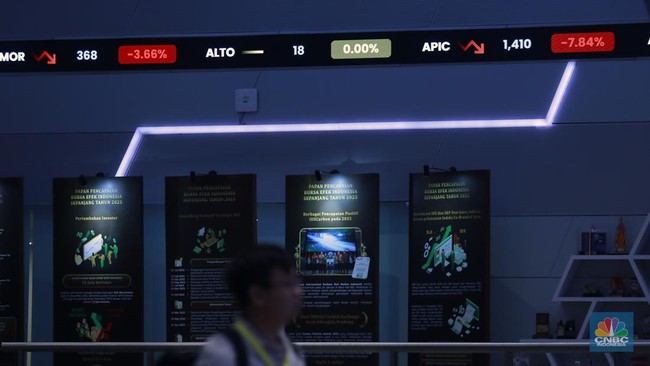
Jakarta, CNBC Indonesia - The Jakarta Composite Index (JCI) fell more than 1% during trading on Wednesday (13/5/2026), as the market reacted negatively to the results of Morgan Stanley Capital International’s (MSCI) index review, which removed several major Indonesian stocks from its global index.
According to data from the Indonesia Stock Exchange (BEI), at the close of the first trading session, the JCI dropped 124.36 points or -1.81% to the level of 6,734.54.
A total of 398 stocks weakened, 262 stocks strengthened, and 150 other stocks were stagnant. The transaction value reached Rp10.28 trillion with a trading volume of 26.13 billion shares in 1.47 million transactions.
The majority of trading sectors weakened, with the deepest corrections recorded in the infrastructure, basic materials, technology, and energy sectors. Meanwhile, only the industrial sector strengthened today.
The greatest pressure on the JCI came from stocks that were removed from the MSCI Global Standard Index and MSCI Global Small Cap Index.
Movers data shows that shares of PT Chandra Asri Pacific Tbk (TPIA) became the biggest dragger on the JCI with a contribution of minus 14.89 index points. Followed by PT Amman Mineral Internasional Tbk (AMMN) which pressured 13.98 index points and PT Dian Swastatika Sentosa Tbk (DSSA) by 10.59 points.
Then PT Barito Renewables Energy Tbk (BREN) pressured the JCI by 11.07 points and PT Petrindo Jaya Kreasi Tbk (CUAN) by 4.2 points.
In terms of share prices, TPIA plunged 14.26%, CUAN dropped 11.11%, AMMN fell 11.30%, DSSA weakened 10.30%, and BREN corrected 8.31%.
Other stocks that were also removed from the MSCI small cap index experienced pressure. PT Bank Aladin Syariah Tbk (BANK) fell 4.71%, PT Midi Utama Indonesia Tbk (MIDI) weakened 7.14%, PT Bumi Serpong Damai Tbk (BSDE) dropped 3.29%, and PT Astra Agro Lestari Tbk (AALI) corrected 5.26%.
Previously, MSCI officially removed six Indonesian stocks from the MSCI Global Standard Index, namely:
PT Amman Mineral Internasional Tbk (AMMN)
PT Barito Renewables Energy Tbk (BREN)
PT Chandra Asri Pacific Tbk (TPIA)
PT Dian Swastatika Sentosa Tbk (DSSA)
PT Petrindo Jaya Kreasi Tbk (CUAN)
PT Sumber Alfaria Trijaya Tbk (AMRT)
In addition, MSCI also removed 13 Indonesian stocks from the MSCI Global Small Cap Index.
CGS International Sekuritas Indonesia previously estimated that this MSCI rebalancing could trigger passive outflows of up to US$1.8 billion or approximately Rp31.49 trillion. All these changes will take effect at the close of trading on 29 May 2026.
The good news is that MSCI maintained Indonesia in the emerging markets group. As is known, MSCI had previously opened the possibility of reclassifying Indonesia’s status from emerging markets to frontier markets.
In the announcement on Tuesday (12/5/2026) US time, Indonesia remains categorised in the emerging markets list along with other countries such as China, India, Korea, Malaysia, the Philippines, Taiwan, and Thailand.
On the other hand, Asian stock market movements were mixed. The Taiwan index was the most pressured with a 1.02% correction, followed by the SGX-CNBC China Growth index down 0.71% and Shenzhen weakening 0.43%.
The ASX 200 Australia index fell 0.23%, Hang Seng Hong Kong weakened 0.16%, and Shanghai Composite corrected 0.14%.
In contrast, the Kospi South Korea index strengthened 1.2%, while the STI Singapore rose 0.61% and Nikkei Japan strengthened 0.32%.
In other developments, US President Donald Trump stated that he does not need assistance from Chinese President Xi Jinping to end the war with Iran, although the chances of achieving peace are increasingly slim.
Trump said the US will resolve the conflict “peacefully or otherwise.” The war has disrupted shipping routes in the Strait of Hormuz, which normally carries around 20% of the world’s oil supply.
Meanwhile, Iran is strengthening its control over the Strait of Hormuz by cooperating with Iraq and Pakistan to channel oil and LNG. Other countries are also reportedly considering similar steps.
Trump is scheduled to discuss this conflict with Xi Jinping this week. Washington demands that Iran halt its nuclear programme and reopen the Strait of Hormuz, while Tehran demands war compensation, lifting of sanctions, and an end to conflicts across the region.