
History Speaks: The US Has Not Succeeded in Land Wars, Does Trump Want to Repeat?
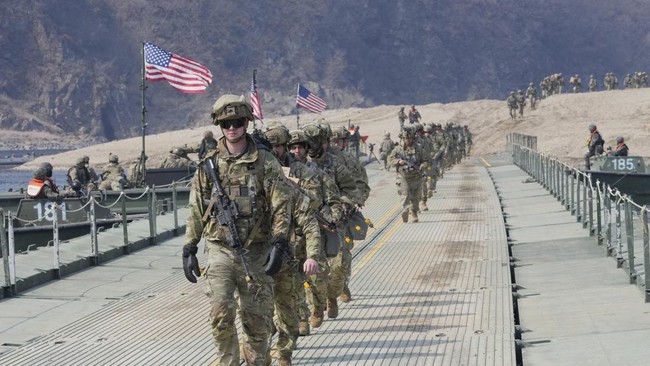
History Speaks: The US Has Not Succeeded in Land Wars, Does Trump Want to Repeat?
Jakarta, CNBC Indonesia - The United States (US) is once again on the brink of a major military decision. Amid limited options to reopen the Strait of Hormuz, President Donald Trump has deployed thousands of troops to the Gulf region and begun discussing the possibility of an invasion of strategic Iranian territory. History records that such steps often lead to prolonged conflicts.
According to The Economist, land wars in Asia over the past several decades have been costly experiences for the United States. Conflicts in Vietnam, Iraq, and Afghanistan lasted far longer than initial planning and drained resources on a massive scale.
Now, a similar pattern could re-emerge in Iran.
The focus of operations is directed towards Kharg Island, a vital point that holds around 90% of Iran’s oil exports. Militarily, the island could be seized by marines and airborne forces in a relatively short time. However, initial success would open a new, more complex phase.
Halting Iran’s oil exports from Kharg would directly impact the global energy market. Iran’s current production is in the range of 2.4 million to 2.8 million barrels per day. Disruption to this volume could drive up energy prices and pressure the global economy.
Operations would not stop at one point. To fully close export routes, the United States would need to extend control to other terminals such as Jask, Lavan, and Sirri. Each additional territory increases logistical needs, protection, and operation duration.
Troops stationed on Kharg would be within direct range of Iran’s military systems. Air and sea supply lines would be open to attack. In recent weeks, some Iranian attacks have successfully penetrated defences, including destroying a US E-3 Sentry airborne radar aircraft in Saudi Arabia. The intensity of drone and missile attacks is expected to increase if occupation persists.
Other options discussed include seizing small islands such as Abu Musa, as well as Greater and Lesser Tunb, up to limited strikes on mainland Iran. Such operations would still require long-term presence to have significant impact. Troop needs and protection remain high.
The political dimension is an important variable. The Iranian government has greater tolerance for pressure. Oil revenues are the main source, but the repressive power structure allows domestic unrest risks to be managed over a long period. In contrast, the US government faces electoral pressure with midterm elections in eight months.
Previous experience shows patterns of indirect attacks. The Islamic Revolutionary Guard Corps has used roadside bombs to target US forces in Iraq. Similar tactics could be employed again on a larger scale.
Another emerging scenario is an operation to seize around 400 kg of enriched uranium. The main target is in Isfahan, with additional locations in Natanz and Fordow. All three facilities have underground protection. Simultaneous operations at multiple sites would require coordination and military capacity on a very large scale.
Pressure is also evident in the overall readiness of the US military. More than 850 Tomahawk missiles have been used, a number exceeding usage during the 2003 Iraq invasion and equivalent to about one-third of the global stock available. The naval fleet faces high operational pressure that could worsen maintenance issues.
The impacts extend to other regions. US and allied military planners in the Pacific are beginning to account for risks of reduced readiness against potential conflicts in that area.
Iran’s Geography: Real Barriers on Land
A factor often overlooked in military operation calculations is Iran’s geography itself. The country stands on a vast highland known as the Iranian Plateau, with a harsh landscape dominated by mountains such as the Zagros Mountains in the west and the Elburz Mountains in the north.
Many peaks are in the range of 3,000 to 4,000 metres, with limited access routes and narrow valleys that slow large-scale troop movements.
This natural structure forms direct barriers to conventional land operations. Tank movements, logistics, and supplies become slower and easier to detect.
On the other hand, central Iran is filled with vast deserts like Dasht-e Kavir and Dasht-e Lut with extreme temperatures, sandstorms, and water limitations. Troop movement routes become even narrower and open opportunities for ambushes, especially against long supply chains.
These conditions amplify the operational burden already complex at points like Kharg Island. Any expansion of operations to the mainland would directly confront terrain that slows the pace of war and increases troop exposure. In such situations, conflict duration tends to widen, logistical needs increase, and military costs rise over time.
This situation places the United States at a crucial juncture. Military operations with limited targets could evolve into long-term engagements with high costs and uncertain outcomes.