
History of Party Mergers Amid NasDem-Gerindra Political Bloc Issues
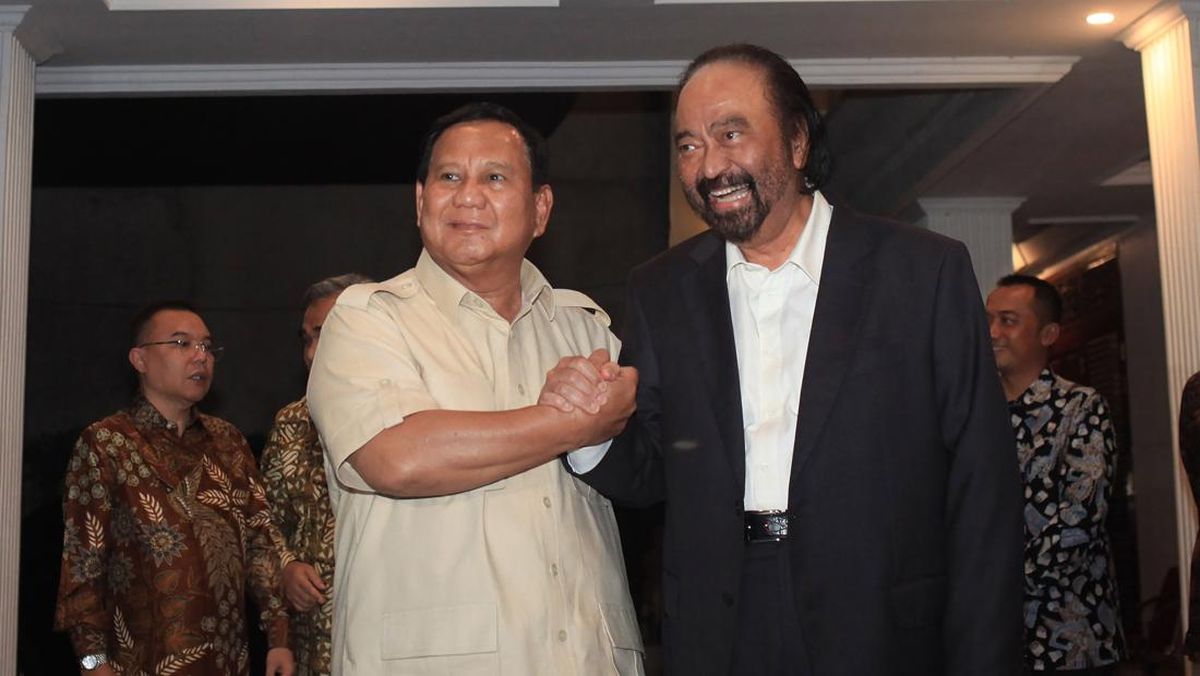
The idea of merging the NasDem Party with Gerindra into a single party appears serious and opens the possibility of creating a new political bloc in Indonesia.
Several NasDem elites did not deny the rumour, although they rejected the use of the term merger. NasDem Deputy Chairman Willy Aditya emphasised that NasDem General Chairman Surya Paloh only proposed a political block.
“Well, what Surya Paloh proposed is a Political Block. A political bloc, not a merger,” Willy said at the parliamentary complex on Monday (13/4).
According to Willy, a political bloc is an effort to unite a vision and ideals into one breath. The cooperation is not carried out transactionally.
He stated that Indonesia has so far only known the term coalition. However, coalitions are only used in the candidate nomination process and not in government because Indonesia adheres to a presidential system.
Nevertheless, Willy has not explained the details of the plan to merge his party with Gerindra.
History of the National Front Political Bloc
Willy added that Indonesia has a history of party mergers when Islamic parties were unified into the United Development Party (PPP) and nationalists into the Indonesian Democratic Party (PDI).
An example of a political bloc can also be seen from the Functional Groups (Golkar), which was formed through the Joint Secretariat between three organisations, namely the All-Purpose Cooperative Unit (Kosgoro), the Independent Labour Organisation Centre of Indonesia (SOKSI), and the Family Deliberation for Mutual Cooperation (MKGR).
President Sukarno also implemented a Political Block through the National Front decree. This means, according to Willy, Indonesia has two histories of political blocs.
“One was when Bung Karno issued the decree called the National Front, named Nasakom [Nationalism, Religion, and Communism]. The second is Golkar, which was previously Sekber Golkar. That is a Political Block,” Willy said.
The formation of the National Front by Sukarno was enshrined in Presidential Regulation No. 13 of 1959 on 31 December 1959. Article 2 of the regulation mentioned three objectives of the National Front: to complete the Indonesian revolution; comprehensive development to achieve a just and prosperous society; and third, to return West Irian to the Unitary Republic of Indonesia.
However, beyond that, the National Front was also used by Sukarno to unite three elements of strength, namely nationalists, religious communists, or abbreviated as Nasakom.
These three elements represented several organisations. The nationalist group consisted of PNI and Murba, the religious group represented NU to the Muslimin Party, and the Communists represented the Indonesian Communist Party (PKI).
Nevertheless, the National Front faced several serious problems after its formation. Rex Mortimer in his book, ‘Indonesian Communism Under Sukarno: Ideology and Politics, 1959-1965’ (1974), described the National Front in its journey as becoming a battleground for PKI and military power.
As a result, the organisation failed to become a neutral container for all ideological elements and organisations within it. The impact was that these problems culminated in a legitimacy crisis for the National Front, which the military used to form Sekber Golkar (1964) as a counter, and accelerated the collapse of Guided Democracy.
Later, Sekber Golkar grew stronger at the beginning of the New Order government under Soeharto as one of the founders.
History of the 1973 Party Merger
After Sukarno stepped down in 1967, Indonesia also recorded the largest political unification history known as the party merger in 1973 shortly after the 1971 election.
At that time, nine parties outside Golkar, which represented military strength, were merged into two parties, namely PPP and PDI.
PPP was formed by the New Order to unite four Islamic parties, namely NU, Indonesian Muslim Brotherhood (Parmusi), Indonesian Islamic Association Party (PSII), and Islamic Education Union (Perti).
Meanwhile, PDI was a merger of five parties, namely PNI, Parkindo, Catholic Party, Murba, and IPKI.
Salim Said in his book Party Golkar and the Pancasila Political System (LP3ES, 1978) described the 1973 party merger as a New Order strategy to strengthen Golkar’s dominance. The party merger was triggered by the results of the 1971 election, which assessed that the existence of nine parties indicated political instability.
Said criticised the party merger as a New Order political engineering to eliminate or minimise opposition forces and make Golkar the main force of the New Order.
“The political party merger in 1973 was a systematic engineering of the New Order to simplify the party system from nine to three pillars, with Golkar as the dominant force outside the formal merger, ensuring stability through Pancasila ideological control,” Said wrote.