
History of Labour Day: From Deadly Tragedies to Worker Exploitation
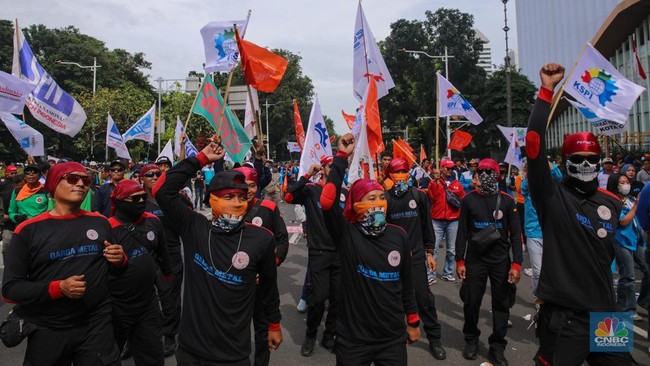
Jakarta, CNBC Indonesia - Nearly the entire world commemorates 1 May as International Labour Day or May Day. The commemoration of Labour Day is also designated as a national holiday.
Today is observed worldwide to honour workers’ struggles for fair rights and decent working protections. There is a long history regarding Labour Day.
Before the 19th century, the term May Day referred to celebrations marking the change of seasons to spring in the United States. May Day is also known as International Workers’ Day to celebrate workers’ rights and an eight-hour workday in the United States.
At that time, working conditions in the United States were extremely poor, especially in the industrial sector. Workers were required to work 16 hours a day for very low wages. These workers also laboured without adequate health and safety guarantees.
In 1886, a workers’ movement began to develop in the United States advocating for workers’ rights.
This movement sought to campaign for an eight-hour workday. On 1 May 1886, thousands of workers across the United States went on strike to fight for their rights.
At that time, three labour organisations coordinated the protests: Knights of Labor, Federation of Organized Trades and Labor Unions, and International Workingmen’s Association, also known as the First International.
Over the following days, demonstrations and strikes spread across the United States, including major cities like Chicago, New York, and Boston. On 3 May 1886, clashes between police and demonstrators erupted in Chicago. This event later became known as the Haymarket Tragedy.
Four demonstrators and seven police officers died in the clashes. Following the incident, many workers and labour rights activists were arrested and imprisoned.
The history of Labour Day continued in 1889, when an international conference in Paris was held to commemorate workers’ struggles and advocate for their rights.
The conference called for international commemorations every 1 May as International Labour Day.
The history of May Day as a labour day was born from an international federation; a socialist group and labour unions designated 1 May as a day to support workers, in remembrance of the Haymarket Riot in Chicago in 1886.
In the 20th century, the 1 May holiday received official endorsement from the Soviet Union and was celebrated as International Workers’ Solidarity Day, particularly in several Communist countries.
However, the United States does not celebrate Labour Day on 1 May, but on the first Monday in September (1 May is Loyalty Day, an official holiday but not widely recognised in the United States).
There are several opinions stating that the reason is to avoid commemorating the riots that occurred in 1886, as cited by Office Holidays.
Since then, International Labour Day has been observed worldwide as a day of workers’ struggles for fair and decent rights in the workplace. In addition, International Labour Day has become a symbol of the fight for independence, democracy, and equality around the world.
In Indonesia itself, International Labour Day was first celebrated on 1 May 1920, when labour unions and workers held protest actions and strikes to fight for their rights.
The history of Labour Day in Indonesia began when the country was still under Dutch rule, and working conditions for workers in the plantation and industrial sectors were extremely poor.
During the Dutch occupation, workers and labour unions often faced exploitation and oppression by Dutch employers.
Inhumane working conditions, low wages, and the absence of health and safety guarantees prompted workers and labour unions to feel the need to fight for their rights.
The commemoration of Labour Day was temporarily halted from being observed openly during President Suharto’s leadership because it was deemed synonymous with communist ideology.
Bursts of protests from the working class e