
Historical Call: Hundreds of CSOs, Activists and Intellectuals Convene 'Republic Conference' at UGM
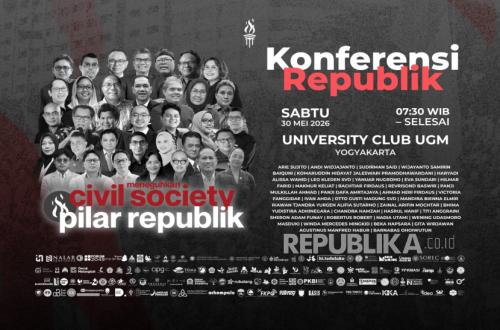
Hundreds of civil society organisations, activists, academics, and intellectual figures from across the nation will gather at Universitas Gadjah Mada (UGM) in Yogyakarta on Saturday, 30 May 2026, for the Republic Conference: Strengthening Civil Society as a Pillar of the Republic.
The conference serves as a national consolidation of civil society elements, providing a space for reflection on ideas scattered across various movements. These will be brought together, clarified, and transformed into an organised collective will.
Sudirman Said, Chairperson of the Republic Conference Committee, emphasised the historical significance of the gathering. ‘This forum continues the historical call. The Republic’s existence was driven by civil society long before the state emerged. Thus, the strength of civil society must be re-established as a pivotal force actively contributing to the Republic’s fate,’ he stated in a comment cited on Saturday (30/5/2026).
History shows, Sudirman added, that civil society, largely led by enlightened intellectuals, has always been at the forefront for the people and societal change, even as the main force driving independence. Their emergence was an unintended consequence of the Ethical Policy. Moreover, they were a tiny minority among a largely illiterate Indonesian population at the time.
Their contribution was not just as enlightening agents, but more importantly, through self-sacrifice and concrete exemplary actions. Sudirman explained that it was thanks to civil society movements that the nation has consistently advanced, with milestones resembling a ‘20-year cycle’.
‘Let us reflect. It began with ’Nation-Building’ (1908), followed by ‘Unity’ (1928), then ‘Independence’ (1945), ‘Development’ (1966), and finally ‘Democracy’ (1998). After ‘Democracy’, the nation should have advanced further. The question is, are we currently moving up a level?’
Yanuar Nugroho, Secretary-General of the Committee, reminded that today’s challenges demand a different approach from the 1998 Reform era. ‘Previously, we united against what we did not want. Today, we face oligarchies operating through laws, regulations, and narrative control — far more subtle,’ he said.
Civil society, he noted, must start thinking about infrastructure to connect various groups so they know, understand, and act together. The Republic has no shortage of concerned citizens but needs connectors to unite them.
The Republic Conference was designed within this framework. The one-day event at UGM will open with an inaugural address by UGM Vice-Rector Arie Sujito, followed by a keynote speech from Professor Komaruddin Hidayat.
As Chairman of the Press Council, he will lay the groundwork for views on the relationship between civil society and power in today’s crisis context. The conference will then proceed to a plenary session discussing four dimensions of crisis simultaneously.
These are: democratic representation crisis, economic inequality and social base erosion, anatomy of strategic institutional weakening, and social fragmentation and public depoliticisation.
Seven parallel panels will then delve into more specific themes: models of institutionalising public participation, national civil society consolidation strategies, economic justice and economic democracy, rule of law and anti-corruption, ecological crisis and growth limits, knowledge democratisation, and active and deliberative citizenship models.
Dozens of speakers are scheduled, hailing from diverse backgrounds: academics, legal practitioners, economists, movement activists, and civil society leaders. Among them are Jaleswari Pramodhawardani (Lab 45), Andi Widjajanto (former Lemhannas Governor), Arie Sujito (Sociologist, UGM’s Faculty of Social and Political Sciences), Father Leo Kleden (IFTK Ledalero), Alissa Wahid (Gusdurian Network).
Others include Professor Zainal Arifin Mochtar (Professor of Constitutional Law, UGM), Bhima Yudhistira (CELIOS), Titi Anggraini (Perludem), Victoria Fanggidae (The Prakarsa), Chandra Hamzah (former KPK Commissioner), and Yanuar Nugroho (Nalar Institute).
The conference will close with remarks from Professor Dr Baiquni (Chair of UGM’s Professors Council) and Gita Wirjawan (Visiting Scholar, Stanford University), who will highlight the importance of building transnational civil society epistemic communities in Southeast Asia.
Conference organisers stressed that the theme ‘Strengthening Civil Society as a Pillar of the Republic’ is not ceremonial. Civil society movements have often stopped at expression and aspiration without converting into decisive decision-making and action.
Therefore, the Republic Conference aims to produce two concrete outcomes: a joint statement on civil society’s role as a Republic pillar, and actionable post-conference steps.