
Higher Education Institutions Must Have Real Impact, Not Merely Administrative Compliance
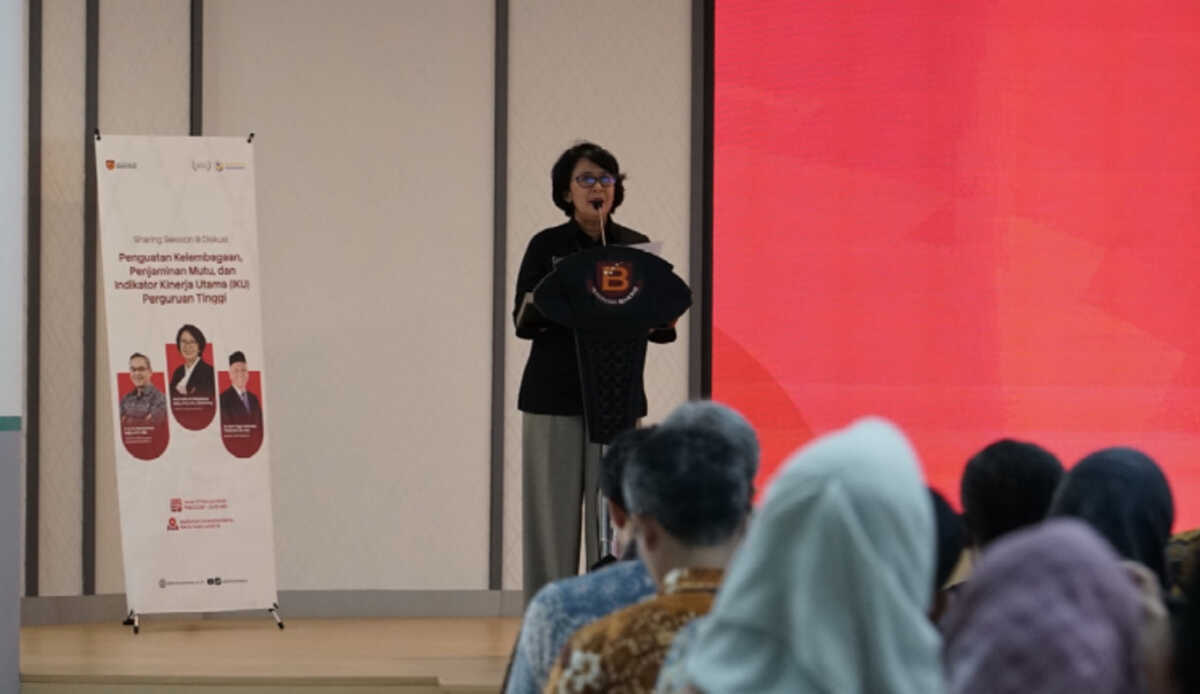
The development of higher education must be focused on the real impact delivered to graduates within society. Higher education institutions are required to be able to implement various innovations and institutional strengthening measures.
Professor Sofia Alisjahbana, Rector of Bakrie University, stated that the current transformation of higher education is not limited to administrative compliance. “Currently, higher education transformation is not just about accreditation and administrative compliance, but about how higher education institutions can deliver real impact,” she said in an official statement on Friday, 27 February 2026.
This was expressed during a Sharing Session and Discussion on Institutional Strengthening, Quality Assurance, and Key Performance Indicators (KPIs) for Higher Education held at Bakrie University Auditorium, Bakrie Tower Level 42 on Friday, 27 February 2026. On this occasion, she stated that institutional strengthening and quality assurance are long-term investments to strengthen competitiveness, whilst ensuring KPIs are built through a measured and sustainable system.
She added that the forum was focused on strengthening impact-based KPI implementation at the institutional level. “Today’s forum is a moment to align vision, strengthen collaboration, and share good practices in impact-based KPI implementation,” she said.
The event featured Muhammad Najib, Director of Institutional Affairs at the Ministry of Higher Education, Science and Technology (Kemdiktisaintek), as well as Henri Togar Hasiholan Tambunan, Head of LLDikti Region III.
Henri Tambunan, Head of LLDikti Region III, emphasised that institutional strengthening must be a priority as it directly influences the quality of higher education governance and performance achievement. “Strong institutions form the foundation of good governance for higher education to develop. KPIs serve as a tool to shift paradigm so that higher education can focus on impact,” Henri said.
Meanwhile, Muhammad Najib emphasised the function of KPIs as an instrument for institutional performance management and a lever for continuous improvement. “KPIs function as a measure of institutional performance, basis for decision-making, accountability instrument, and driver of performance culture,” said Professor Najib. He also stressed the importance of consistent implementation so that performance measurement does not stop at reporting, but becomes a tool for improvement.
During this occasion, issues that frequently emerge in the implementation of internal quality assurance (SPMI) were also discussed, including gaps between documentation and implementation, quality audits that are merely formal, and lack of data integration and linkage between SPMI and KPIs. In this forum, participants also explored steps to strengthen SPMI, including integration of SPMI with strategic planning, digitalisation of documentation and monitoring, risk-based quality audits, involvement of all work units, and performance-based quality incentives.
The forum was designed as a space for policy alignment, sharing practices, and directed discussion to identify strategic issues and formulate relevant recommendations for strengthening governance and quality culture in higher education. As a follow-up, Sofia Alisjahbana stated that she was committed to continuing to open spaces for collaboration and exchange of practices among higher education institutions, particularly regarding institutional strengthening, quality assurance, and impact-oriented KPI implementation.