
High Satisfaction Amid Economic Pressures
In recent months, complaints from the public about the prices of basic necessities have become increasingly common in everyday conversations. From traditional markets to digital spaces, the issue of purchasing power has once again become a major concern. The results of a national survey by Poltracking Indonesia for the March 2026 period are particularly noteworthy.
Amid these economic pressures, the level of public satisfaction with President Prabowo Subianto’s performance is recorded at 74.9%. At the same time, the main issues felt by the public remain related to the high prices of basic necessities (28.5%) and poverty (23.6%).
At first glance, this data appears contradictory. Typically, economic pressures would directly impact a decline in public satisfaction with the government. When food prices rise, job opportunities are limited, and household needs increase, the public usually becomes more critical. However, political reality does not always follow economic logic so simply. This is where we need to read public support more holistically.
Political scientist David Easton distinguishes public support into two forms: specific support and diffuse support. Specific support arises from satisfaction with concrete policies. Meanwhile, diffuse support is based on trust in leaders, institutions, and the belief that conditions will move in a better direction.
Using this framework, the current high satisfaction seems to be largely supported by diffuse support. Parts of the public may not be fully satisfied with everyday economic conditions, but they still believe that the current government is working and has a clear policy direction. In the experience of many countries, such trust often becomes an important asset in the early phase of a government.
Additionally, leadership factors cannot be ignored. Max Weber once explained that political legitimacy often relies on personal authority, namely when a leader is perceived to have certain qualities and is worthy of being followed. In the Indonesian context, President Prabowo appears with an image as a firm, experienced figure who prioritises stability. And in democracy, perception can provide tolerance and delay evaluation, but it cannot eliminate it.
When this Poltracking Indonesia survey was released on 13 April 2026, President Prabowo’s leadership had been in place for 540 days, or about 1 year, 5 months, and 24 days. In running the government, President Prabowo has implemented various priority programmes expected to realise the government’s vision and mission.
On the other hand, global geopolitical tensions have impacts domestically, both directly and indirectly, and the government is required to run a stable administration amid such uncertainty. When the public faces economic anxiety, the need for a sense of security usually intertwines. Leadership characteristics perceived as firm, brave, strong, and the like tend to receive positive responses from the public.
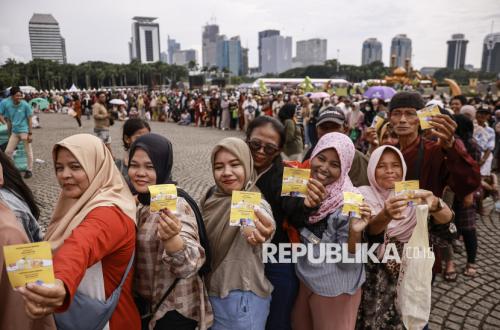
On the other hand, the government also benefits from policies that are easy to recognise and can be felt directly by the public. For example, the Free Nutritious Meals Programme (MBG) has become one of the policies most frequently mentioned by the public as a programme whose benefits are very tangible. Programmes like this are important not only substantively but also psychologically, because the state appears to be present in the public’s daily lives.
Walter Lippmann’s view helps explain this. Lippmann reminds us that the public often judges politics not from the overall complex reality, but from the tangible images present in their minds. Symbols, direct experiences, and simple messages often have a stronger influence than overly complicated technocratic explanations.
Therefore, one concrete and easily understood policy can sometimes have a far greater political impact than a good but abstract technocratic policy in the eyes of the public. In modern politics, work alone is not enough; that work must also be visible and its benefits felt tangibly by the public.
Nevertheless, high satisfaction levels should not be understood as a permanent guarantee, because this public support is dynamic. If issues of food prices, job opportunities, and other social inequalities do not improve, public trust will gradually erode.
Therefore, evaluation of priority programmes becomes very important. The government needs to ensure that every programme is not only good in design but also strong in implementation and effective in communication. Because in many cases, the biggest challenge is not the policy itself, but how that policy can be translated within society.
Of course, President Prabowo’s leadership at this time is still considered to be in a transition period from the previous government, namely President Joko Widodo’s administration. Poltracking Indonesia also recorded in its September 2024 survey release regarding the evaluation of the president’s performance at the end of his term, the public satisfaction level with President Jokowi’s performance was 86.5%. There is a gap of 14.6% compared to the current public satisfaction level with President Prabowo’s performance.
Therefore, the main challenge for the current government is not just maintaining popularity, but converting trust into real achievements. Stability of basic necessity prices, job creation, quality of public services, and certainty of economic direction will be the true measures. Public trust is political capital.