
Hidden Risks Behind 1,000-Degree Waste Incineration in Bali
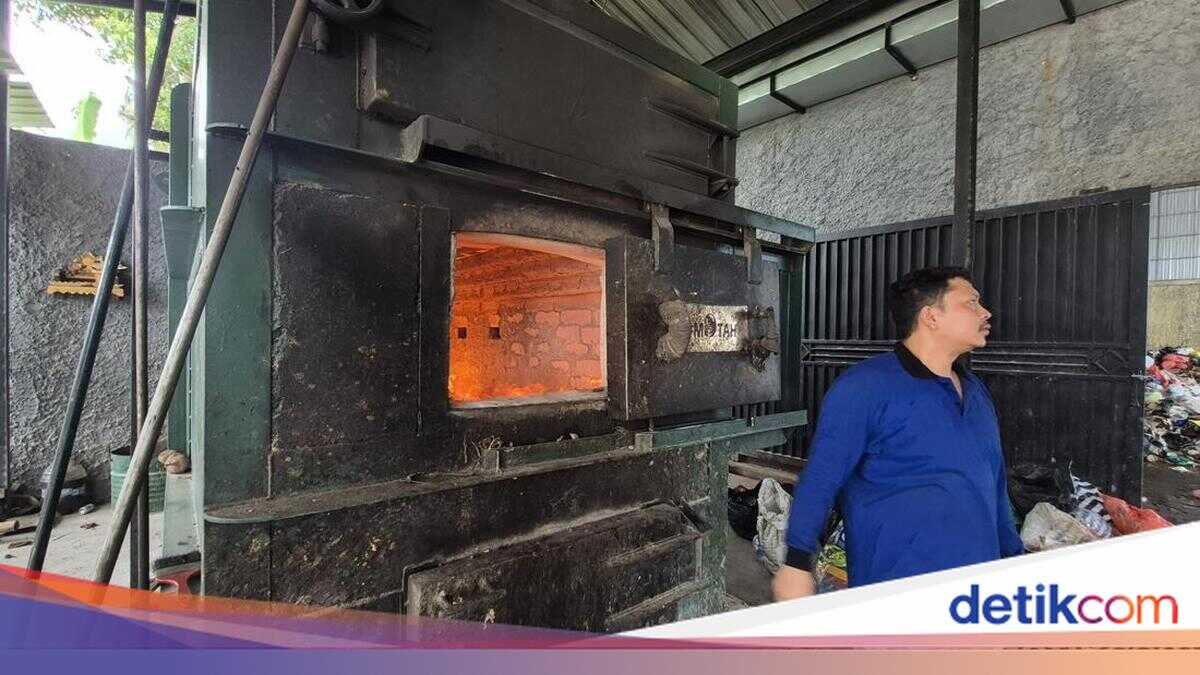
The heat is intense. In the incineration room of the TPST in Desa Kutuh, Badung, the fire is allowed to burn, reportedly reaching 1,000 degrees Celsius.
Outside the room, several women sit in a row with bamboo baskets beside them. They sort mixed waste without masks, only equipped with gloves and boots. A pungent smell seems to be part of the daily air.
Standard safety posters are displayed on the wall. However, a few meters away, incinerator operators work with minimal protection. Gloves are provided. Footwear consists only of flip-flops.
“They should wear complete PPE,” said Wandri, the incinerator operator who accompanied detikBali on a tour on Sunday (December 28, 2025).
There have been accidents. One worker was hit by a spray of hot smoke while routinely checking the burning process every five minutes. His face was affected.
“It was just because he was careless,” said Wandri. The worker has stopped working and returned to Bandung, West Java, although he briefly returned to work after the incident. The medical costs, according to Wandri, were covered by the company.
Inside the furnace, the process begins with wood scraps sent from Nusa Dua. The first two hours are the dry combustion phase to raise the temperature. After that, up to 18 tons of mixed waste per day from one of the villages in Kuta is added. Batteries, lamps, glass bottles, and aerosol packaging are separated because they pose an explosion risk. The rest is burned together. Organic and inorganic materials merge in the fire.
There is no digital thermometer displaying the exact number. Wandri brings his hand close to the furnace mouth to estimate the temperature. “If I can still hold my hand near the furnace, it means it’s not yet 1,000 degrees Celsius. It’s still around 900 degrees Celsius,” he said.
The remaining ash is left over from the fire. In the corner of the sorting room, paving blocks made from processed ash are leaning without a clear distribution plan. The recycling program is hampered by a lack of manpower and the absence of a marketing channel. Meanwhile, on the open land near the machine, what remains is a spread of ash and dry soil.
Wandri mentioned that the ash contains good nutrients. Melon plants once grew there. However, detikBali’s observation on Sunday (December 28, 2025) showed that the land is now barren.
In Linggasana, Smoke Returns to the Ground
At the Linggasana landfill in Karangasem, the story is similar. The incinerator has been operating since January 2025, burning about 15 tons of waste per day.
Wayan Budi, the operator there, said he had received mesh vests and helmets. However, this protection is considered insufficient for the claimed burning temperature of 1,000 degrees.
A request for additional PPE has been submitted. It has not yet been fulfilled. The bamboo baskets used to transport waste are also fragile and are being repaired as best as possible.
“In the morning shift, the task is to remove the remaining ash from the burning process. Plastic waste like this is put in and burned. It’s not yet ash, but rather embers. This means the waste has not been completely destroyed. The concept of combustion is to put dry waste in first and then pile it with wet waste so that the heat from the wet waste dampens it. Wet in the sense of leaves,” Budi explained.
According to him, the smoke no longer billows wildly like open burning. The chimney directs it upwards. However, the height of the chimney is considered inadequate. When the wind changes direction, the smoke returns to the incineration room.
“I have been told by family members about the health risks, but thankfully, so far, hopefully, there will be no health complaints in the future,” Budi said.
Residents around the TPST in Desa Kutuh have also begun to feel the impact. Wayan Satuh, who lives not far from the location, said that the smell and smoke often disturb him. One guesthouse is said to have been empty because guests could not stand it.
“It’s not bad, but the problem is where the smoke is actually placed. Should it be raised or how? It’s nature. If the wind changes tomorrow, I will be the one affected. There may be seeds of disease. Because disease is not visible,” said Satuh.
The Questionable Economic Claim
Amidst Bali’s waste generation of 1.2 million tons per year or 3,436 tons per day based on SIPSN 2024, incinerators are presented as a quick solution. Moreover, the Suwung landfill is scheduled to close on March 1, 2026.
The Village Head of Desa Kutuh, I Wayan Mudana, said that the incinerator, which costs Rp 1 billion, does not impose a large operational cost. The village only allocates Rp 5-6 million for replacing furnace bricks and less than Rp 15 million in 2025 for broken bricks.
In Karangasem, the Head of Waste Management at the Department of Environment, I Wayan Merta, said that the waste management budget for 2025 reached Rp 15.77 billion, including the purchase of an incinerator for Rp 4 billion and other operational costs.
However, Nindhita Proboretno, Co-Director of Nexus3 Foundation, reminded that there are costs that are not always visible on paper.
“It may be economical because only operational costs are included. Not health costs, ash management, and monitoring. It has not been calculated comprehensively, which will result in higher costs. Not including external costs can lead to other consequences,” explained Nindhi.
In February 2026, the operation of the incinerator at the Linggasana landfill was stopped. Merta said that the decision referred to the ban on the use of mini-incinerators conveyed by the Minister of Environment of the Republic of Indonesia, Hanif Faisol, regarding persistent emissions for up to 20 years.
“We dared to use the incinerator after studying the PDU Mengwitani. Because it has been closed there and monitored by a central team, we will coordinate with the center about this,” he said.
Dioxins, Ash, and Unanswered Questions
In a publication by the Nexus3 Foundation, waste incineration has the potential to release persistent compounds such as BFR, BPA, Phthalates, and PFAS. Incomplete combustion can also form dioxins (PCDDs), which are associated with cancer and hormonal disorders.
“This applies to small and large incinerators, because the temperature must be above 800 degrees Celsius, which takes time. How long…”