
Here Are the Results of Purbaya's Visit to the US: Meeting 'Elephants' to Debating IMF-WB
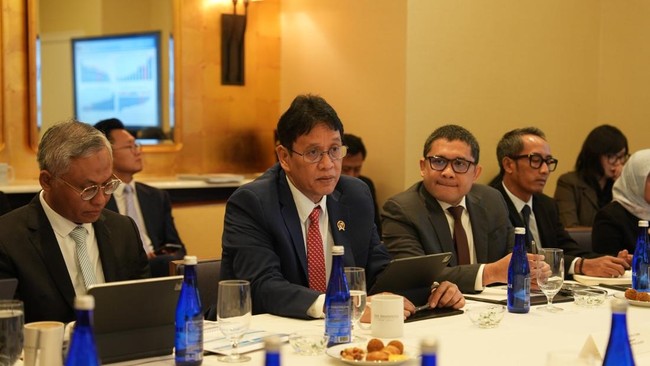
Finance Minister Purbaya Yudhi Sadewa met with key officials from global financial institutions and investors during his visit to the United States.
Purbaya recounted his meetings with major investment institutions, or ‘elephants’, such as BlackRock and Fidelity, during a press briefing at the Juanda I Building in Jakarta today (21/4/2025).
These institutions, Purbaya said, wanted to assess whether Indonesia’s fiscal policies were reasonable. However, he emphasised that the most important aspect was conveying the prospects of the Indonesian economy.
“The key thing is they wanted to see the messenger, whether the way of conveying it makes sense, or the people delivering it. It turns out they’re straightforward, and I’m smart too. So after that, doubts about fiscal matters disappeared, no more questions about deficits and such,” Purbaya stated.
Following that, he met again with investors in New York who closely examined Indonesia’s economic conditions.
He then travelled to Washington DC, where he met 17 individuals and engaged in lively debates.
One topic discussed was the Indonesian government’s steps to maintain a 3% deficit amid rising subsidies due to surging global crude oil prices.
“Yes, we’ve explained it so far, we explained it here. We’re gradually saving here and there, plus additional income from natural resources and minerals. We also said not to worry. If anything happens, we’re still safe because we have a buffer of Rp20 trillion. That’s the main point,” Purbaya said.
Furthermore, Purbaya revealed that the IMF and World Bank offered loans to Indonesia. According to Purbaya, the two institutions could offer between US$20 billion and US$30 billion to countries in need. To the World Bank’s offer, Purbaya said he remained silent. However, to the IMF, he rejected the offer.
“I stayed quiet to the WB. Last time they offered again, telling me to borrow from them. The IMF was the same. I said thank you for the offer, I don’t need it yet, I already have US$25 billion myself for that. So our financial condition is still safe,” he asserted.
In addition, Finance Minister Purbaya held a meeting with the management of a major global debt rating agency, Standard & Poor’s (S&P).
In that meeting, Purbaya said S&P wanted to visit him in Jakarta in June 2026 to discuss fiscal management and Indonesia’s economic stability.
“So I also told S&P at that time, they’re coming here in June, it’s not to change our outlook, just to discuss whether your steps are right or not,” he added.
Moreover, S&P provided assurance during the meeting that Indonesia’s debt or credit rating would remain stable for the next two years, until 2028.
“They said our rating is safe for the next two years, I didn’t quite understand that but they said so. They asked me, do you understand what I just said? No, I don’t, please explain. It means we won’t change the rating for the next two years,” Purbaya explained.
Purbaya said the reason S&P is confident not to change Indonesia’s BBB rating is due to the safe economic fundamentals.
“The economic foundation is still good amid these turbulences and can be managed,” Purbaya stated.
As is known, the global rating agency S&P Global has released a report on the impact of surging energy prices on the fiscal and external conditions of Southeast Asian countries.
In the report, S&P highlighted four major countries in the region, namely Indonesia, Malaysia, Thailand, and Vietnam, which are seen to face similar pressures if the global energy turmoil due to the Middle East conflict persists longer.
S&P explained that the fiscal and external resilience of these countries could erode if the global energy market does not normalise soon in the coming months. In their base scenario, the war’s intensity is expected to peak and the effective closure of the Strait of Hormuz to begin easing in April.
However, disruptions are assessed to potentially last for months, especially if damage to energy infrastructure in the Middle East delays the recovery of oil and gas production.
Indonesia was one of the main focuses. S&P affirmed that Indonesia’s current debt rating is at BBB/Stable/A-2.
However, the agency also assessed that Indonesia’s rating is one of the most vulnerable to pressure if the conflict prolongs and energy market disruptions continue.
As a note, global rating agencies are indeed paying close attention to Indonesia’s condition. For instance, Moody’s Ratings on 5 February 2026 changed Indonesia’s sovereign outlook to negative from stable, while maintaining the rating at Baa2.