
Hengjaya Mineralindo and Residents Restore Morowali Coastline, Marine Biota Re-emerge
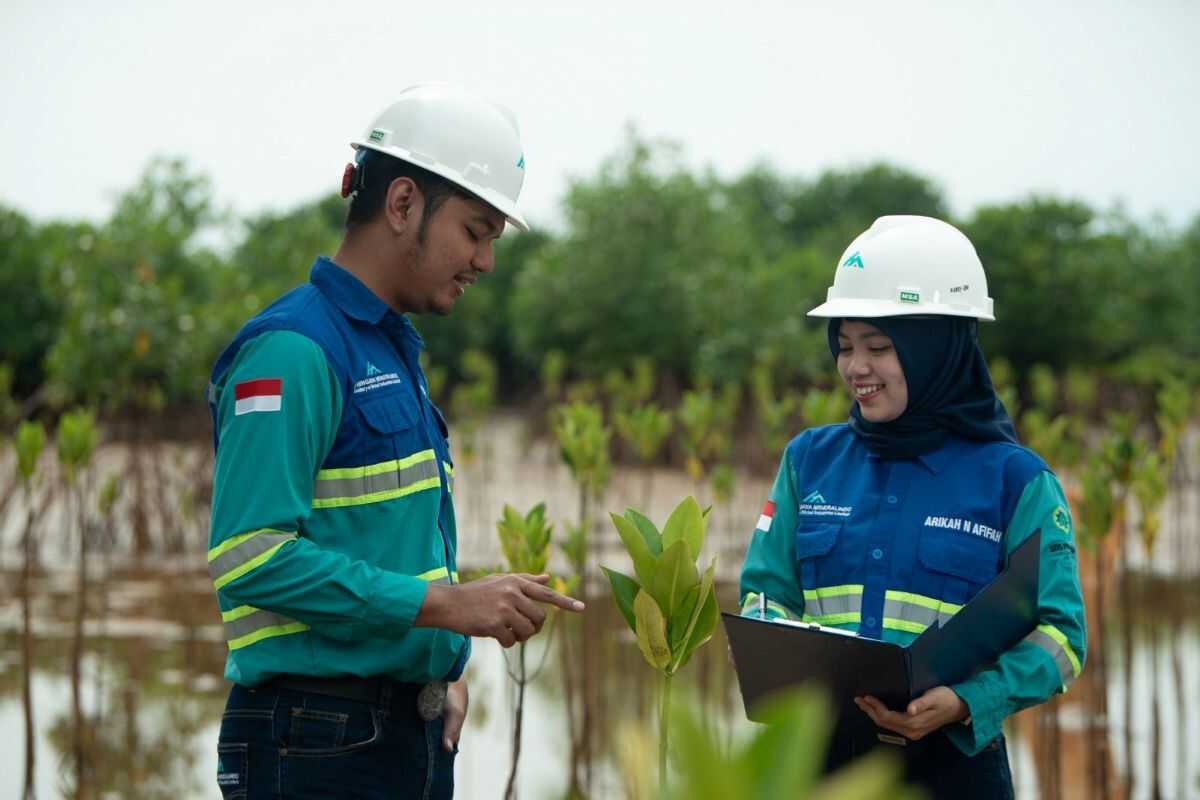
From waters that once had minimal life, coral reefs now display vibrant colours and mangroves grow increasingly robust along the coast of One Ete Village and Bapa Island, Morowali Regency. The rehabilitation programme implemented by Hengjaya Mineralindo in partnership with the community and Halu Oleo University demonstrates concrete results, evidenced by increased ecosystem cover and the return of diverse marine biota.
In the coral reef rehabilitation programme, the company has installed 8,644 coral transplant units using the Triangle Patch Reef (TPR) method, recycled tyre media, and Mini Artificial Reef (MAR) structures. Monitoring results show coral survival rates ranging from 70 to 80 per cent. The TPR method and recycled tyre media achieved the best results with success rates reaching approximately 80 per cent.
Compared with 2024 conditions, when transplantation areas were dominated by bare substrate and minimal bioindicators, current coral reef conditions demonstrate significant improvement. Surviving corals show branch growth of approximately 90 per cent of their original fragment size, with brighter coral colours indicating healthy physiological condition.
Oktsyavitto Adhitya, Mining Sustainability Manager at Hengjaya Mineralindo, stated that this achievement reflects the company’s long-term commitment to coastal environmental management. “The growth of coral reefs and mangroves we have achieved demonstrates that coastal rehabilitation is not merely an environmental activity, but part of our long-term sustainability commitment. Through collaboration with the community and Halu Oleo University, we ensure that ecosystem recovery proceeds alongside biodiversity protection, strengthened coastal resilience, and the creation of environmental and social value for surrounding communities,” he said.
Alongside coral growth, marine biota diversity has increased correspondingly. More than 20 coral fish species have been identified, accompanied by discoveries of starfish, soft corals, and nudibranchs. This indicates that coral reefs are beginning to function again as natural habitats.
In the mangrove ecosystem of One Ete Village, rehabilitation focused on Rhizophora apiculata species. Of 6,000 seedlings planted, 5,425 trees survived, equivalent to 90.4 per cent survival rate. Mangrove growth remained stable with average heights exceeding one metre. The presence of crabs, mangrove snails, and mudskipper fish serve as indicators that this area is resuming its ecological function as a coastal habitat and nursery ground for marine life.
Masudin, Head of One Ete Village, noted that coastal rehabilitation has provided tangible benefits for both the environment and the village community. “We see direct changes in One Ete Village’s coastal area. Coral reefs are beginning to function again as fish habitat, and planted mangroves are growing well. This rehabilitation effort is important not only for environmental protection, but also for the long-term sustainability of coastal livelihoods,” he said.
He added that One Ete Village is now becoming recognised as an example of successful coastal rehabilitation in Bungku Pesisir District. “We are proud that One Ete Village can demonstrate that coastal rehabilitation can succeed when undertaken together and implemented consistently. This motivates us to continue protecting our environment,” he stated.
In line with community perspective, Hengjaya Mineralindo reaffirmed that coastal rehabilitation forms part of the company’s long-term sustainability commitment. Ecosystem recovery efforts are undertaken in a measured and phased manner, ensuring environmental benefits proceed alongside social benefits for surrounding communities.
Going forward, coral reef and mangrove rehabilitation will continue to strengthen coastal resilience and ensure long-term ecological benefits for the environment and communities in the Morowali region.