
Hena Gian Hermana's Story: Growing a Tile Manufacturing Business with BRI Support
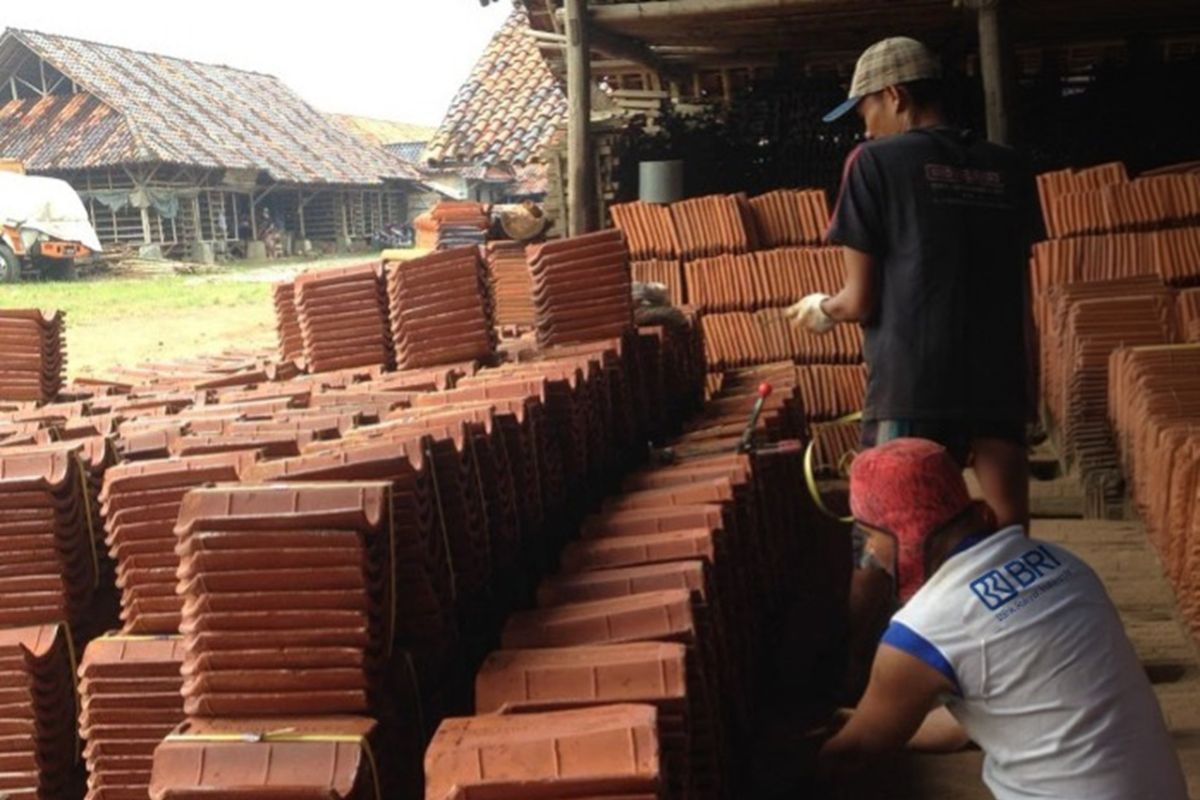
Jakarta — In a quiet corner of a village filled with the constant sound of clay being shaped and printing machinery whirring, the tile manufacturing business belonging to Hena Gian Hermana has grown steadily and persistently.
From her modest home courtyard, neatly stacked tiles drying under the scorching sun stand as testament to the long journey of a small business owner who has persevered amid changing times.
For Gian, tiles are far more than mere building materials. Behind each piece that is pressed lies a story of dedication, courage to take risks, and conviction that traditional enterprises can thrive if managed properly.
The tile factory, which was established in 1985, was born as a response to high demand for clay roof tiles at that time. However, the production capacity of tile factories in the Jatiwangi area was unable to meet the growing market demands.
Unfortunately, this strong market demand has been constrained by various challenges such as changing times, intense product competition, high production costs, limited raw materials, declining workforce numbers, and financial constraints.
“Speaking of tile factory businesses, it is inevitable that they experience ebbs and flows. Changing times, product competition, high production costs, limited raw materials, and declining workforce numbers are factors causing many tile factories to fail,” said Gian.
Gian’s business journey began to change when she became a customer of the People’s Business Credit (KUR) at PT Bank Rakyat Indonesia (Persero) Tbk. Easy access to affordable financing gave her room to expand her operations.
The additional capital was used to purchase more modern printing machines and to improve kiln efficiency. Production capacity increased, tile quality became more uniform, and production time became faster.
“BRI is certainly a key partner for tile factory operators like us, as it offers low-interest KUR loan facilities for small and medium enterprises such as ours, allowing us to continuously increase tile production,” she explained.
Beyond financing, BRI’s mentoring also helped Gian become more disciplined in managing her business finances. She began separating personal and business finances, keeping cash flow records, and planning long-term development.
Because of this empowerment from BRI, production increased significantly, requiring additional workforce. Gian recruited nearby residents to help with the production process, from pressing to transportation. Her business has now become a source of income for several families in the neighbourhood.
Despite the proliferation of modern roofing materials such as lightweight steel and metal tiles, Gian remains optimistic. According to her, clay tiles have their own market, particularly among communities that prioritise heat resistance and traditional aesthetic value.
“We continue to maintain quality so that customers remain confident,” she said.
Looking ahead, Gian plans to expand her marketing network, not relying solely on local buyers but also targeting larger housing development projects. She is also beginning to consider design innovations to enable her products to compete with more modern tile models.
Gian hopes BRI and the government can further strengthen collaboration in providing support to tile factory UMKM operators, both through access to capital and market demand certainty supported by pro-business policies.
“Such support is important so that tile factory businesses not only survive to meet roofing needs, but also remain sustainable as part of ancestral heritage, local cultural wealth, and a reliable source of livelihood for workers,” she said.
On this occasion, Gian also touched upon the “Gentengisasi” programme initiated by President Prabowo. Gian described the Gentengisasi Programme as an oasis in the desert that has long been awaited. Its arrival offers great hope for Jatiwangi tiles to rise again and reclaim their former glory.
The programme is also expected to drive improved welfare and bring broader positive impacts, not only for factory owners but also for all workers whose livelihoods depend on this industry.
For information, President Prabowo Subianto initiated the “gentengisasi” programme, which involves replacing zinc roofing with clay tiles. Gentengisasi is part of the Indonesia ASRI Movement (Safe, Healthy, Clean, Beautiful).
Meanwhile, as a bank focused on UMKM and people’s economy, BRI continues to actively support government programmes in strengthening the national economy, including through Housing KUR financing support for the gentengisasi programme.
BRI Chief Executive Officer Hery Gunardi emphasised that BRI plays a strategic role in facilitating financing between tile manufacturers and developers. Under the scheme, BRI becomes involved after a cooperation agreement is in place between the tile manufacturer and developer, allowing financing to be immediately facilitated.
“BRI’s role is in the middle. Once there is a contract between the tile manufacturer and developer or user, BRI is ready to facilitate financing. We already have Housing KUR, and building materials like this are part of Housing KUR. As a bank whose DNA is to support small businesses and ordinary people, true to the name Bank Rakyat Indonesia, we are ready to provide financing to support such needs,” said Hery.
Hery emphasised that as part of BRI’s commitment to Housing KUR, this financing not only contributes to improving housing quality for the community, but also drives multiplier effects, ranging from UMKM building materials production activities, strengthening the supply chain of the housing industry, and opening employment opportunities in various regions.