
Heavy Challenges for Hajj Catering Staff in Serving Pilgrims
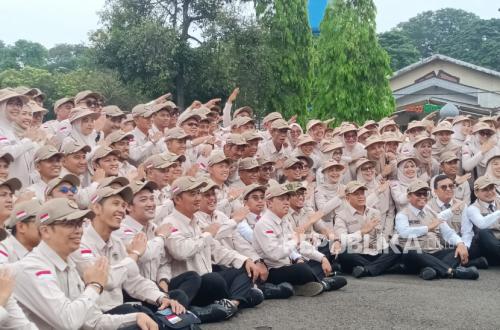
In the organisation of the 2026 Hajj pilgrimage, Hajj officials must ensure that every meal arrives on time, is fit for consumption, and meets the needs of Indonesian pilgrims. However, in serving the diverse conditions of the pilgrims, Hajj staff in the catering sector will face heavy challenges.
For M Fihri, these challenges are already felt even before departure. This catering officer from the Madinah Work Area (Daker) imagines a scenario that often occurs in the field, namely delays in pilgrims collecting their meal rations.
“Since I’m in catering, the possibility of pilgrims being late to collect their rations, while time is limited. That could impact the food’s suitability and even cause panic,” he told Republika.co.id as he was about to be sent off to Madinah from the Pondok Gede Hajj Hostel in East Jakarta on Friday (17/4/2026).
In such situations, the prepared food risks no longer being in optimal condition. Yet, Hajj meal distribution has strict standards, both in terms of timing and quality. A small delay could lead to major problems in the field.
However, amid these concerns, Fihri still holds hope. “Hopefully everything goes smoothly,” he said briefly, as if summarising the prayers of many officials preparing to depart.
The challenges multiply when dealing with elderly pilgrims (lansia), whose numbers are significant in the composition of Indonesian Hajj pilgrims. Their needs are not always the same, especially regarding consumption.
“If the elderly need food that requires a special request or something, it can be asked for. And we’re ready to serve the pilgrims’ requests,” Fihri said.
In agreement, another catering officer, Khusnul, views these challenges more as issues of management and coordination. For her, the key lies in schedule accuracy and communication between parties.
“As long as we know the hotel check-in and check-out schedule, we coordinate in the evening with the cluster officers, insya Allah it can be handled,” said Khusnul.
The experience she has gone through several times as a Hajj officer becomes important capital in facing field dynamics. Moreover, she understands that catering services are not just about distributing food, but also ensuring its quality suits the pilgrims’ conditions.
For elderly pilgrims, for example, food is prepared specially. The rice texture is made softer, the meat is processed more finely, and dishes like rendang are cooked with extra care to make them easy to consume.
“The officers monitor and oversee everything before it’s served,” she said.
Behind all this, there is optimism that this year’s Hajj organisation—under the newly formed Ministry of Hajj and Umrah—will bring improvements in services, including in the catering sector.
“Insya Allah it will be better than before,” said Khusnul.
The challenges for catering officers are not just about logistics or schedules. They are about maintaining the pilgrims’ calm through the most basic thing, namely food. For from the kitchens in the Holy Land, the energy for pilgrims’ worship is ensured to remain sustained, and their spiritual journey can proceed more devoutly.