
Health Minister: Intensify leprosy screening and surveillance to eliminate disease
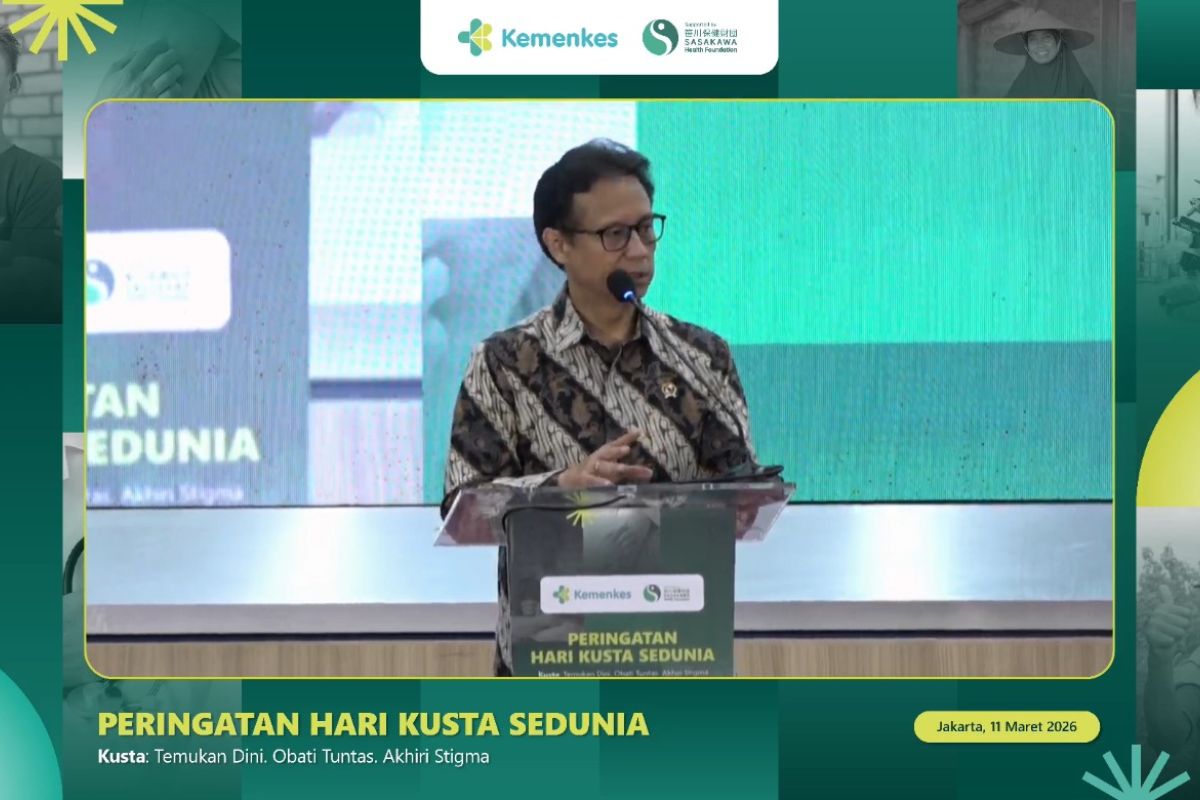
Jakarta — Indonesia’s Health Minister Budi Gunadi Sadikin has stated that accelerated screening and surveillance of leprosy is necessary to eliminate the disease, given that Indonesia ranks third globally in leprosy cases, following India and Brazil.
Budi explained that Indonesia recorded 16,000 leprosy cases in recent years. He noted that Indonesia frequently ranks high for communicable diseases, such as tuberculosis (TB). According to him, the key to addressing this is screening and surveillance.
“I’ve already incorporated it into the free health check programme. I’ve just reviewed this. I’ve specifically added leprosy screening to all free health check sites,” Budi said in Jakarta on Wednesday, marking World Leprosy Day.
He noted that many people are reluctant to undergo leprosy screening because the disease is perceived as a curse. Budi explained that leprosy, like TB, has existed for thousands of years. Because people in ancient times could not explain the cause, leprosy became a legend or folklore about a curse from God.
“Yet in reality, we already know the disease is similar to TB, Mycobacterium tuberculosis. This is Mycobacterium leprae,” he said.
He explained that some regions are embarrassed if they are found to have many leprosy cases. Therefore, to intensify leprosy case detection, his ministry will provide incentives to regions that discover the most cases.
“Detect as many cases as possible. So we can quickly treat them with rifampicin. Similar to TB with dapsone, it takes six months to cure,” he said.
To strengthen leprosy elimination efforts, he said his ministry will also enhance surveillance systems in eastern Indonesia with genome sequencing. This is because some eastern Indonesian populations are sensitive to dapsone treatment.
“DHS, or dapsone hypersensitivity syndrome. This means the drug package must be different because it can cause death,” he said.
Once someone with leprosy is identified, he explained, they are treated until fully recovered. Their close contacts are also given prophylaxis and other medications for prevention, similar to TB management.
However, he said the greatest challenge is the stigma attached to leprosy patients, resulting in them being perceived as sinful, ostracised, and even confined as if they had a mental health disorder.