
Head of Plastic Entrepreneurs Assures No Layoffs Despite Global Turmoil
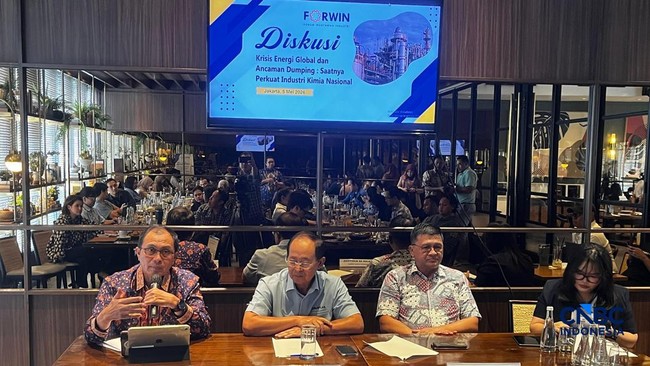
Indonesia’s national plastic industry is facing heavy pressure due to global turmoil, ranging from disruptions in raw material supplies to surging prices. However, amid these conditions, industry players assure that the sector remains capable of surviving without a wave of layoffs (PHK).
General Chairman of the Indonesian Olefin, Aromatic, and Plastic Industry Association (Inaplas), Suhat Miyarso, confirmed that to date, there have been no reports of layoffs from association members.
“Up to today, not a single Inaplas member has reported any layoffs. Accordingly, Inaplas has never reported to the government any layoffs in our member industries,” he stated during a discussion at the Industrial Journalists’ Forum (Forwin) in Jakarta on Tuesday (5/5/2026).
The pressure on the industry did not come suddenly. Over the past few years, the sector has already been hit by various structural challenges, from import dependency to dumping practices from abroad.
The latest conditions have become even more complex with raw material supplies disrupted due to global geopolitical dynamics. This situation forces industry players to adapt quickly to keep operations running.
Inaplas Vice Chairman Edi Rivai explained that the petrochemical industry has a different character compared to other sectors, particularly in terms of cost structure and production patterns.
“If you look at the cost components of the petrochemical and downstream plastic industries, the dominant cost is raw materials. So it’s not labour costs. That’s why for the past 10 years, there has been almost no talk of layoffs in this industry,” Edi said.
In difficult conditions, the industry tends to adjust operational strategies rather than immediately reducing the workforce. This is done because petrochemical production processes are continuous and cannot be stopped abruptly.
Additionally, dependency on global supply chains makes companies focus more on maintaining production continuity rather than achieving efficiency through layoffs.
Edi emphasised that the risk of layoffs is more likely in certain downstream sectors that are highly dependent on one market or one type of product.
“If it happens, it’s usually in very specific downstream areas, for example, dependent on one customer or heavily impacted by dumping. But in the plastic industry in general, it is very rare,” he said.
Amid this pressure, the industry chooses to focus on survival strategies. These steps include securing raw material supplies, operational efficiency, and diversifying input sources.
This situation also encourages industry players to strengthen ties with the domestic market to avoid over-reliance on imports.
Edi stressed that keeping operations running remains the priority to prevent the industry from facing even greater impacts.
“The important thing for us is how to ensure we can survive. Because if we stop, it becomes even harder. So our strategy is to keep operations running and secure raw material supplies,” he asserted.