
Hans Hartung's 'The Invisible Chord' Resonates in Venice
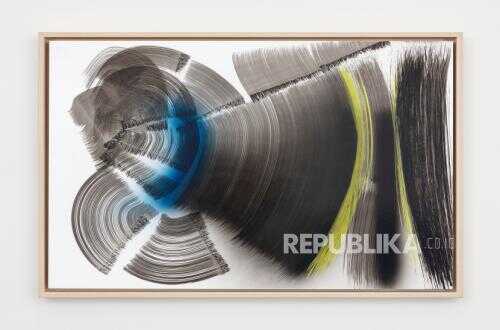
REPUBLIKA.CO.ID, VENICE – The exhibition entitled ‘The Invisible Chord: Hans Hartung and Music’ officially opened at the Fondazione Querini Stampalia, Venice, Italy, on May 5th and will run until September 13th, 2026. Curated by Thomas Schlesser, the exhibition is presented by the Fondazione Querini Stampalia and the Hartung-Bergman Foundation, in collaboration with the international gallery Perrotin.
Featuring nearly 80 paintings, archival documents, and studio equipment, the exhibition explores the central role of music in the creative universe of the German abstract painter, Hans Hartung. From the Baroque compositions of Johann Sebastian Bach to the psychedelic nuances of Pink Floyd, the soundscapes, rhythms, and resonances are believed to flow within every brushstroke.
From a young age, Hartung was known as a talented pianist and dancer who was obsessed with music. He almost never worked in silence. In a letter from 1948, his friend, the painter Pierre Soulages, described how Hartung’s radio was always on, even when he visited. For Hartung, painting without music was almost impossible.
In his studio, the melodies of Goldberg Variations, Sarabande, and The Four Seasons by Antonio Vivaldi often accompanied his creative process. He also listened to modern composers such as Lili Boulanger, Pierre Boulez, and Philip Glass. Although he never formulated a theory about the relationship between color and sound like Wassily Kandinsky, Hartung’s relationship with music was direct, physical, and intuitive. Without music, there is no creation. Without creation, there is no reason to live.
The exhibition in Venice has historical significance. In 1960, Hartung won the Grand International Prize for Painting at the Venice Biennale, which catapulted him onto the international art stage. Since then, he has become increasingly bold in experimenting, using fast-drying acrylic paints, industrial spray techniques, and even tools he made himself.
As an important figure in the art informel movement in France during World War II, Hartung also carries a strong personal historical legacy. He was a war veteran who lost a leg and was an opponent of Nazism. All of these experiences are reflected in the firm yet emotional calligraphic gestures on his canvases.
The exhibition not only features works from the 1920s until the end of his life in 1989, but also exclusive archives and documentary films that invite visitors to explore Hartung’s ‘sound universe’. A special video presented at Riva Botta features interviews with composers, performers, and choreographers who reflect on Hartung’s influence across disciplines.
As one of the oldest cultural foundations in Italy, established in 1869, Querini Stampalia continues to uphold its vision as a space for dialogue between the past and the present. Through this exhibition, the institution reaffirms its commitment to making art an intellectual as well as emotional experience.
The Invisible Chord is an invitation for the public to hear what is not heard. In the silence of Hartung’s canvases, visitors are invited to feel the resonance of the fugue, the explosion of the symphony, and the echo of the opera that shaped the creative pulse of a 20th-century European abstraction master.