
Hajj Dormitory Jakarta's 'Ajag-Ijig' Vehicle Assists Elderly and Disabled Pilgrims
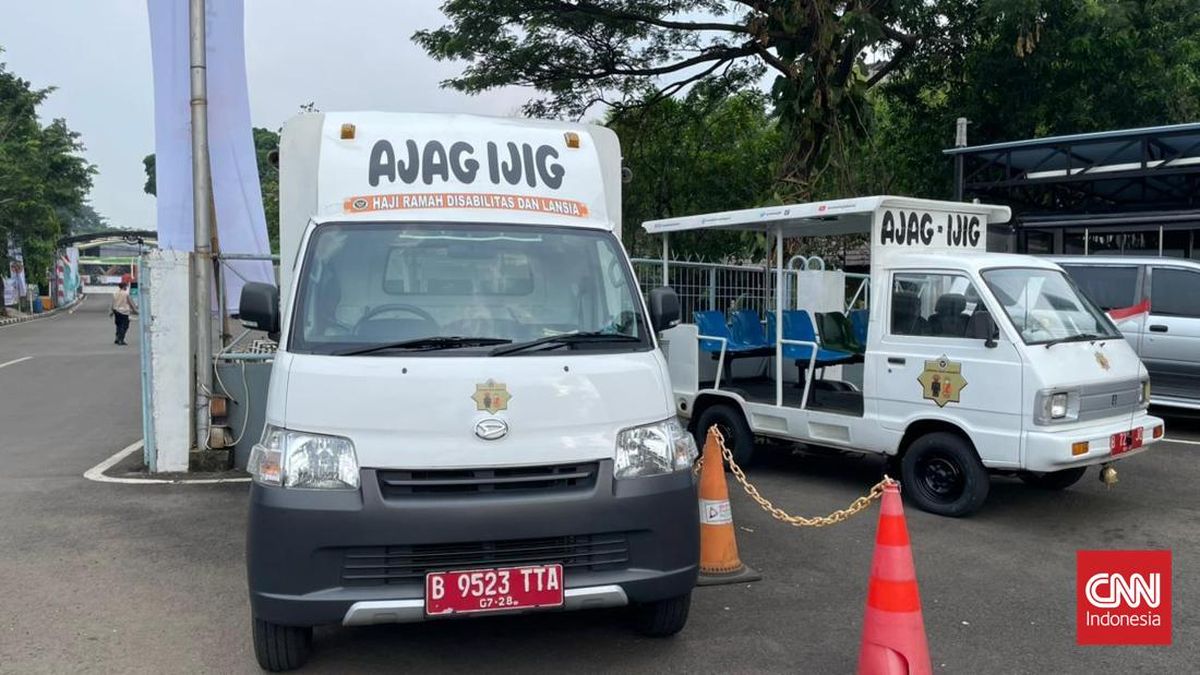
The Hajj Organising Committee (PPIH) at the Pondok Gede Hajj Dormitory in East Jakarta has prepared a special fleet named the ‘Ajag-Ijig’ vehicle to ease the mobility of elderly (lansia) and disabled pilgrims.
This facility has been fully mobilised following the arrival of the third flight group (kloter) from West Jakarta on Wednesday afternoon, which included 83 elderly pilgrims and three with special needs.
To ensure the comfort and safety of these vulnerable groups while moving around the expansive 16-hectare dormitory area, the committee has allocated the fleet specifically according to each pilgrim’s requirements.
“One of them is the Ajag-Ijig vehicle, which we divide into three categories. The Ajag-Ijig is specifically for women, another Ajag-Ijig specifically for the elderly, and we have a Hiace vehicle dedicated to those with disabilities who use wheelchairs so that the chairs can fit inside the vehicle,” said the Head of the Pondok Gede Hajj Dormitory Unit, Muhammad Ali Zakiyudin, at the Pondok Gede Hajj Dormitory in East Jakarta on Wednesday (22/4).
“Specifically for buses, two three-quarter buses are used for other pilgrims who do not fall into those three categories,” he added.
This affirmative action for priority groups is not limited to inter-building transportation ease.
Fast-track
The embarkation team has also anticipated the physical fatigue of pilgrims since disembarking from the bus by providing dozens of mobility aids directly connected to fast-track services during documentation processing.
“For the elderly who need wheelchairs, we have prepared a reserve of 20 wheelchairs at the front to be used when needed. Then we will escort them to the multipurpose area, placing them in the fast-track for the elderly, with priority seats to be used,” said Ali.
Although elderly and disabled pilgrims receive special treatment in terms of administrative comfort and pocket money distribution (living cost), the medical examination stage remains strictly applied to all pilgrims.
They—all of them—undergo final observation from the dormitory’s polyclinic, which will serve as the determining ticket for their fitness to fly to the Holy Land.
“For now, it’s still the health process. So the determination will be based on health. If the health issues are only minor illnesses or minor referrals that can possibly be combined with the departure time, that will be what determines it. So for now, it’s still the health process,” said Ali.
Beyond health procedures, Ali explained the smooth progress of the pilgrims’ luggage screening phase. According to him, extensive education at the regional level has successfully made pilgrims compliant and no longer bringing prohibited items in their luggage.
“Alhamdulillah, for the initial screening, perhaps because the socialisation to the regions has started massively, and assisted by media friends as well, regarding prohibited items and maximum baggage limits, so pilgrims have become aware of packing their luggage according to the regulations,” said Ali.
Pilgrim families’ access restricted
In addition, the PPIH has strictly enforced area restrictions for accompanying families at the said Hajj dormitory.
Accompanying groups and relatives of pilgrims are only allowed to stay up to the East Parking area boundary of the dormitory.
“After parking in the east, they can then enter SG2 according to the door prepared specifically for the pilgrims and their carry-on items,” said Ali.
According to the schedule, if this third kloter pilgrims pass the health checks without issues, they will be dispatched to the airport five hours before takeoff.
The aircraft is scheduled to depart for the Holy Land on Thursday (23/4) at 12.25 WIB.