
Gowa Regent Declares War on Child Marriage and Stunting
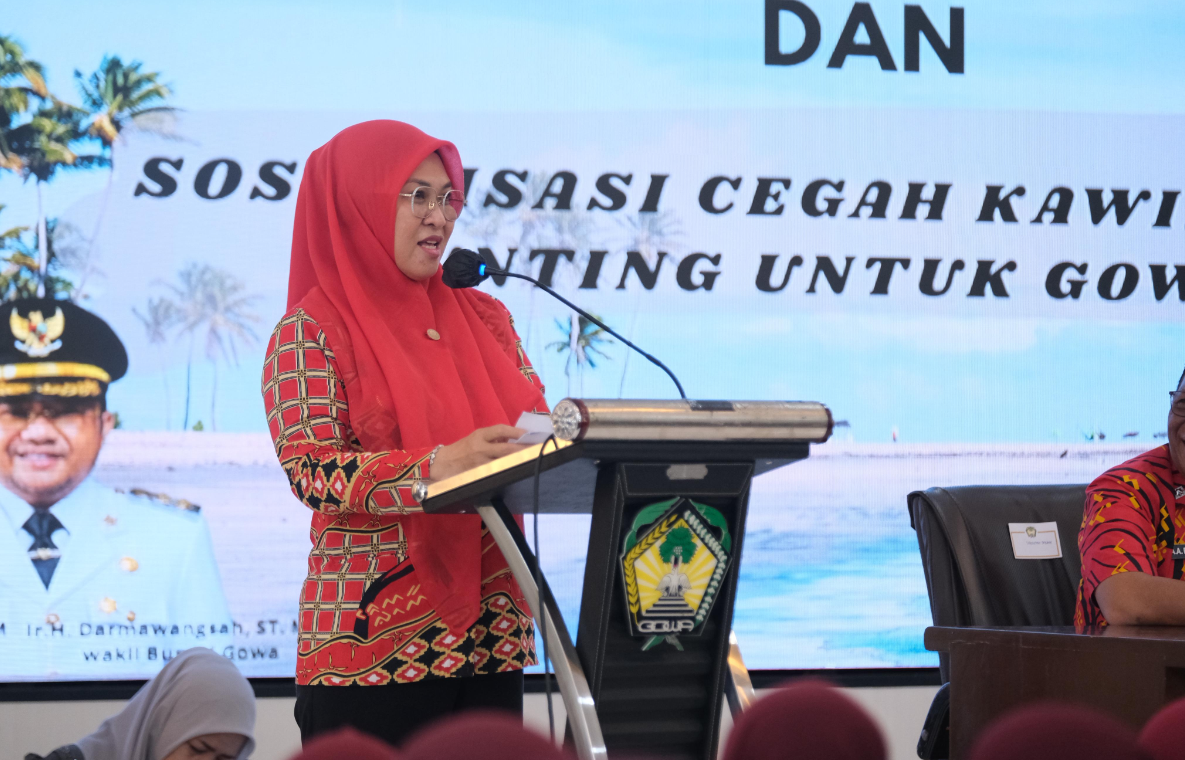
The Regent of Gowa, Sitti Husniah Talenrang, has warned of the hidden threat of child marriage that continues to occur in the field, often accompanied by early pregnancies. Behind the drastic drop in prevalence from 21.1% to 17% based on the 2024 Indonesia Nutrition Status Survey (SSGI), serious issues still lurk.
“Child marriage halts education, forces children to bear responsibilities prematurely, and opens the door to a generation of stunting. This is the cycle that we must break now,” she stressed at the Halal Bihalal and Socialisation event to Prevent Child Marriage and Stunting for an Advanced Gowa, held at Baruga Tinggimae, the Regent’s Official Residence in Gowa, on Thursday (9/4).
The event, attended by around 700 participants from various women’s organisations, Majelis Ta’lim, and community elements, was a collaboration between the Indonesian Religious Counsellors Association (IKAPEN RI) and the Gowa District Majelis Ta’lim Working Group.
Gowa Regency has recently achieved Third Place in the Best Anti-Stunting Action Innovation Category across South Sulawesi. The flagship “ASS” (Anti-Stunting Action) programme has been deemed successful. However, the Regent, affectionately known as Regent Talenrang, is not complacent.
She revealed facts from the field that underage marriages still occur, even with prior pregnancies. “If we remain silent, we share the responsibility. If we neglect it, we risk Gowa’s future,” she stated.
Therefore, she called for active roles from KUA (Office of Religious Affairs) to remote areas to socialise the dangers of early marriage.
“We want KUA to reach remote villages. Marriage must be with readiness, not just haste. Children must grow up healthy, not just grow,” she urged.
Regent Talenrang emphasised that the “war against child marriage and stunting” is not solely the government’s responsibility. She invited Majelis Ta’lim to be at the forefront of social change.
“I hope the mothers of Majelis Ta’lim do not just attend but become drivers of change,” she said.
On the same occasion, she also outlined five regional priority programmes that require public support: Gowa Annangkasi (Clean), Gowa Caradde (Smart) through the Gowa Mengaji Movement, Gowa Masunggu (Prosperous) for eradicating extreme poverty, Gowa Salewangan (Healthy), and Gowa Masannang (Safe).
The Head of the Gowa Regency Ministry of Religious Affairs, Jamaris, stated that he would strengthen collaboration with women’s organisations down to the village level.
“We will partner with PKK, Dharma Wanita, and Majelis Ta’lim. They interact directly with the community,” he said.
He acknowledged that cultural challenges and parents’ concerns about rejecting proposals still trigger early marriages. “This is a situation we must face together,” he concluded.
Meanwhile, the Committee Chair, Fatmawati (Islamic Religious Counsellor of Somba Opu Subdistrict), highlighted the importance of the First 1,000 Days of Life (HPK) in efforts to reduce stunting. “The role of women’s organisations is very strategic in realising an Advanced Gowa,” she explained.
Although Gowa shows progress, child marriage rates in South Sulawesi remain a major homework. Based on UNICEF and Ministry of Religious Affairs data, the child marriage prevalence in South Sulawesi in 2024 reached 8.09%, far above the national average of 5.90%. South Sulawesi is now ranked 11th nationally.
Previously, the UNICEF Representative for Sulawesi and Maluku, Henky Wijaya, warned that a decrease in marriage dispensations is not good news if accompanied by a shift to unregistered siri marriages.
“When dispensations are tightened, child marriages do not automatically disappear. What happens is a shift to siri marriages,” he explained.
Data on child pregnancies in several regencies also show spikes: Gowa recorded 304 pregnant children, but only 8 marriage dispensations applied for. Makassar 331 pregnant, 9 dispensations. Bone 241 pregnant, 10 dispensations. Takalar 204 pregnant, 0 dispensations.
Henky added that the risk of maternal mortality for births under 18 years old is five times higher than for adult mothers. Additionally, children from siri marriages often lack birth certificates, hindering access to education, health, and social assistance.
The hope is that with cross-sector collaboration and grassroots movements, Gowa not only records a decline in stunting but also breaks the chain of child marriage forever.