
Governor Koster: Bali Tourism Foreign Exchange Contributes 55% to National Total in 2025
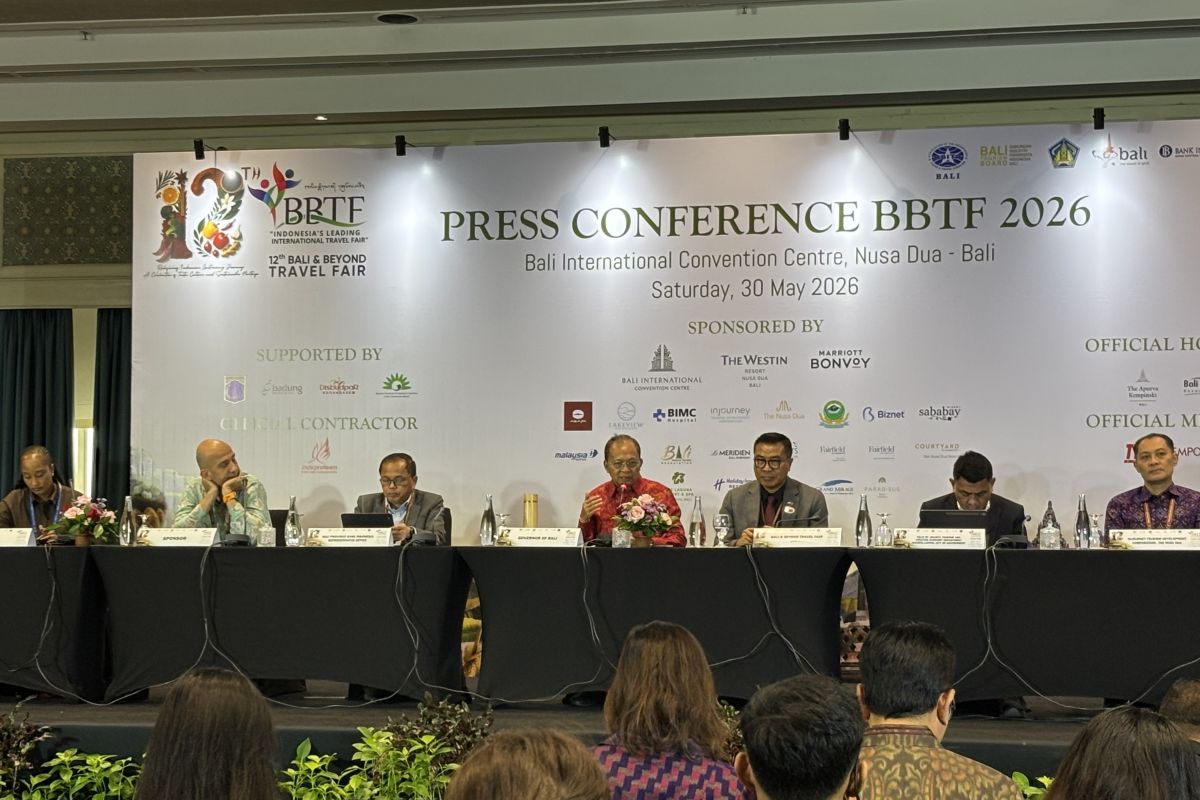
BADUNG (ANTARA) – Governor of Bali Wayan Koster noted that Bali’s tourism foreign exchange contribution in 2025 accounted for 55 per cent of the national total.
“When comparing Bali’s tourism foreign exchange of Rp176 trillion to the national total of Rp320 trillion, it amounts to 55 per cent,” he said during the Bali & Beyond Travel Fair (BBTF) 2026 in Badung Regency on Saturday.
Governor Koster explained that the 55 per cent figure was derived from calculations of tourist arrivals and spending, with foreign tourist arrivals reaching 7.05 million in 2025, or 45.8 per cent of Indonesia’s total 15.39 million arrivals.
Statistics Indonesia (BPS) data revealed that the average foreign tourist spending on the island was $1,522.44, which, when multiplied by total arrivals and converted at a rate of Rp16,500 per dollar, resulted in Rp176 trillion in tourism foreign exchange for Bali in 2025.
“This foreign tourist spending, calculated according to the formula, becomes tourism foreign exchange – the foreign currency circulating in Bali spent on hotels, transport, restaurants, and small and medium enterprises (UMKM), totalling Rp176 trillion, compared to Indonesia’s total of Rp319.9 trillion, or approximately Rp320 trillion,” said the governor, an ITB Mathematics graduate.
Governor Koster said this significant contribution demonstrates Bali’s tourism resilience despite negative issues affecting the island in 2025.
The Bali provincial government has pledged to continue addressing issues such as waste management, infrastructure, and traffic congestion to sustain the tourism sector.
Tourism accounts for 66 per cent of Bali’s own economy, contributing to the island’s 5.82 per cent economic growth in 2025.
“Per capita income is Rp72 million, with poverty and unemployment rates at 1.42 per cent and 1.45 per cent respectively – the lowest in Indonesia – and it also benefits agriculture and fisheries, as many hotels use local Bali products such as fruit, vegetables, eggs, and rice,” Koster said.
The Bali provincial government views tourism not only as a source of foreign exchange but also as a contributor to other economic sectors directly involving local communities.
This has placed Bali as the fifth-highest growing economy in Indonesia and the top province without mineral wealth.
“Tourism drives farmers, fishermen, and artisans, with widespread benefits to communities – unlike resource-based industries where wealth is concentrated among few, here it is dispersed across numerous hotels, restaurants, travel agencies, farmers, and small businesses,” he added.