
Government Urged to Safeguard Economy Amid Global Pressures
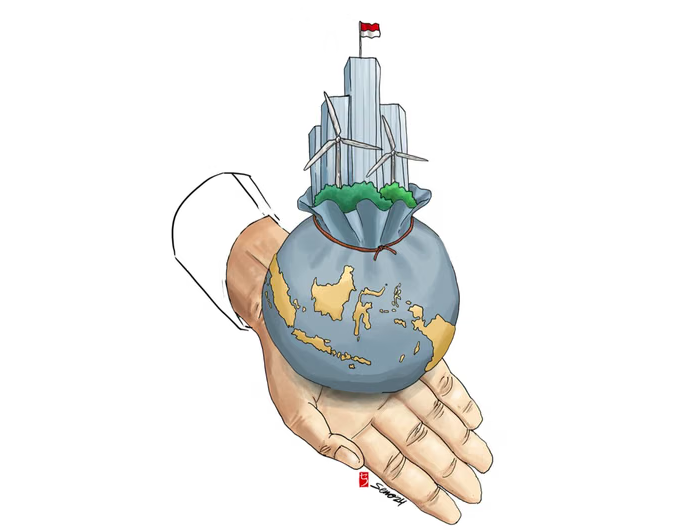
The Institute for Development of Economics and Finance (Indef) has assessed that the Indonesian Government needs to prepare strategic measures to protect the stability of the national economy amid increasing global pressures.
Executive Director Esther Sri Astuti, speaking in Jakarta on Saturday, explained that the weakening exchange rate of the rupiah against the US dollar could potentially push the state budget deficit beyond the 3 per cent threshold relative to Gross Domestic Product (GDP).
This is because the exchange rate assumption in the state budget stands at around Rp16,500 per US dollar, whilst the rupiah is currently approaching Rp17,000 per US dollar.
According to Esther, this condition could increase the burden on the state budget because various expenditure components denominated in US dollars will also increase, thereby limiting the government’s fiscal space for implementing development programmes.
“Moreover, crude oil prices have now exceeded $100 per barrel, far removed from the state budget’s assumption of $70 per barrel,” she said.
Nevertheless, Esther believes the government can still anticipate this situation through several strategies to protect national economic resilience amid global uncertainty.
First, the government needs to direct state spending towards productive activities, such as programmes capable of driving economic growth and increasing state revenue. Meanwhile, consumptive spending is deemed necessary to reduce or halt in order to make the budget more efficient.
Second, the government is encouraged to expand opportunities from sectors with potential to generate foreign exchange. This step is considered important given the increasing need for US dollars, particularly for servicing foreign debt obligations and various international transactions.
Third, the government needs to strengthen hedging strategies against rupiah exchange rate movements in every payment using US dollars. Through such mechanisms, the impact of rupiah weakening on foreign currency payment obligations can be mitigated.
Additionally, Esther also emphasised the importance of strengthening national energy resilience. One approach involves the development and expansion of oil refineries domestically so that Indonesia’s crude oil reserves can be processed and utilised optimally.
On the other hand, the government must also accelerate the development of new and renewable energy to reduce dependence on fossil fuels. Indonesia is considered to have significant potential in alternative energy sources such as hydroelectric, solar and wind power.
“Encourage renewable energy investment so Indonesia is not entirely dependent on fossil energy, as Indonesia has many alternative renewable energy sources such as hydroelectric, solar, wind and others. Provide more incentives,” she said.
Previously, President Prabowo Subianto expressed his hope that the worst-case scenario envisioned by various parties in the Middle East would not materialise, particularly following the conflict between Iran against the United States and Israel that has been ongoing for approximately two weeks.
At a plenary cabinet session at the State Palace in Jakarta on Friday (13 March), the President emphasised that the government had taken several steps to anticipate the impact of conflict in the West Asian region, whilst examining several cost-saving options.
“We hope the worst scenario does not occur in the Middle East, but there are also many predictions that this could be a very long war, a very long war,” Prabowo said.
Nonetheless, the President stated that Indonesia is currently in a relatively safe condition. However, the President reminded his officials to remain vigilant and not become complacent. “Whilst feeling safe and not panicking, we must prepare ourselves for the worst possibility,” the President said.
During the plenary cabinet session, the impact of the conflict between Iran versus Israel and the United States also received attention. Coordinating Minister for Economic Affairs Airlangga Hartarto and Chairman of the National Economic Council (DEN) Luhut Binsar Pandjaitan reported directly on their respective observations regarding this issue and its impact on Indonesia.
In presenting his report to the President, Airlangga opened the possibility that the state budget deficit could exceed 3 per cent if the war scenario were to extend to five, six or ten months.
In the scenario developed by the government, global crude oil prices are predicted to reach $90 per barrel if the conflict lasts five months, then $97 per barrel if the war extends to six months, and $115 per barrel if the conflict lasts ten months.
“If we apply this to our state budget, Pak, which is current, this first scenario, ICP at 86 (dollars per barrel), exchange rate at Rp17,000, Pak. Our state budget exchange rate at Rp16,500, then with growth we maintain, Pak. So this growth we maintain at 5.3 (per cent). State Securities yield at 6.8 per cent then the deficit is 3.18 per cent,” Airlangga said.
Indef Executive Director Esther Sri Astuti stated that the discourse surrounding an expansion of the state budget deficit above 3 per cent is realistic.
Increased consumption is typically driven by the disbursement of year-end bonuses (THR) and increased mobility of the public during the homecoming season.
Indef assessed that the rupiah exchange rate still faces potential pressure amid increasingly severe global economic conditions, with the dollar exchange rate against the rupiah today having surpassed Rp17,000.
Senior economist Didik J. Rachbini from Indef assessed that the plan to import 105,000 commercial pick-up vehicles from India risks weakening the national automotive industry and the trade balance.
Indef valued that Ramadan and Eid al-Fitr 2026 could drive the economy in quarters I-II through the food, transport and logistics sectors, supported by government stimulus.