
Government Unites 15 Agencies to Develop Rare Earth Metal Technology
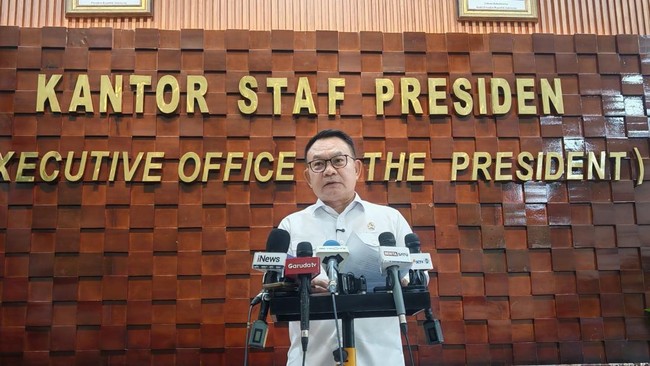
Jakarta, CNBC Indonesia - The Presidential Staff Office has announced that 15 ministries and agencies are synergising to promote the development of technology and exploration of rare earth metals (LTJ). The move is intended to enable Indonesia to independently process this ‘treasure trove’ of resources.
Kepala Staf Kepresidenan Dudung Abdurachman stated that the synergy aims to produce policies and regulations for LTJ development. He noted that the technology sector is key for Indonesia to maximise the processing of its natural resource wealth without having to export raw materials due to a lack of technological mastery.
‘This will be discussed, there are 15 institutions that will talk about this, not only about the technology but also the regulations, so that these regulations will bind all related institutions, thus eliminating any hesitation for business actors,’ he said in CNBC Indonesia’s Mining Zone programme, quoted on Tuesday (4/8/2026).
The collaboration also involves the National Research and Innovation Agency (BRIN), MIND ID, and PT Timah to address the limitations in rare mineral processing technology. While Indonesia has been pursuing downstream processing, it remains limited, meaning some associated minerals have not been optimally utilised.
‘In addition, the development of the technology itself will also be discussed, one of which involves BRIN, then Mineral and Coal, Perminas, and others, so that we are not just exporting raw materials, that is the downstream process that is then developed,’ he explained.
Indonesia’s natural resource availability for LTJ is considered quite abundant, but the readiness of human resources and access to high-level refining technology remain the biggest obstacles. The government is targeting the construction of more complex downstream industries, including supporting infrastructure for electric vehicles, as part of the national strategy.
‘The technology is clear. In terms of natural resources, we are indeed abundant, but in terms of human resources and technology, we are not there yet,’ he added.
Through this coordination, the government hopes the formulated regulations will encourage a more conducive investment climate in the rare mineral sector. The Presidential Staff Office has confirmed it will continue to oversee the process of cutting bureaucracy so that the national mining potential provides added value for economic stability.
‘For mining, as I said, we are cutting bureaucracy so that it does not harm several parties,’ he concluded.
Indonesia’s Rare Earth Potential
Citing the Rare Earth Metals Booklet released by the Ministry of Energy and Mineral Resources (ESDM) in 2020, Indonesia’s rare earth mineral potential comes from various derivative products of mineral processing, such as tin, gold, alumina, zircon sand, and nickel. The majority of these locations are in Bangka Belitung, West Kalimantan, and Sulawesi.
Of the total 28 revealed LTJ mineralisation locations, only about 9 locations (30%) have undergone initial exploration, while 19 locations (70%) have not been explored or have not been optimally explored.
Several types of rare earth minerals in Indonesia include:
Monazite and Xenotime, which are by-products of tin ore processing. Their potential lies in tin mines in Bangka Belitung.
Monazite: Indonesia has monazite resources totalling 185,179 tonnes of metal that can be further developed into reserves. Analysis of monazite concentrate in tin shows contents including 31.5% CeO2, 13.2% La2O3, and 11% Nd2O3. Three provinces hold this potential: Riau Islands (2,268 tonnes), Bangka Belitung Islands (181,735 tonnes), and West Kalimantan (1,175 tonnes).
Xenotime: Indonesia has xenotime resources of 20,734 tonnes of metal, located in the Bangka Belitung Islands.
Zirconium silicate, a by-product of tin and gold ore processing and found in zircon sand, with potential in Kalimantan. The LTJ elements within it include Yttrium (Y) and Cerium (Ce).
Ferrotitanates, a residue from processing bauxite into alumina, with potential in red mud in West Kalimantan.
Laterite nickel ore, a by-product of processing laterite nickel ore through a hydrometallurgical process, namely High Pressure Acid Leaching (HPAL) nickel-cobalt smelters. Its potential lies in nickel (limonite) mines in Sulawesi, with LTJ elements including Scandium (Sc), Neodymium (Nd), Praseodymium (Pr), and Dysprosium (Dy).
Granite rocks.
Fly ash and bottom ash (FABA) containing monazite.