
Government to Build 140,000 MBR Housing Units on Lippo-Donated Land
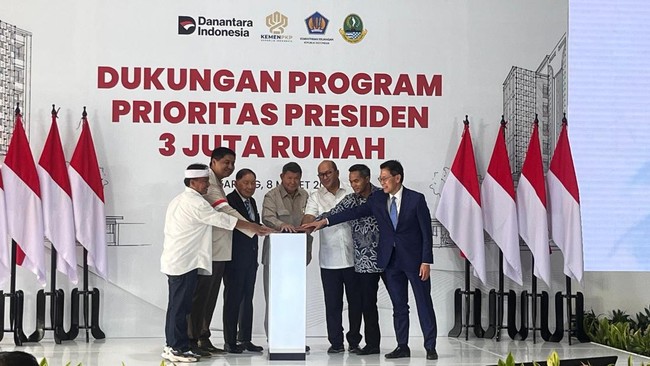
Jakarta, CNBC Indonesia — The government, through the Ministry of Public Housing and Settlement Areas (Kementerian Perumahan dan Kawasan Permukiman, PKP) and the Danantara Daya Anagata Nusantara Investment Management Agency (Badan Pengelola Investasi Daya Anagata Nusantara, Danantara), will join with Lippo Group to construct 140,000 vertical housing units for low-income households (MBR). The programme is part of the government’s 3 million homes for MBR initiative.
PKP Minister Maruarar Sirait said Lippo Group donated land in the Cikarang area, West Java, spanning over 30 hectares. “The donated land is 30 hectares. On this land, the value is Rp15-20 million; Rp15 million is equivalent to Rp4.5 trillion. At Rp20 million, it would be Rp6 trillion,” he said in Cikarang, West Java, on Sunday (8 March 2026).
The funding for the MBR housing will be provided through national budget subsidies and banking, beginning with state-owned banks (Himbara) and extending to private banks with tenors up to 30 years. “We will extend Indonesians’ loan tenors to 30 years so that the instalments are not burdensome,” he noted.
In the same event, Danantara Indonesia CEO Rosan Roeslani said the development of these homes marks a historic milestone, as a single project will yield 140,000 units. It will create an economic impact because the housing/property sector has a multiplier effect on national economic growth.
“Imagine the scale—it’s enormous. The multiplier effects will be extraordinary, from job creation to empowering nearby communities and boosting the economy, which will drive the national economy,” he explained.
Housing Task Force Chairman Hashim Djojohadikusumo added that the programme’s background will yield a large impact because it involves more than 180 economic sectors related to property, construction, and housing.
“The housing industry multiplier effects on our economy can be immense. It could be 1.5-5 times; some say 2 times,” he said.
“140,000 units of apartments, for example, will require furniture. Each apartment needs beds for a couple and two children—3-4 beds—and tables, wardrobes, and other furnishings. Each apartment will also require a TV. Therefore, we can calculate the explosive economic impact,” he concluded.