
Government Strengthens Indonesia's Fiscal Resilience Against Disaster Risk
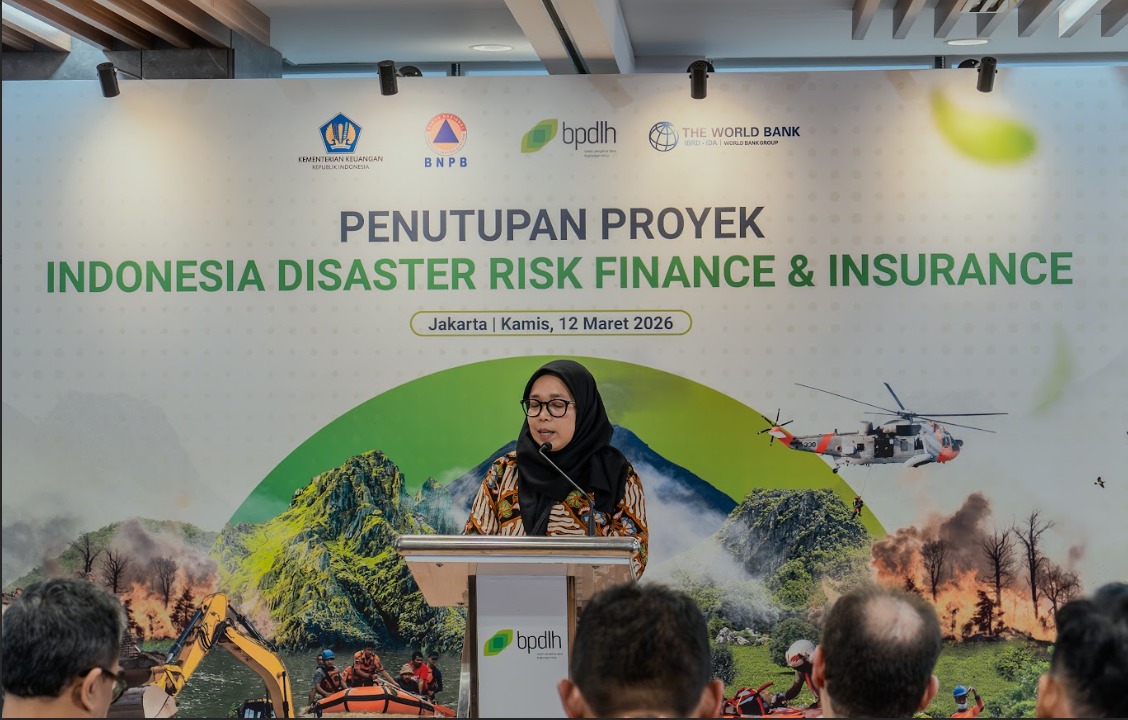
The Indonesian Government has formally closed the implementation of the Indonesia Disaster Risk Finance & Insurance (IndoRisk) initiative as part of efforts to strengthen the national disaster risk financing and insurance system.
IndoRisk represents a strategic government initiative to enhance the nation’s fiscal resilience against the economic impacts of disasters through the establishment and strengthening of the Pooling Fund for Disasters (PFB). The project, supported by Foreign Loan LN-9197-ID as well as grants from the Global Risk Financing Facility (GRiF), became effective from 4 October 2021.
During the implementation period, several significant achievements were realised, including the strengthening of disaster risk financing governance and the development of more responsive funding mechanisms for emergency situations.
One strategic step was the appointment of the Environmental Fund Management Agency (BPDLH) as the manager of the PFB through the Ministry of Finance Decision No. 407 of 2021, followed by the approval of the Operations Manual in October 2021 as guidelines for fund management.
Suska, Director of Welfare Strategy and Economic Distribution at the Directorate General of Economic and Fiscal Strategy of the Ministry of Finance, explained the importance of the Disaster Risk Financing and Insurance (DRFI) strategy in managing disaster risks.
“The DRFI strategy, launched in 2018, is a combination of financial instruments designed to obtain adequate, timely, targeted, effective, sustainable, and transparent disaster risk financing schemes. In the future, the PFB as part of the DRFI Strategy will become an important instrument in managing disaster risks and serve as a buffer for the state budget,” Suska said in Jakarta on Thursday (12 March 2026).
He continued that optimisation of grant management was also conducted through the transfer of signing authority from the Fiscal Policy Agency to BPDLH in February 2023. This policy provided greater flexibility in managing finances based on the Public Service Agency (BLU) framework to strengthen the Public Financial Buffer function in facing disaster risks.
“From the allocation of US$10 million in grants, realisation by 2026 is projected to reach US$7.81 million, with approximately US$2.19 million remaining in the final administrative completion process,” he said.
The IndoRisk implementation used the Investment Project Financing with Performance-Based Conditions (IPF-PBC) scheme, which is a mechanism for drawing loan funds dependent on meeting certain performance indicators. By the final implementation stage, the loan value drawn reached US$460 million, with approximately US$40 million still in the verification process.
He stated that several key performance indicators were successfully met, including the establishment of the PFB, strengthening of the funding structure, implementation of disaster risk financing plans, and improvement of the disaster budget tracking system.
“This programme also supports improved disaster preparedness through synergies among various ministries and agencies, including the National Disaster Management Authority (BNPB), the Ministry of Home Affairs, the Ministry of Social Affairs, and the Ministry of Health,” he said.
In the final year of implementation, the actual fund disbursement realisation showed very good achievement. Pre-disaster activities reached 96.01% of budgeted plans, whilst the State Asset Insurance programme as part of the risk transfer strategy reached 87.46%. Overall, the rate of fund disbursement realisation reached 94.66%, exceeding the minimum target of 80% set in the performance indicators. He added that the PFB was designed as the main instrument in the National Disaster Risk Financing and Insurance Strategy to protect the state budget from fiscal pressures caused by disasters.
“Going forward, this mechanism is expected to become an integrated funding source that can be accessed by central and regional governments to accelerate post-disaster recovery more evenly and effectively,” he said.
He emphasised that the closure of IndoRisk served as an opportunity to present the final implementation report and as a form of appreciation to all ministries, agencies, and development partners who contributed to the programme’s achievements.
“Through the various achievements that have been realised, IndoRisk is expected to be an important foundation for strengthening the national disaster risk financing system and promoting the development of more resilient, adaptive, and sustainable disaster management governance,” he concluded.
Julian Casal, Lead Financial Sector Economist at the World Bank, appreciated the success and support of all parties in disaster management in Indonesia. “On this occasion, let us reflect again on Indonesia’s readiness in disaster mitigation and risk management,” Julian concluded.