
Government Sets Rice Price at IDR 6,500 to Support Farmers
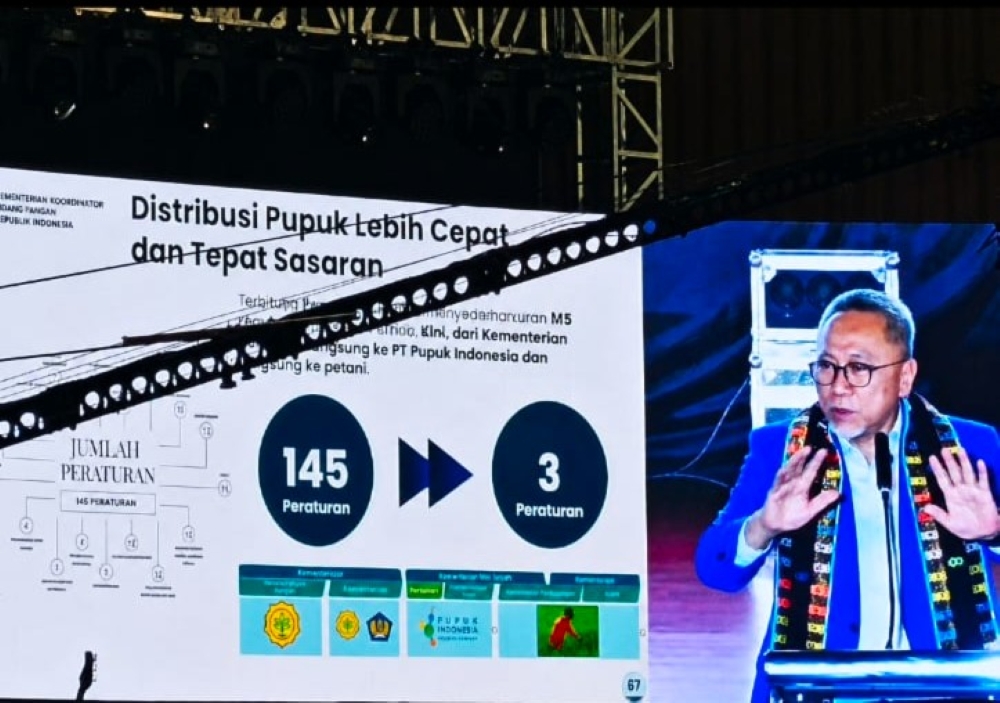
The Coordinating Minister for Food Affairs, who is also the Chairman of the National Mandate Party (PAN), stated that setting the price of unhusked rice at IDR 6,500 per kilogram is a form of government support for farmers to improve their welfare and national food production.
“For 30 years of reform, we have not been able to achieve rice self-sufficiency. This is because our policy has been based on a free market. The focus has been on figures, not on empathy or support,” he said after inaugurating the PAN’s Regional Management Council (DPW) and Branch Management Council (DPD) in Kupang, NTT, on Friday (May 15) afternoon.
The event was also attended by the Minister of Village and Transmigration Development, who is also the Deputy Chairman of PAN, Yandri Susanto, PAN Secretary General Eko Hendro Purnomo, and a number of PAN faction members in the DPR RI, namely Sigit Purnomo Syamsuddin Said and Verrell Bramasta, as well as the Governor of NTT Emanuel Melkiades Laka Lena, Deputy Governor of NTT Johni Asadoma, and Chairman of the NTT DPRD Emilia Nomleni.
According to him, for decades, food policies have focused more on macroeconomic figures than on supporting farmers. Therefore, the government is now taking steps to increase the price of unhusked rice to IDR 6,500 per kilogram without conditions that burden farmers. “As soon as farmers harvest the rice, they will be paid IDR 6,500, no less. That is what it means to support them,” he said.
He said that the policy has a direct impact on increasing rice production by up to three percent. In addition, the government has also streamlined the bureaucracy in the distribution of fertilizers, which was previously considered too long. “There used to be 145 regulations. We have reduced it, so that fertilizer goes directly from the factory to farmers. From 145 regulations, it is now only three,” he said.
In addition, there are now easier distribution channels for fertilizers, which has increased the availability of fertilizers and increased national rice production by up to eight percent. “In 2024, we imported 4.5 million tons of rice. In 2025, imports will be zero, and our rice stocks will be more than 4.2 million tons,” he explained.
Zulkifli also highlighted the plight of fishermen who often suffer losses when their catches are abundant but fish prices fall. “One bucket of fish costs IDR 20,000 to IDR 25,000. Fishermen bring fish from the sea using fuel and energy, but when they arrive on land, the price is low. If they don’t sell it, the fish will rot,” he said.
Therefore, he added, the government is encouraging the development of fishing villages complete with cold storage facilities, auction venues, and village cooperatives so that fishermen’s catches can be absorbed well. “Later, the village cooperative will buy the fishermen’s catch so that they do not suffer losses,” said Zulhas.
The Chairman of the PAN NTT DPW, Ahmad Yohan, said that the presence of the Chairman of PAN in NTT was a source of pride for all PAN cadres in the region. “The DPW has been appointed several times, but it has never been inaugurated. Today, we are proud that the Chairman is present in NTT to inaugurate the DPW and all of the PAN DPD in NTT,” said Ahmad Yohan when delivering his speech.
According to Ahmad Yohan, PAN NTT continues to encourage various development programs for the community, including the salt, shrimp, and fisheries sectors in several areas of NTT. He mentioned that a shrimp industry project worth IDR 7.8 trillion will be built in Sumba, and the initial phase of IDR 2.8 trillion has been signed. In addition, a fisheries development program is also planned in Kupang Regency, West Manggarai, Alor, Ende, and East Flores. “We continue to work to help the people as directed by the chairman,” he said.
He also expressed his appreciation to the Minister of Village and Transmigration Development, who is said to be encouraging many thematic village programs and the development of underdeveloped villages in NTT. “This is not a party interest, but the interest of East Nusa Tenggara that we love,” he said.
Meanwhile, the Governor of NTT, Emanuel Melkiades Laka Lena, asked all PAN cadres to fully support the programs of the government of President Prabowo Subianto in NTT. This is because the difficult geographical conditions of NTT require the hard work of all parties to build the region. “Politics is essentially a daily job that is not far from the people. NTT needs politicians who work with their hearts,” he said.
Melkiades also said that NTT’s agricultural production has increased by up to 35 percent this year thanks to the support of the central government in the food and agricultural sectors. Currently, the NTT Provincial Government is encouraging the downstreaming of local products through the concept of “plant, harvest, process, package, then sell” so that the economic value remains in NTT. “We want the community’s production to no longer be sold raw, but processed so that the economic value remains in NTT,” he concluded.
The price of unhusked rice ranges from IDR 7,200 per kilogram for the kebo variety, while for the Ciherang variety and similar varieties, the price is in the range of IDR 7,500 to IDR 7,800 per kilogram. On Friday and Saturday (April 11), the price of harvested unhusked rice in the coastal area of the Strait of Malacca began to rise again to IDR 7,200 per kg. On Tuesday and Wednesday (April 8), in Pidie Regency, for example, the price of harvested unhusked rice ranged from IDR 7,000-IDR 7,100/kg, cheaper than about two weeks ago when it reached IDR 7,400/kg. The unhusked rice is still bought at the Government Purchase Price (HPP) of IDR 6,500 per kilogram even though the quality has decreased due to being submerged in mud. The increase in the price of unhusked rice did not discourage middlemen from making purchases.