
Government Reins in Food Price Fluctuations Ahead of and After Eid al-Fitr
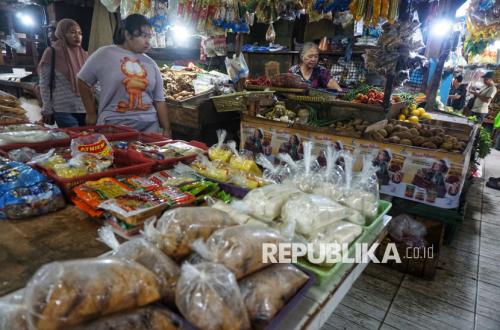
Jakarta — The National Food Agency (Bapanas) has assured that the government will curb fluctuations in food prices from one week before to one week after Eid al-Fitr 1447 AH, by strengthening supply and distribution stabilisation to safeguard the availability and affordability of food for the public.
“We have seen in recent years that during Ramadan there is usually fluctuations one week before and one week after. So one week before and one week after Eid, the government will anticipate it,” said Sekretaris Utama Bapanas Sarwo Edhy when contacted in Jakarta on Saturday, 7 March 2026.
Bapanas predicts the possibility of fluctuations in staple food prices one week before and one week after Eid al-Fitr 1447 AH. He said this is a recurring trend each year. Therefore, this condition has been anticipated by the government as early as possible through several food intervention programmes.
Sarwo said the government continues to push domestic food production as the main pillar. Beyond that, the implementation of food intervention programmes aimed directly at the public is ensured to be carried out on a massive scale.
“The first thing the government ensures is the fulfilment of domestic production. We see domestic production remains very sufficient. Most of the supply of our strategic staple foods can be met from the hard work of Indonesian farmers themselves,” he said.
Bapanas projects that national rice availability through the end of April is projected to record a surplus of 17.2 million tonnes. The corn commodity is projected to have a surplus of 4.8 million tonnes. Cooking oil nationwide is recorded as a surplus of 3.5 million tonnes.
Chicken meat also records a surplus of 727 thousand tonnes by April. Consumer sugar surplus 595 thousand tonnes. Chicken eggs surplus 349 thousand tonnes.
Meanwhile, bird’s eye chillies, large chillies, and red onions each have surpluses of 105 thousand tonnes, 74 thousand tonnes, and 57 thousand tonnes. These nine types of foods are fully supplied from domestic production.
After confirming that domestic food production is adequate, economic stimulus programmes were launched to welcome Ramadan and Eid al-Fitr this year. One of them is the rice and cooking oil aid programme via Bapanas’s assignment to Perum Bulog.
Sarwo said the government is ready to implement this pro-people programme. Bapanas has also requested support from the Ministry of Home Affairs so that regional government devices, from provinces to districts/cities and villages, can help ensure the success of the distribution.
“We have also sent a letter to the Ministry of Home Affairs to participate in overseeing this food aid down to the village level. In other words, village-level devices will assist in ensuring the aid reaches its target,” he said.
The rice and cooking oil food aid programme for early 2026 was allocated for February and March. However, due to budget procedures that Bapanas must follow, the programme’s implementation budget only became available at the end of February.
Bapanas continues to push Bulog to immediately begin distributing the rice and cooking oil food aid programme with a total target of up to 33.2 million Beneficiary Families (KPM). The programme is a direct order from President Prabowo Subianto to assist low-income households.
Meanwhile, the head of Bapanas and concurrently Minister of Agriculture Andi Amran Sulaiman confirmed that preparations for the rice and cooking oil aid programme have been completed. “I have already signed for 33.2 million people. This is the President’s order to ease the burden of our fellow citizens in the holy month of Ramadan. In short, everything is ready. All the needs of the people must not stay on my desk overnight,” Amran said.
With a target of 33,244,408 KPM, for the two-month distribution, Bulog will release rice stocks amounting to 664.8 thousand tonnes and cooking oil 132.9 thousand kilolitres.
According to Bapanas, as of 5 March Bulog managed 3.7 million tonnes of rice and 25 thousand kilolitres of cooking oil.